

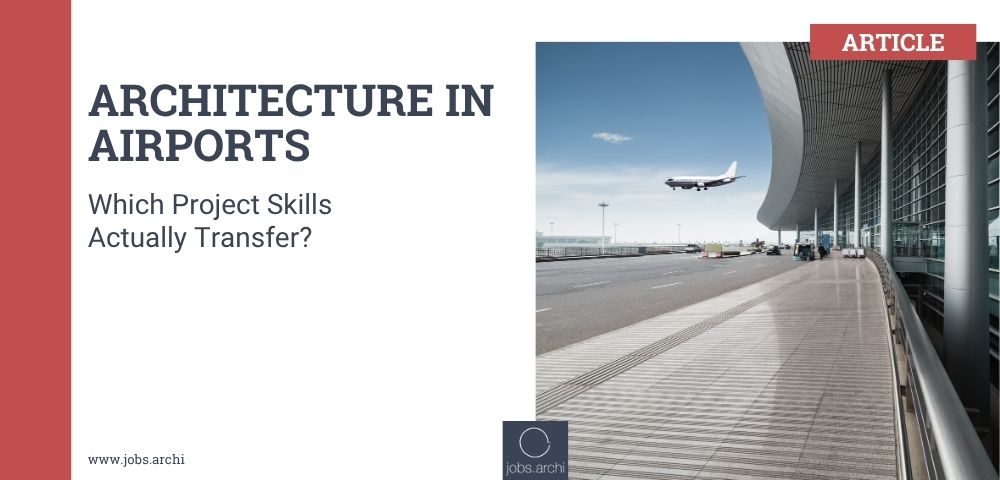

An airport terminal has a dramatic roof and a carefully composed public hall, but the architecture job may be dominated by passenger flows, security boundaries, baggage systems, phased construction and many operational stakeholders. If you want to enter aviation from schools, hospitals, stations or commercial work, the useful question is not “Have I designed an airport?” It is “Which airport problems have I already helped solve in another setting, and which specialist knowledge will I need to learn?”
Airport work varies widely. A small regional terminal expansion differs from a major hub redevelopment. The role may focus on planning, interiors, technical documentation or construction in an occupied facility. The FAA’s airport terminal planning circular and the Transportation Research Board’s terminal planning guide show that planning involves operational demand and multiple processing points, not only form. Use current local rules for actual projects; the following is a career evidence map.
Trace the passenger journey
An airport passenger may move from road or rail to check-in, screening, waiting, boarding and, on return, baggage claim and onward transport. Different users need different routes: staff, deliveries, people requiring assistance, transfer passengers and emergency responders. In an interview, describe how you have mapped a complex sequence elsewhere. A hospital outpatient journey or a rail-station interchange may show relevant thinking even though the controls and volumes differ.
Bring one diagram that makes a flow conflict visible. Where did two groups cross? How did you test an alternative? What information came from an operator or user group? Do not claim that a successful school circulation diagram proves you can size an airport checkpoint. Say that it shows your method for translating user movement into spatial decisions, then identify the airport-specific data and specialists needed.
Ask the aviation firm who owns demand forecasts and operational modelling. An architect should understand the inputs and consequences, but may not produce the traffic model. The TRB planning materials describe tools for design-hour, gate, check-in, baggage and security analysis. Your interview question can be: “How do those forecasts enter the architectural brief, and who resolves a change when the forecast affects space?”
Treat security as a spatial boundary
Airports contain boundaries between public, screened, staff, airside and service areas. A door is not only a door; it can create a security, operational and fire strategy question. Experience with secure healthcare, laboratories or civic buildings may help you understand controlled access, but it is not a substitute for aviation security requirements. Show how you previously identified a boundary and worked with the responsible specialist.
The TRB guidebook discusses security considerations alongside circulation and support functions. In a job interview, you can ask what the team considers its most difficult boundary on the current project. Is it passenger/staff separation, baggage handling, deliveries, emergency access or construction through an active zone? The answer will reveal the role’s real work.
Avoid presenting a speculative terminal concept whose attractive open plan ignores security and operational separation. If you include a student airport project, label assumptions and show the questions you would need to validate. A thoughtful limitation is stronger than a confident but unrealistic diagram.
Show experience with occupied phasing
Many airports must continue operating during refurbishment or expansion. Schools, hospitals, shopping centres and transit facilities provide transferable experience with occupied works. In your portfolio, show a sequence that protected access, services or safety while construction proceeded. Explain who approved the phase plan and what changed after user feedback.
For example: “I coordinated a library renovation in three phases to maintain a public entrance and staff route. The project taught me to test temporary wayfinding and service access. An airport would require a more complex operational and security review.” This is a strong bridge because it shows both skill and boundary.
Ask how the aviation team coordinates contractor access and temporary routes with airport operations. Does the role include night work or periodic site presence? How are changes communicated to tenants and passengers? These questions may matter as much to your career choice as the building’s design ambition.
Understand the stakeholder map
An airport project can involve an owner, operator, airlines, tenants, security bodies, border authorities, transport agencies, consultants and contractors. You do not need to memorise a universal organisational chart; it will differ by project and country. Show that you can map who decides what. A diagram with “requirement owner,” “design response,” “reviewer” and “approval” can be a useful interview sample from any complex project.
If you have coordinated multiple client groups on a school or healthcare project, tell that story. Did a late user request conflict with another group’s need? Who made the trade-off? How did the drawing package change? Architecture firms value candidates who can keep decisions traceable across a large group, particularly where the building stays in operation.
Ask whether the role will be client-facing or mostly internal production. A job advert may say “aviation design” but the actual first year may be focused on terminal restroom upgrades, baggage-support rooms or technical packages. Those tasks can be valuable. You should know what kind of learning they offer.
Build a portfolio spread around one transferable problem
If your previous project included a transport interchange, identify which routes were based on observed demand and which were only design assumptions. That distinction will matter in aviation, where planning teams may use forecast inputs that architects did not create. Show how you questioned an assumption and sought the right specialist’s evidence before fixing a plan. A hiring manager can then see a working habit that travels between sectors without confusing one sector’s standards with another’s.
Choose a project with complex movement, controlled access, occupied phasing or stakeholder coordination. Use one sentence to name the airport-relevant problem, one diagram to show the decision and one role box to credit your work. Do not insert an airport photograph just to signal sector interest. The hiring manager should see an evidence bridge, not a rebranded project.
Add a small “what I would need to learn” note: aviation-specific operational metrics, applicable security rules, airport stakeholder processes or baggage-system interfaces. Link it to a question you will ask the team. This is more useful than a broad statement that you are “passionate about travel.”
If you have a genuine aviation student project, place it after the professional evidence unless it better demonstrates the role’s tasks. Be honest about its assumptions. Concept work can show ambition; professional work can show reliability. Together they may make a convincing case.
Ask the firm how a newcomer enters the sector
A useful interview exercise
Ask the interviewer to describe a small but real problem, such as a queue that spills into a circulation route. Explain how you would frame it: confirm the measured demand, identify adjacent functions, ask the operator about peak conditions, map safe temporary and permanent options, then test the options with security, accessibility and operations leads. State that you would not size the solution from intuition alone. This short exercise shows how you turn an attractive sketch into a brief that specialists can review. It also gives the interviewer a chance to correct your assumptions, which is itself evidence of how you collaborate. If they cannot share a live issue, use a clearly hypothetical one.
What is the first project stage? Who mentors someone new to aviation? Which specialist consultant interfaces will you manage? How does the team review local airport and security requirements? Has the firm hired architects from other sectors, and which skills helped them most? A firm with a clear onboarding path may be a better entry point than one requiring instant sector autonomy.
Ask about the project’s timetable and site conditions. An airport role may involve travel or unusual hours, but that depends on the phase and team. Do not infer the working pattern from the word “airport.” Get the details in the offer process.
An aviation employer will not mistake a hospital or station for an airport. They may, however, recognise an architect who can analyse flows, map authority, protect operations during works and document an interface. Show the transferable decision, name the aviation-specific gap and ask how the team bridges it.
Browse current architecture jobs on Jobs.archi and compare your next step with our guide to architecture job opportunities.
The post Architecture in Airports: Which Project Skills Actually Transfer? first appeared on jobs.archi.