

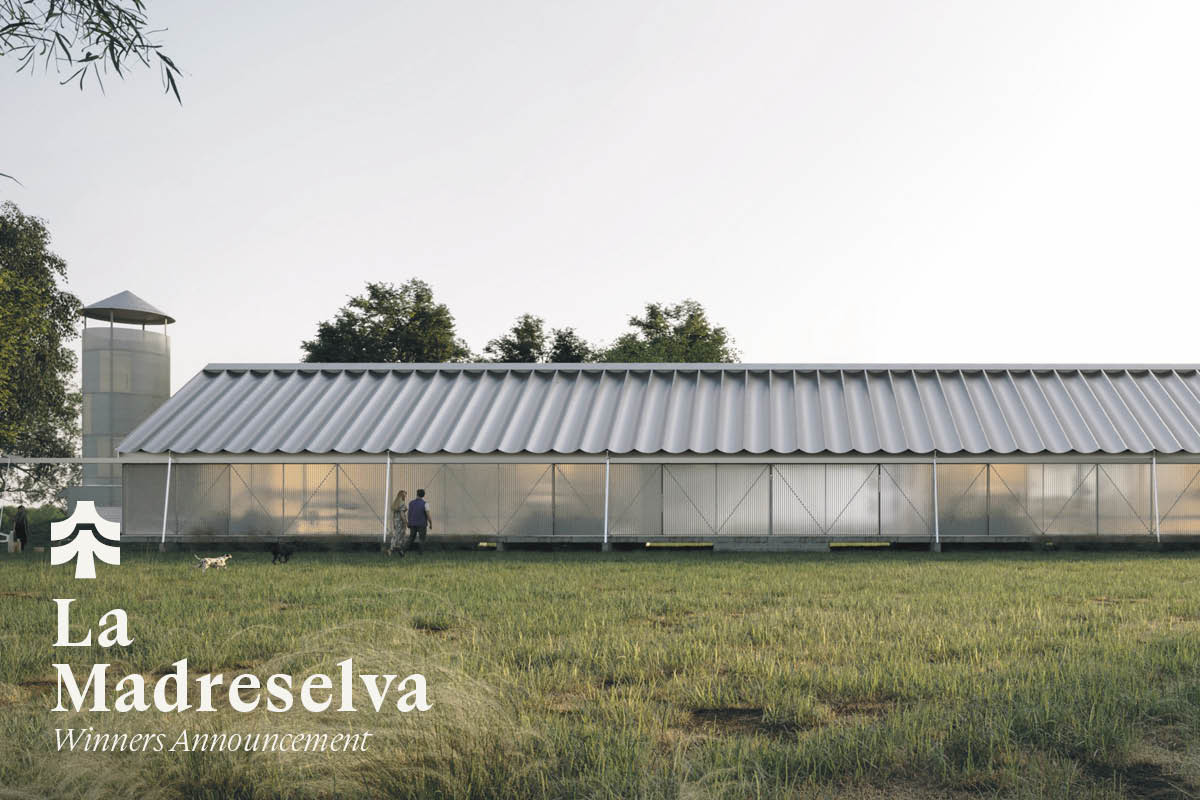
Terraviva has officially released the complete list of awarded projects of the architecture contest entitled “La Madreselva”.
The competition invited participants to envision the expansion of a distinctive rural retreat set within the Argentine Pampas, with the aim of accommodating up to 20 guests while preserving the site’s intimate and authentic character. It called for the design of small-scale lodging units capable of integrating harmoniously with the surrounding landscape through sensitive material choices and sustainable design principles. More than a simple hospitality project, the challenge encouraged a meaningful dialogue between past and present, connecting new architectural interventions with the existing structures and the vast rural context. Participants were free to explore a wide range of spatial strategies, from repeatable units to flexible systems or clustered configurations, allowing architecture to respond organically to both use and place.

The awarded proposals were recognized for their refined balance between innovation and respect for the rural setting. The jury highlighted projects that redefined spatial hierarchies by strengthening relationships between existing buildings and new additions, creating coherent systems rather than isolated expansions. Particularly appreciated were approaches that merged traditional rural logics with contemporary construction technologies, embedding modern material expressions within the site’s layered sense of time. Other proposals stood out for their emphasis on social and cultural gathering, using architectural language, materiality and programmatic originality to foster connection while maintaining a sensitive scale. Across the awarded works, a strong attention to context, typological clarity and spatial precision underscored a thoughtful and restrained approach to rural architecture.
Terraviva warmly congratulates all participants for their insightful contributions, creativity and dedication, which have offered inspiring interpretations of contemporary architecture rooted in landscape, memory and place.
The winners were selected by an international jury panel composed by:
• Marco Rampulla [Cordoba, Argentina] | Marco Rampulla Arquitecto
• Ana Lina Klotzman [Rosario, Argentina] | Navello Klotzman Arquitectas
• Valerio Poltrini [Milan, Italy] | Studio Nebbia
• Iuliia Tambovtseva [San Francisco, USA] | Jayson Architecture
• Lara Andrea Pendino [Rosario, Argentina] | FAPyD
• T. R. Radhakrishnan [New York, USA] | Interboro Partners
• Weiyu Xu [New York, USA] | KPF Associates
• Davide Casaletto [Turin, Italy] | Fluidiforme

1st Prize
From Tradition to Technology
Leonardo Liñan, Maria Florencia Bellido
Argentina


In the Pampas rural territory, the dwelling is not a mere shelter: it is also a cultural fact. Its form, materiality, and construction technique express ways of life, relationships with the landscape, and productive traditions. In this context, the house is conceived as a device for intermediation between living and the territory, capable of integrating domestic life with the productive logic of the contemporary countryside.
Rural dwelling is understood as a life extended into the landscape, where activities are not concentrated inside the house but are dispersed throughout the grounds. Cooking, drying clothes, repairing tools, gardening, or resting under a porch are actions that occur between the interior and exterior, in a continuous space without clear limits.
The proposal reinterprets that traditional typology organized around a domestic core and a series of dispersed annexes—sheds, chicken coops, storage rooms, corrals—that function interdependently within a productive system. The daily practices of those who inhabit these territories are what ultimately produce the space and shape the landscape.
In the Pampa plain, the productive artifacts—silos, large sheds, metal roofing structures — have built an identity where technique became language. Modularity, repetition, and economy of means form an industrial-agrarian aesthetic that has become part of the landscape’s imaginary. Dry-construction systems and lightweight envelopes condense that technical rationality, while also allowing the architecture to adapt to seasonal cycles of use, assembly and disassembly, and the mobility that characterizes current rural life.
The proposed dwelling translates that productive logic into a contemporary key, understanding that the industrialized house, a product of our time, embraces this technical tradition and projects it into the present. Its installation does not require destruction for construction: it can enhance nature, integrating into the landscape without imposing itself, even through aesthetic contrast.
Its technified object does not deny the environment but reveals and enhances it. Instead of seeking camouflage, its presence defines a balance between production and contemplation, between industrial precision and the vitality of the territory.
Its adaptable nature allows for variations in program, extensions, or new additions without losing coherence. Thus, the dwelling ceases to be a fixed object and transforms into a living system, capable of evolving with its inhabitants and with the material and cultural landscape of the Pampa.
The project, therefore, proposes a new rurality where technique and culture, memory and innovation, coexist in balance, recognizing the productive materiality of the countryside as a source of identity and contemporaneity.
_________________________________________
About the First Prize – Davide Casaletto – Fluidiforme
“The project deliberately rejects the idea of an expansion in the northern part of the plot, instead emphasizing a new centrality through a system that brings together the existing buildings and the new extension of the cabins. The dual relationship between tradition and advanced technological solutions—expressed through the use of new materialities—is particularly compelling, as is the introduction of functional “devices” such as the outdoor cinema and the viewpoint tower, which contribute to the overall coherence of the scheme. Greater emphasis could be placed on the relationship with the entrance and arrival sequence.”
About the First Prize – T. R. Radhakrishnan – Interboro Partners
“This projecti situates the design at the intersection of industrial construction technologies and territorial rural logics, inscribing the contemporary state of architecture and its material products into the rural site’s layered sense of time.”
2nd Prize
Collage Cultures
Szymon Kazirod, Regina Jedrzejek
Poland


The Project
La Madreselva is rooted in the character of its region – its climate and traditions. Instead of imposing a new order, the focus was put on the social traditions of the region – its informal gatherings, shared meals, music, and everyday encounters – guided the entire design process. These customs, deeply rooted and omnipresent in local life, shaped both the indoor and outdoor spaces, encouraging interaction whether in dedicated event areas or on a quiet bench tucked into the landscape
The project begins with the existing building and locally sourced materials, unfolding into a clear sequence of experiences across the site. The former storage hall is transformed into a shared dining space for local cuisine, communal cooking, and spontaneous payadas. The existing houses were redesigned to feel more open and collective, with local clay tiles connecting the old structure to the new interventions. One house receives an additional quincho and barbecue area, creating a generous outdoor kitchen and gathering space. The new guesthouses take cues from local vernacular architecture, using timber frames and earth blocks. Their simple forms are carved to create shaded terraces and framed views, with red clay tiles and crate-like details adding texture and character. Metal roofing and elements echo the material language already present on the site.
The architecture, together with the network of paths and small anchor points scattered across the site, forms a cohesive map of the Madreselva experience. Each element was conceived to preserve and highlight local habits and enrich them through thoughtful, functional additions that support and elevate the way people naturally come together.
Housing Units
The form of units composed of intersecting rectangular volumes, naturally define the two distinct outdoor spaces: a front terrace toward the site encouraging casual encounters, and a private one at the back. The voids carved in the building form are framed with tiles, creating a refined dialogue with the other materials,
The front entrance part remains partially covered to provide privacy while preserving a welcoming presence, the rear façade, fully glazed, invites the landscape views into the rooms. Above, the roof gently reinterprets a traditional silhouette. Subtle details, such as the slender columns at the corners or the roof drainage, complement the simple and calm, yet rich conceptually architecture.
_________________________________________
About the 2nd Prize – Weiyu Xu – KPF Associates
“I enjoyed how the sense of cultural and social gathering is woven into the architectural composition by material selection and free grid. The collage-like architectural language blends seamlessly into the landscape while also creating new cultural ground for connection.”
3rd Prize
Prototypes for rural living
Karla Radovic, Lucien Schmidt-Berteau
Belgium


The proposal begins with a close reading of the site, using what is already present-its buildings, trees and irregularities- as the framework for a series of measured interventions.
A circular path structures the whole, connecting the terrain through a sequence of small episodes reacting to the existing beauties and curiosities, connecting and valorising the site’s specificities. Along the walk, moments of contemplation are either emphasised or created. These points act as simple but deliberate markers that guide movement and define how the place is experienced.
The project follows a principle: reuse when possible, add where needed, and build only when necessary.
Influenced by the discoveries around the site, such as the windmill or the elevated water tank, functions are consciously and visibly added instead of hidden. They communicate an extension while valorising the existing.
The so-called second house gets a new reading room on the roof, this extension structures the open floor plan on the ground by furnishing it with a central bookshelf. The nest sitting on the roof is equipped with solar windows, catching the sunlight and furnishing the house not only with books, but also with electricity. In the former storehouse a greenhouse is inserted, this allows for a new spatial organisation and structures the storage shed into four rooms, hosting up to eight people. Organised as a central core, the greenhouse acts as a light-shaft and climate regulator and with its communal kitchen and living space becomes a shared place of encounters.
Learning from these interventions and with an outlook towards the future use of the site, a new building supplements the ensemble, its ground floor functioning as the communal hub for all guests, with spaces for cooking, gathering and resting. On the upper floor, four independent rooms allow for views over the site and beyond. The new construction leaves room to imagine forms of habitation for both larger groups and individual use.
Throughout the site, the interventions stay practical and low-tech, favouring adaptation over replacement. Taken together, the path and the dispersed set of interventions form a coherent retreat, offering a structure for moving, experiencing and wondering through the landscapes and a set of places for being in it- alone, together, and in between.
_________________________________________
About the 3rd Prize – Valerio Poltrini – Studio Nebbia
“The project is inserted into the context with tact and precision, both in terms of the scale of the intervention and the character of the architecture. Particularly noteworthy is the symbiotic relationship between the proposed additions and the existing rural buildings. The originality of the functional program and its typological
articulation is also appreciated.”
Golden Mention
The sky´s long weight
Lucia Maria Cugno, Daiana Fernández, Brian Ejsmont, Margarita Eraso, Martina Maurino
Argentina


The project reimagines La Madreselva as a contemporary rural retreat, ideal for short departures, where the landscape itself becomes the primary structure. A vast, unbroken horizon that guides perception and movement. In a time defined by schedules and urban noise, the Argentinian Pampas offers a counter condition: an immensity so still it seems to absorb the restlessness carried from the city.
The Lodging Area, north of territory, conceived as a calm and introspective domain, here seven dwellings are placed with deliberate distance from the homestead, allowing silence and long views to settle around each one. Five one-bedroom units welcome couples or small families, while two larger houses host extended groups, bringing the estate’s total capacity up to twenty guests. All dwellings share the same daytime core, allowing the one-bedroom units to be expanded into larger houses over time with the simple addition of a second room. Their radial arrangement defines the project’s main gesture: each dwelling turns toward its own fragment of the horizon, avoiding visual overlap and intensifying the feeling of inhabiting the Pampas in solitude. Privacy here is understood not as separation, but as a quiet form of freedom.
Inside, each dwelling unfolds as a continuous domestic landscape, where spaces flow without interruption. The main living area sinks gently by two steps, a small shift that grounds the body, slows perception, and frames the horizon with a quiet sense of ritual. Fireplaces and outdoor fire pits extend inhabitation into the cool nights, while the bedrooms become the most sheltered retreats, oriented toward the longest and calmest views.
Vehicular access remains discreet and secondary, each dwelling with its own parking space. Movement returns to the scale of the body, walking, drifting without urgency.
At the center of the estate, the Landscape Area, ease the passage from quietude to collective encounters. Introduces a new artificial pond that acts as climatic and scenic device, cooling the air and supporting native species. The existing tank is preserved as a pool overlooking the water, reinforcing the role of water as an atmospheric and symbolic presence. Around this oasis, small recess areas and informal recreational spaces, for cycling, soccer, or simple wandering, fold gently into the landscape.
The Homestead Area, is reactivated as the social heart of the retreat, preserving the character and quiet dignity of Argentine rural culture. The main house becomes a clubhouse for reception, breakfast, and communal indoor activities, maintaining its role as a place where daily life naturally converges. Near the windmill and the old well, the former second house is refitted as a small general store for essential provisions, while an open-fire gathering space anchors evenings shaped by stories, music, and rituals of the countryside. Slightly apart, a quiet clearing hosts outdoor cinema nights under the vast sky. Finally, the large barn is adapted as a flexible hall for celebrations, allowing the estate to embrace moments of festivity.
Golden Mention
The Meadow
Ian Bankhead, Stuti Murarka, Thomas Delahouliere, Jaes Lee
United States


The Meadow
The Pampas Plain stretches as a vast open field reshaped over centuries by large-scale agriculture and cattle ranching. Its surface carries the marks of sustained cultivation with deep-plowed monocultures and rotating herds of grazing cattle. Plot boundaries and irrigation channels inscribe their networks upon the plain. Here and there, patches of native grasses and wetlands persist as traces of an older ecology that continues to endure in one of the world’s most altered landscapes.
Within this altered condition, this intervention restores a small pocket of native vegetation with scattered trees, wildflowers and perennial grasses. The re-wilded ground returns permeability and habitat to the site. Visitors are offered an encounter with the land’s erstwhile character and with the gaucho heritage of San Antonio de Areco.
At the center of the compound, two existing houses and a barn frame a grassy area now re-imagined as a courtyard meadow. In this pastoral square, planted with native grasses, an earthen fire pit invites visitors to gather and contemplate the vastness of the Pampas. Flanking the meadow, existing buildings are re-purposed to host new programs from a welcome office and supply desk in the historic main house to an event space in the barn. A new bar building defines the fourth edge of the courtyard and extends outward into the re-wilded landscape. Together, these four structures frame a new center of social activity on the site.
The hotel building extends the logic of the estancia galleria into a full architectural system that reaches outward into the landscape to establish a new relationship between the courtyard, the lodgings, and the Pampas beyond. The new building imbues the traditional galleria with a novel porosity; its compressed earth floor expresses continuity with the re-wilded ground and its spatial organization invites a sense of collective belonging, with a centrifugal scattering of volumes under one continuous roof. This language extends into the lodging units, where engineered earthen floors and enfilades continue the dialogue between Argentine tradition and landscape.
This porosity enables the introduction of shared programs in the galleries; a traditional dance floor, several quinchos, and an Australian-tank-turned-pool weave together the site’s agricultural history with gaucho traditions of music and dance alongside social cooking. This new architecture infuses the site with a deep sense of history, recalling the cultural highway that once brought customs from Areco to Buenos Aires, where Gaucho musical traditions like milonga campera and payadas shaped early urban milonga and formed the roots of tango.
The new, resilient landscape of La Madreselva sustains the living heritage of the gaucho – from sheltered galleries to the open landscape, from reflecting alone to cooking together, from walking with wildflowers to dancing with strangers. The Meadow juxtaposes curated moments of social intensity with the quietude of the restored Pampas landscape, its openness, calm, and ecological richness.
Golden Mention
HORIZONTE INFINITO
Frank Szlaifsztein, Renata Romero
Argentina


The vast, silent Pampas plains are defined by an endless horizon. This minimal line—dividing yet integrating sky and earth—organizes the territory and reveals the essential. In its simplicity, the horizon ripples only with the occasional tree, a gesture translating the horizontal immensity of these spaces. Here, nature imposes itself through both presence and silence, where simple elements acquire profound meaning.
This horizon guides the project. In this open landscape, the new architecture adopts a light, suspended attitude: touching the earth lightly. Constructions rest gently on the ground, allowing the continuity of the Pampas, recognizing that the territory is matter, time, and memory.
Existing structures, charged with history, are recovered to house new social and commercial programs. Notably, the existing shed (galpón) is reconverted into a restaurant dedicated to traditional Argentine asado al asador, a transformation matching the magnitude of the new complex. Rather than replacing these structures, the project amplifies their validity, embracing Glenn Murcutt’s premise: “If it is worth keeping, then that is where true sustainability begins.”
The “Australian tank,” a fundamental rural element, is redefined as the complex’s center of leisure. Once pure infrastructure, it transforms into a Wellness Hosue with a new pool integrated with the tank, spa, solarium and gym. The tank becomes a meeting point and the symbolic heart articulating the Madreselva’s life.
New accommodation units—for two and four guests—are interspersed throughout the site, generating patios and natural corridors. This avoids rigid repetition, producing a horizontal rhythm that dialogues with the Pampas scale. The units delineate a new “horizon within the horizon,” offering guests a direct relationship with nature, light, and wind.
Two distinct circulation systems structure the experience of the territory. A primary path connects the three architectural moments—the recovered heritage, the wellness center, and the new housing—culminating in an open-air amphitheater designed for bonfires and traditional payadas. Simultaneously, a second trail weaves through the natural infrastructure, linking the children’s playgrounds and the forest before terminating at a newly created lagoon.
These interventions seek not to alter the place’s essence, but to intensify it. They recover what is valuable and propose new ways of inhabiting the plains. The project celebrates the landscape, proposing a future where gathering and wellness are integrated into a gesture that touches the earth with softness, just as the horizon touches the sky.
Golden Mention
Tapiales de Areco
Serenella Perreca, Hannah Radovich, Maria Sol Aupi Bobbio, Valentin Mancino, Benjamin Zunino Carrazzoni
Argentina


In Tapiales de Areco, we propose an architecture that does not arrive to impose itself, but to accompany the place and uphold its pampeano identity. The project is guided by a central principle: to refunctionalize what exists with the minimum intervention required, and to expand only with materials consistent with the site’s constructive tradition. The intention is to accommodate up to 20 guests without altering the rural essence of the property, allowing the landscape to continue setting the rhythm.
San Antonio de Areco is a land of low horizons, honest materials, and long silences. For this reason, the new intervention works with a palette that extends that memory: tapia (rammed earth), laminated wood, and metal sheeting, in dialogue with the site’s historic materials— adobe, wood and metal. Tapia (rammed earth) provides thermal mass and cultural continuity; laminated wood enables structural efficiency, fast assembly, and a contemporary tectonic expression; metal sheeting continues in the roofs as an element already present on the lodge.
The landscape strategy focuses on intervening only where necessary. It is organized around three layers of landscape: native vegetation is restored—growing unhurriedly, defining seasons, scents, and textures—and it structures paths and access routes while providing the required shade. The existing trees on the site are preserved and, in some cases, new ones are added to reinforce shade and microclimate, always respecting the original species. Mown grass is limited to circulation and rest areas only. A perimeter of gravel organizes access and hard surfaces without altering the topography, while the center of the site remains open to preserve the reading of the pampa.
Within this setting, the new lodging units are placed as compact, low-impact pieces dispersed among the grasslands to ensure privacy, cross-ventilation, and a direct relationship with the landscape. Each module includes a bedroom, bathroom, and kitchenette, resolving an essential program with spatial efficiency and minimal infrastructure.
The original buildings are preserved and reactivated with new uses. The smaller house functions as reception and shop; the main house becomes a restaurant and communal heart; the barn is transformed into a flexible hall for celebrations, classes, and gatherings, incorporating the side facing the pool as spa with services and a controlled expansion area. The tanque australiano is maintained as a swimming pool, reinforcing the site’s rural identity. Each of these preexisting structures receives a rammed earth volume, a material gesture that unifies the ensemble and links past and present through a coherent language.
The outdoor spaces — tables under the trees, a central fire pit, paths through the grasslands, rest areas — weave together activities and people, generating a porous system of encounter that extends life toward the landscape.
More than a collection of cabins, Tapiales de Areco is an ecosystem of architecture and landscape that amplifies the site’s identity without altering it. With precise and quiet interventions, the project allows the place to resonate again with its original essence.
Golden Mention
Of Clearings and Rooms
Yuechao Zhang, Yifei Chen, Xiaodi Chang
United States


Of Clearings and Rooms imagines living as a condition embedded within nature rather than placed beside it. At La Madreselva, dwelling is not conceived as an isolated object in the Pampas, but as a series of clearings in which daily life unfolds. Eight lodging units—six for two guests and two for four—are distributed lightly across the site, allowing up to twenty people to inhabit the landscape as part of a shared living field.
A pair of conceptual diagrams guides the project. Living and nature are not treated as parallel domains, but as a continuous relationship. What is usually divided into house and landscape dissolves into a gradient: built rooms gradually open toward the Pampas itself. Within each unit, living space is understood not as a dominant room, but as a shared condition. Bedrooms, kitchens and bathrooms are conceived as distinct yet equal volumes, placed together beneath a light roof. Gathered around an open living space, these rooms form a compact clearing where daily activities intersect with light, air and ground.
Read at a larger scale, this logic extends across the site. Individual units relate to one another through the continuity of open ground, so that living is experienced as movement between enclosed rooms and shared clearings rather than transitions between inside and outside. In this way, the site itself becomes a collective living room shaped by trees, wind and grass.
Material and section play a central role in articulating use, atmosphere and memory. Each program is assigned a material that reinforces its character while extending the logic of the existing buildings on site. Brick is primarily used for kitchens and dining spaces, where its mass and thermal presence support cooking and gathering; in many cases these volumes rise above the roofline, recalling chimneys within the landscape. Timber forms the bedroom volumes, remaining aligned with the roof plane to preserve controlled light, shade and retreat. Concrete defines bathrooms and service spaces, where walls stop short of the roof to create lateral openings for additional light and air.
Above, corrugated metal roofing combined with translucent panels ensures daylight reaches all spaces throughout the day. Clay tiles and metal sheets, drawn from the original house and buildings, form a continuous roofscape that unifies the project while allowing sectional variation. Through differentiated volumes held beneath a shared roof, the project reinterprets the material language of La Madreselva, creating a contemporary place for living, gathering and retreat that remains inseparable from the Pampas landscape.
Honorable Mention
Emana
Yana Polevaya, Arina Isaeva, Kirill Shiryaev, Tatiana Polevaya
Russia, Argentina


Honorable Mention
Ranch Memory
Micaela Belén de la Fuente, Andrea Alejandra Dalprá
Argentina


Honorable Mention
Roots in Motion
Valentina Ferri, Mariano Caprarulo Martina Di María, Francisco Velasquez, Delfina Tocho
Argentina


Honorable Mention
Unit of freedom
Aleksandr Trofimov, Sergey Zakharov, Ekaterina Zueva, Sofia Rayman, Ekaterina Staninets, Varvara Zhukova, Anastasiya Kovaleva, Arman Alexanyan
Russia


Honorable Mention
ALONE TOGETHER
Nima Ghanei, Hossein Fathi Roudsari
Iran


Honorable Mention
La Madreselva
Carla Sylvia Divry, Celia Sylvia Divry
United Kingdom


Honorable Mention
Tierra Calma
Mariia Diakova, Mariia Svetovidova, Mikhail Bodrov
Russia


Honorable Mention
tres tejados
Anıl Akalın, Mustafa Ata İçer
Turkey


Honorable Mention
Reimagining the Pampean gallery
Francisco Soloaga, María Guadalupe Ferrari, Valentina Perujo Corona
Argentina


Honorable Mention
ROOTS
Iorgovan Andrei, Corduneanu Ana, Gigica Theo, Muhscina Diana Ioana
Romania


SHORTLISTED PROJECTS

The post Results: La Madreselva appeared first on Competitions.archi.