

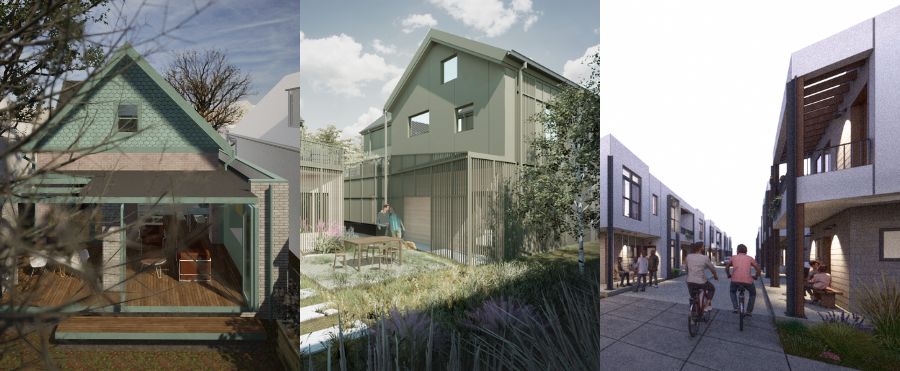
Buildner, in collaboration with the City and County of Denver and AIA Colorado, is pleased to announce the winners of the Denver Affordable Housing Challenge, an international ideas competition exploring how affordability and design excellence can reinforce one another within the specific urban, social, and environmental context of Denver.
As the nineteenth edition in Buildner’s Affordable Housing Challenge series, the competition invited architects and designers from around the world to respond to Denver’s housing crisis through proposals operating at architectural, urban, and systemic scales. Rather than prescribing a single site or typology, the brief encouraged flexible strategies capable of addressing affordability, climate resilience, and community impact while contributing positively to Denver’s urban identity.
The winning projects reflect a wide range of approaches united by a shared ambition to elevate affordable housing beyond minimum compliance and toward long-term civic value. From carefully calibrated gentle-density infill and courtyard-based missing-middle housing, to ambitious modular frameworks that treat incremental growth as a form of urban repair, the awarded proposals demonstrate that affordability, adaptability, and architectural quality are not mutually exclusive.

Several winning entries engage directly with existing neighborhoods, transforming single-family lots and underutilized urban spaces into shared, community-oriented environments without erasing local character. Others operate at a broader urban scale, proposing expandable systems and 15-minute neighborhood frameworks that challenge conventional development models while remaining conceptually rigorous and visually precise. Together, the winners illustrate the range of architectural thinking required to address Denver’s housing challenges, from immediately deployable building strategies to long-term urban systems.
The competition concluded with a live public results announcement in Denver, attended by the Mayor of Denver and the CEO of AIA Colorado, underscoring the city’s commitment to advancing housing solutions that are affordable, socially inclusive, environmentally resilient, and architecturally ambitious.
Buildner congratulates all winners and participants for their contributions to this important dialogue and thanks the City and County of Denver, AIA Colorado, and the international jury for their leadership in championing design excellence in affordable housing.
Results Announced at Denver Housing Challenge Event
The results of the Denver Affordable Housing Challenge were officially announced at a public event in Denver, where leaders and stakeholders gathered to recognize the winning proposals. The announcement was made in the presence of Denver Mayor Mike Johnston, alongside representatives from the City of Denver, AIA Colorado, and Buildner.
1st Place
X-MU-X
Damian John Madigan
Australia


“I enter design competitions because they force me to stretch the boundaries of my work. They often have to be undertaken quickly, which forces me to think and act with clarity and to work instinctively. Competitions also provide crucial peer review of my ideas and their communication. Where a traditional theoretical researcher can write a paper and have it peer reviewed, a design competition – especially one where the entrants cannot identify themselves – gets your ideas in front of international experts who are basing their opinions and judgements solely on the work put before them, and not on who has created it, where they’re from, or their motivations for entering the competition in the first instance. Competitions are crucial for demonstrating the deployability of my work outside my own city. There are very few such opportunities to get valued outside opinions and to demonstrate that an idea can scale.”
_________________________________________
JURY FEEDBACK summary
This project proposes X‑MU‑X, a design-led zoning framework that enables incremental density within Denver’s historic single-family neighborhoods by working at the scale of the individual lot. Rather than introducing new building types or wholesale redevelopment, the proposal retrofits existing Queen Anne houses through modest additions, backyard dwellings, and shared amenities accessed primarily from alleys. By reframing zoning as an architectural and spatial question, X‑MU‑X shifts regulatory logic from abstract metrics toward qualitative, context-sensitive design outcomes. The system allows multiple independently owned dwellings to coexist on a single parcel while preserving neighborhood character, leveraging Denver’s existing housing stock, local construction practices, and small-contractor capacity. The result is a bottom-up model for affordability that aligns policy, architecture, and lived experience without erasing historic fabric.
2nd Place + Buildner Sustainability Award
reFRAME
Meghan Helena Kress, Margaret Rose Krantz, Sean Edward Pike
United States


“We use competitions as a way to collaborate, explore new ideas, and push our skills. They let us step outside constraints of everyday work, experiment freely, and simply have fun creating with friends.
_________________________________________
JURY FEEDBACK summary
reFRAME proposes a six-unit housing prototype that reframes the conventional single-family lot as a shared, courtyard-oriented living environment. Set within Denver’s established residential fabric, the project organizes two-and-three-bedroom units around a central communal garden, balancing gentle density with a familiar domestic scale. The massing strategy carefully preserves neighborhood character while introducing shared outdoor spaces, individual patios, and clear unit identities through separate entries. Architecturally, the project emphasizes sustainability and long-term livability through CLT and glulam construction, passive climate strategies, photovoltaic integration, water management, and low-water native planting.
3rd Place
Alley Town La Alma
Ozi Friedrich, Alexander Phillip St Angelo, Archer Lee Squire
United States


“This is Radix Design’s first architectural competition. As a small firm, we don’t typically have enough surplus time or budget to support what it takes to produce a quality entry. However, this competition was so close to home, and so immediately related to the things we are passionate about in our everyday work, that we felt it was worthwhile to commit ourselves to a deeply challenging month of developing the competition entry while still keeping the business going.”
_________________________________________
JURY FEEDBACK summary
This project proposes Alley Town La Alma, a housing framework that reimagines Denver’s alley network as the basis for incremental, anti-displacement urbanism. Working within the existing scale and fabric of the La Alma neighborhood, the proposal introduces a modular rowhouse typology aligned along the alley, allowing multiple families to co-inhabit formerly single-family lots. Rather than replacing homes, the scheme retains historic structures while adding units and shared amenities in the rear, transforming the alley from a service corridor into a lived and social space. The architectural approach emphasizes affordability through modular design, permit-ready construction, and IRC code use, while policy tools such as shared equity models and streamlined permitting support access and community stability. At once strategic and site-specific, the project offers a replicable model for sustainable infill rooted in cultural preservation and spatial dignity.
Buildner Student Award
Can Denver afford us ?
Thiên Trí Võ, Gia Bảo Lương, đức Tuệ Nguyễn, Phương Uyên Phạm
Vietnam


“My primary motivation is to bridge the gap between academic theory and professional reality. While university education has provided me with a strong conceptual foundation, I believe that true growth comes from navigating the constraints and complexities of real-world problems. Participating in this competition is an opportunity for me to step out of my academic comfort zone, challenge my problem-solving skills against tangible constraints, and gain the practical insights that are essential for my future career as an architect. More importantly, I want to move beyond ‘paper architecture’ to create solutions that are not only visually compelling but also structurally viable and contextually responsive. This competition challenges me to consider the lifecycle of the building, material efficiency, and the actual user experience—elements that are often idealized in a purely academic setting.”
_________________________________________
JURY FEEDBACK summary
This proposal advances a new vision for Denver’s future housing by framing incremental modular construction as a form of urban repair. Rather than operating at the scale of a single site, the project establishes a repeatable, expandable system capable of occupying residual urban land, spanning infrastructure, and stitching together fragmented neighborhoods. Modular unit cells aggregate into larger residential clusters connected by elevated walkways, shared amenities, and civic programs, aligning with the principles of the 15-minute city and net-zero operation. The scheme positions adaptability as its core strength, allowing housing, services, and public space to evolve over time in response to social, economic, and environmental pressures. While speculative in scale and execution, the project integrates urban strategy, architectural systems, and socioeconomic intent into a coherent framework aimed at affordability, density, and long-term resilience.
HONORABLE MENTION
Re-Ground: Toward a Regenerative Housing Typology
Kexuan Shang, Shenglu Qiu
United States


“Architecture competitions provide a space to explore ideas without the constraints of conventional practice. They encourage us to move beyond the immediate demands of professional projects and to address design issues at broader, even global scales. Competitions offer opportunities for rigorous experimentation, collaboration, and growth, allowing us to develop visionary approaches while remaining engaged with the critical debates and responsibilities that define the field of architecture.”
HONORABLE MENTION
The Missing Middle
David Andrew Gallo, Epp Jerlel, Maria łomiak
Finland


“We participate in architecture competitions for the thrill of it. Even if the odds of winning are slim, it’s a great experience to give something your whole attention and engage the whole process of envisioning a piece of architecture. This is something that can become quite rare or difficult to achieve in professional practice. The arena of the competition lets you tune out the noise of the world. ”
HONORABLE MENTION
Re: Alley
Yingzhuo Wang
United States


HONORABLE MENTION
Alleyway Commons
Tian Ouyang, Yibin Yang
United States


“As designers, we conjure up many different ideas throughout the day. Architecture competitions serve as proving grounds and a platform to test these ideas and sharpen our design sensibility.”
HONORABLE MENTION
Common Spaces
Matthew Lewis Scarlett
United States


“We participate in competitions only if the parameters and scope of the competition align with an area of ongoing inquiry or interest in the office. In an ideal scenario, the competition work helps us to build expertise that we can leverage with other projects. We are generally only interested in competition briefs that are grounded in reality. In this instance, the Denver Affordable Housing Competition offered the opportunity to address an important real-world issue.”
HONORABLE MENTION
Parked Grounds
Jongseung Lee, Habin Park
South Korea


“We try to approach architecture with responsibility and with an optimism that comes from seeing how small changes can matter. Adjustments such as reusing material, reshaping a surface, or improving a shared threshold can influence how people experience their environment. When these changes accumulate, they can help cities move toward futures that are more resilient and more equitable.”
SHORTLISTED PROJECTS

The post Results: AIA Denver Affordable Housing Challenge appeared first on Competitions.archi.