

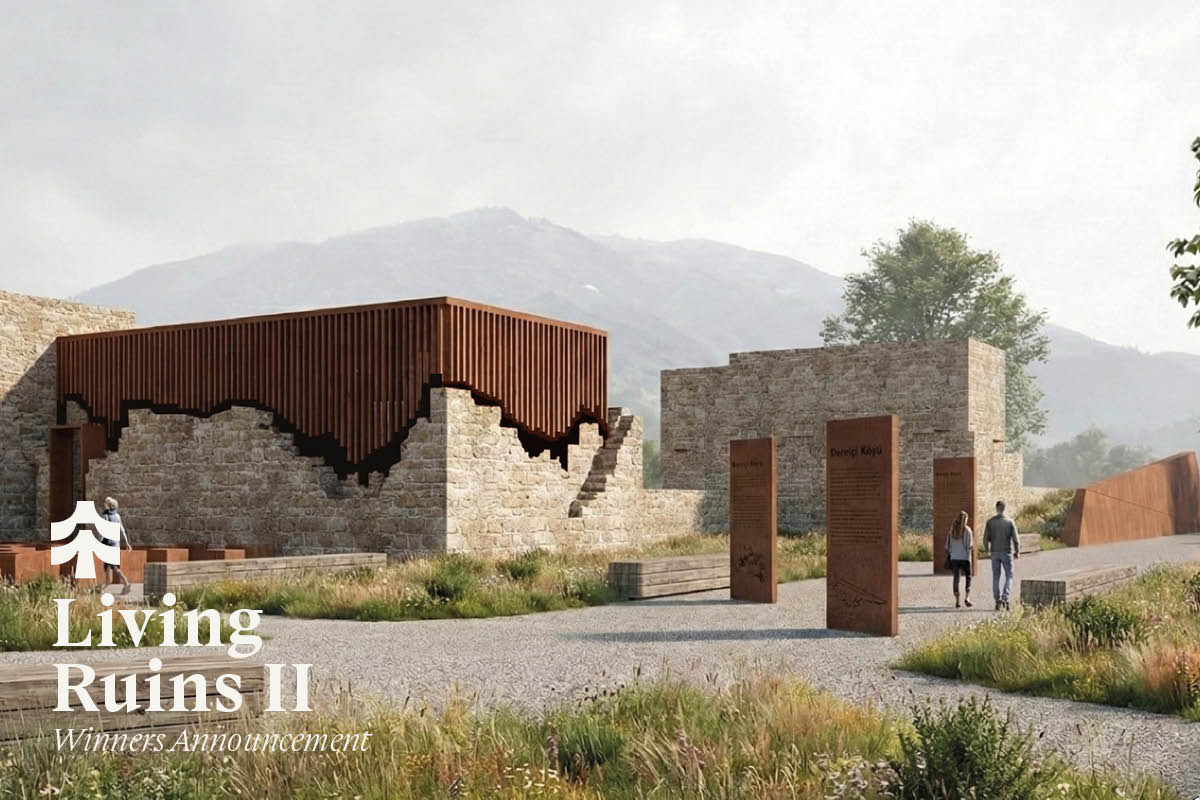
Terraviva has officially released the complete list of awarded projects of the architecture contest entitled “Living Ruins II”.
The competition invited architects and designers to envision an Open-Air Museum capable of safeguarding and revalorising the unique heritage of Dereiçi, Turkey. Often described as a “Ghost Town,” the site embodies layers of history that risk fading without thoughtful intervention. The competition sought to counteract this condition by promoting Slow Tourism as a catalyst for cultural awareness and local economic revitalisation. Participants were challenged to develop a museography concept that would transform Dereiçi into a dynamic living exhibition, seamlessly blending historical traces with contemporary architectural insertions. Alongside the open-air experience, the program required the design of a Visitor Centre to serve as both a gateway for tourists and a hub for cultural activities.

The awarded proposals were praised for their ability to reinterpret the notion of ruins with sensitivity, imagination and conceptual rigor. The jury highlighted projects that entrusted visitors with an active role in constructing their own spatial narratives, employing restrained yet precise interventions that enhanced rather than overwhelmed the existing fabric. Some designs stood out for orchestrating immersive experiences through a careful integration of architecture, landscape, multimedia and even agricultural strategies, crafting cohesive visions for the site’s future while remaining deeply rooted in its material context. Other recognized works demonstrated clarity and intellectual consistency, balancing poetic storytelling with controlled and legible spatial sequences. Across the selected proposals, a shared commitment emerged: to move beyond mere preservation and instead amplify the dialogue between past and present through thoughtful material and spatial strategies.
Terraviva warmly congratulates all participants for their remarkable creativity and dedication, whose inspiring contributions have opened new perspectives on how heritage sites can evolve into meaningful and vibrant cultural landscapes.
The winners were selected by an international jury panel composed by:
• Ayhan Gök [Mardin, Turkey] | Provincial Directorate
• Foteini Kanellopoulou [London, UK] | Arup
• Murat Çağlayan [Mardin, Turkey] | Mardin Artuklu University
• Selim Atak [Ankara Turkey] | Atölyemekan
• Francesca Porro [Milan, Italy] | Stefano Boeri Architetti
• Serdar Aydın [Mardin, Turkey] | Mimfab
• Nehali Doshi [San Francisco, USA] | Scape
• Xuanyu (Alfred) Wei [New York, USA] | Diller Scofidio + Renfro

1st Prize
OOZE OF THE PAST (sızıntılar)
Berkehan Cesur, Aybike Kocabas, Irem Senturk, Rana Buse Tavsan
Turkey


This design is not about demolition, but about remembering what has been forgotten. Because understanding is only possible through memory.
Mardin Dereiçi Village holds a multilayered cultural memory through its architecture, vineyards, sacred spaces, stone texture, botanical landscape, and gastronomy. Over time, these layers have eroded one by one. The wholeness has fragmented, and the village has transformed from a physical ruin into a mental void. This project doesn’t aim to restore Dereiçi, but to make its memory readable again.
The proposed open-air museum and visitor center doesn’t present the village’s past through objective displays or didactic narratives. Instead, it makes memory experiential through sensory stops positioned within and attached to the village’s existing fabric. These stops are conceived not as independent structures, but as infiltrations that touch the village’s existing paths, voids, and structural traces.
The project consists of five sensory stops located along a main route through the village: Sight, Sound, Touch, Smell, and Taste. Each stop focuses on one sense while maintaining connections with the others. These zones sometimes seep into existing structures, sometimes become open courtyards, and sometimes take form as semi-open spaces defined only by ground and wall relationships.
As visitors experience this route, they connect with the space not only through their five senses but through a sixth sense—intuition—which links them together and strengthens spatial orientation. This intuitive guidance happens through “ooze” elements placed throughout the site. In this project, ooze isn’t a single object or linear path. It’s a system that moves through the village fabric in fragments, intensifying in some places and thinning to disappearance in others.
No signage, directional text, or conventional circulation diagrams are used. Instead, linear structures designed from corten steel seep into the space, slowing visitors at points where they should pause. The system uses permeable surfaces in areas where visibility is prioritized, and closed surfaces where guidance intensifies. Direction becomes a bodily experience.
The visitor center, serving as both starting and ending point, is conceived as the threshold space of the experience. The entrance courtyard references water systems found in Syriac monastery traditions—symbolizing the cycle of life—and acts as a transition zone that initiates the remembering process. The center includes workshop and exhibition areas, terraces, and restaurant units.
Unlike conventional museum layouts, this system doesn’t limit visitors or force them into a single narrative. Instead, it offers silent guidance, allowing each person to perceive the route through their own experience. Each visitor defines and perceives Dereiçi through their intuitive exploration.
Ultimately, this project transforms Dereiçi Village into a living open-air museum where remembering, perceiving, and intuitive discovery are constantly reproduced. In this design, Dereiçi exists not as a past, but as a memory space reconstructed through the senses
_________________________________________
About the First Prize – Nehali Doshi – Scape
“This project distinguishes itself through a radical commitment to intuition as a design driver, constructing a spatial system where orientation emerges through sensory cues rather than prescribed narratives or informational frameworks. By dissolving signage and conventional wayfinding into subtle “ooze” elements, the proposal grants visitors agency to construct their own readings of Dereiçi, allowing memory to remain personal, fragmented, and unresolved. The precision of the interventions, carefully calibrated in materiality, texture, and framing, demonstrates a rare confidence in doing less, trusting the site and the visitor to complete the experience.”
About the First Prize – Xuanyu (Alfred) Wei – Diller Scofidio + Renfro
““Ooze of the Past” curates a carefully orchestrated visitor experience through architectural, landscape, multimedia, and agricultural interventions. The comprehensive project narrates a compelling future for the “ruins” while remaining cohesive with the material context.”
2nd Prize
RĒHYO!
Muhammet Kaan Danışmaz, Elif Naz Sarıbal, Ekin Tezel
Turkey


STAY, LISTEN, FEEL
An Experiential Open-Air Museum in Dereiçi
Dereiçi, with its architectural fabric, natural landscape, and layered history, reflects the cosmopolitan character of Mardin and the cultural, ethnic, and religious diversity shaped by this heritage. Conceived with the principle of RĒHYO! “guest rather than visitor,” the Dereiçi Open-Air Museum transforms the village into a lived, multi-sensory experience where heritage is encountered through presence and participation rather than observation.
The project is grounded in the existing spatial logic of the settlement. Instead of introducing new circulation systems or isolated exhibition spaces, it reactivates the village’s organic axis network, courtyard typologies, and everyday spatial practices. These elements are reinterpreted as experiential layers that unfold through movement, forming a continuous spatial narrative of open courtyards, transitional passages, interior spaces, and gathering nodes.
Courtyards function as the primary medium of memory. Derived from traditional domestic typologies, private courtyards are subtly transformed into semi-public spaces of encounter, preserving spatial memory while expanding collective use. Through light, sound, material, and everyday practices, the village becomes a dynamic open-air museum where heritage survives not as a static artifact, but as a continuous, embodied experience. The produced courtyard are named in accordance to the emphasized sensory with the Syriac linguistics: HAYĒ (Life) ܚܰܝܶܐ, ṬA‘MĀ (Taste) ܛܰܥܡܳܐ, BŌSMA (Scent) ܒܳܣܡܳܐ, NŪHRĀ (Ligh) ܢܘܼܗܪܵܐ, QŌLĀ (Sound) ܩܳܠܳܐ, NESYONO (Experience) ܢܣܝܢܐ, ŠĒNYĀ (Stay) ܫܶܢܝܳܐ, RĒ‘YĀNĀ (Memory) ܪܶܥܝܳܢܳܐ…
Three experiential axes form the multi-sensored journey with varius methods. The first one, by being in touch with the courtyards attach to the route, establishes sensory engagement through taste and smell, integrating wine production areas and the reactivated bazaar, where bread, incense, and local foods become part of the spatial atmosphere. The second axis, by passing through the ruins and narrow streets, emphasizes transition and sound, guiding guests through light-oriented passages, echo spaces, and memory routes recalling daily life. The third axis, by being inside, invites inward engagement through workshops, exhibition spaces, and the Mor Yuhannon Church, deepening the encounter with Syriac heritage. At the end of that axis, visitors reach to the museum that is renovated with mirror material, and encounter with themselves. The journey emphasizes the idea of “Finding Space of the Sprit” which is the meaning of RĒHYO!.
_________________________________________
About the 2nd Prize – Murat Çağlayan – Mardin Artuklu University
“This proposal offers a compelling conceptual narrative supported by carefully crafted spatial sequences and evocative architectural moments. The project successfully balances sensitivity to the site with a controlled and legible intervention, making it both intellectually rigorous and architecturally convincing. While less experimental than some entries, its consistency and precision justify its recognition.”
3rd Prize
Veiled Witness
Mehmet Eren Kavcı, Tayyip Caner Ceylan, Damla Görnük
Turkey


Regardless of scale, physically emptying a space does not erase what once existed within it. What remains are not only structural fragments but perceptual traces embedded in memory. The traceability of remnants begins with awareness of oneself and one’s surroundings. From the room we inhabit to the walls enclosing it, each element becomes part of the remnant. By addressing the concealed lived experiences of Dereiçi, the project seeks to read historical traces embedded in every wall fragment, while making visitors aware of their own presence and the fact that remnants continue to live around us.
The route is conceived as a formation shaped through reflections of the past produced by mirrors placed alongside remnants, allowing the experience to remain personal and singular. Each spatial sequence enables the completion of a memory. Revealing the route’s potential in a direct manner shapes the trace the design leaves on the site. Thus, the route is not merely a circulation line, but a line of witnessing through which the village’s hidden orientations, ruins, and thresholds are made visible.
The approach to each memory space derives from intuitive directions embedded within the village’s texture, not predefined axes. Reading spatial intentions suggested by each house and structural remnant forms a fundamental design strategy. Circulation is conceived not as a guiding system, but as one that listens and responds. Material transitions are treated as expressions of temporal stratification. In this way, the route transforms into a continuous line of reading between past and presenta route of time.
Selected materials aim to multiply existing traces. Mirror surfaces dissolve boundaries by reflecting surroundings, rendering visible what is remembered behind what is seen. The mirror establishes a threshold, adding physical witnessing to memory. Semi-transparent polycarbonate surfaces occupy a grey zone between visibility and enclosure, filtering light and blurring silhouettes. This ambiguity references the abandoned village, where the past persists through fragmented memories. As light changes, these surfaces transform, rendering space time-sensitive.
In contrast, white concrete-like surfaces define a zero point free of traces. Used in the Visitor Center, this material constructs a neutral perceptual state where memory is not yet activated. Its monolithic character enables a spatial reset. The route begins here, entering a circulation line where layered memory unfolds.
A continuous flow connects the Productive Garden, Creative Ruins, Mor Mete Church, Protestant Church, Amphitheatre, Platform of Remnants, and the Bazaar. Vineyards are introduced into the orchard, while the bazaar offers purchasable fragments of history. Spatial transformability is expressed through weddings in the amphitheatre and roofs serving as kite-flying spaces. At the Platform of Remnants, time is articulated through layered flow, reinforcing the coexistence of movement and witnessing.
The Visitor Center serves as the reference point. Together with the building masses, circulation anchors the route. Designed to reflect spatial neutrality, the Visitor Center works with open voids to create subtle plays of light, reinforcing a calm perceptual state.
_________________________________________
About the 3rd Prize – Foteini Kanellopoulou – Arup
“The proposal demonstrates a sensitive approach to the theme of ruins, moving beyond preservation towards reinterpretation. The use of the proposed materials act in coherent manner as a spatial strategy to multiply readings of the ruins and amplify the dialogue between past and present.”
Golden Mention
Re:Village.When the ruins keep living.
Kristina Kapustina
Russia


Dereiçi is not an abandoned village, but a space of suspended time. Its ruins testify to a completed cycle of life, where memory has become denser than matter. The open-air museum does not aim to restore what has been lost, but to listen to the silence lingering between the stones.
The architectural experience unfolds as a series of moments – a gradual passage from the present to the past, from noise to contemplation. This journey begins even before entering the village – in the Visitor Center, a threshold rather than a mere building. Its white architecture, free of symbols, acts as a light screen that clears the gaze. History is allowed to unfold, leaving visitors alone with anticipation. The white surface becomes a canvas on which the ruins gain expressiveness, while the warm stone of the village speaks more clearly because nothing competes with it. This is a silent acknowledgment of the primacy of the authentic.
Beyond the threshold lies the historical core of Dereiçi. Movement through the village is organized as a journey through layers of time. The main route, Path of Shrines, connects sacred sites of Islamic, Syrian, and Protestant traditions, not as opposed forms, but as overlapping layers. Traveling from one sanctuary to another becomes a spiritual and cultural pilgrimage – toward understanding the complexity of the place, not toward doctrine.
Off this main path, quieter, intimate routes – Strata of Everyday Life – lead into the residential ruins, where history loses scale and becomes private. Attention shifts from events to traces: a broken wall, a threshold, the line of a water channel. These trajectories return the visitor to the everyday life that once thrived here, making loss tangible not to the mind, but to the body.
Encircling the village runs The Path over Time, a contemplative route tracing Dereiçi’s perimeter. Like a barely audible whisper, it guides along the ruins, creating a rhythm of stone and space where each form holds meaning. The path offers pause, reflection, and immersion, allowing the village to be felt in its fullness.
Life returns to Dereiçi through presence. Traditional crafts act as quiet resistance to oblivion: in the hands of artisans, stone, clay, and fabric regain meaning without disturbing the silence, weaving themselves into the ruins. The past is not staged – it continues in gesture, material, and repetition.
At the heart of the project is acceptance of the tragic beauty of the ruined. The ruins are not symbols of decline, but testimonies of dignity and resilience, existing between human will and nature’s indifference, between memory and disappearance. Architecture frames this condition, allowing the village to speak for itself. Despite silence and emptiness, Dereiçi continues to live – not as a reconstructed village or conventional museum, but as a space of internal experience, where time slows and memory becomes visible.
Golden Mention
KAPI
Kerim Aslan Kuroglu
Turkey


KAPI derives its name from the Turkish word kapı, meaning door—a fundamental architectural element that signifies passage, threshold, and encounter. Beyond its literal meaning, the door represents welcome, dialogue, and shared life, where private and collective realms intersect. In the context of Dereici, Mardin, kapı becomes a metaphor for the village’s social fabric, symbolizing relationships between neighbors, generations, and memories shaped by openness, trust, and mutual presence.
Set within the layered landscape of Dereici, the project reimagines architecture as a shared threshold rather than a singular object. The central architectural intervention—a visitor centre carved from red pigmented concrete—establishes both a physical and symbolic entry point to the site. Grounded in the region’s iron-rich soil and stone heritage, the building is defined by a deep arched void that reinterprets the door as a spatial condition of encounter. Its shaded and permeable ground level mediates between street, landscape, and interior, allowing the visitor centre to open itself to public life while preserving the traces of abandonment and memory embedded in the village fabric.
The interior spatial organization of the visitor centre draws inspiration from the Shahmaran myth, shaping an experience of descent, concealment, and guarded knowledge. At its heart, a monumental stacked form rises vertically, recalling both the stratified stone formations of Mardin and the mythical well associated with Shahmaran. This central element anchors movement and vision, fostering inwardness and contemplation. Carefully controlled top lighting descends along the red concrete surfaces, producing a strong interplay of light and shadow that evokes the atmosphere of a deep, hidden chamber. Circulation unfolds gradually around this core, mirroring the myth’s narrative in which wisdom is revealed through time, proximity, and patience.
Extending beyond the visitor centre, KAPI transforms the abandoned village of Dereici into a contemporary open-air museum through adaptive reuse and spatial reprogramming. Rather than introducing isolated architectural objects, the project reactivates existing buildings and ruins by re-dividing and re-purposing them to restore social, cultural, and economic continuity. The guiding material and conceptual reference is telkari, the traditional filigree metal craftsmanship of Mardin. Perforated corten steel elements reinterpret the logic of telkari at an architectural scale, functioning as spatial devices that filter light, air, and movement while introducing new inhabitable layers within stone structures.
The site is organized into five interconnected zones—Educational, Commercial, Historical, Social, and Natural—each responding to existing conditions and future potential. Educational spaces support local learning and craftsmanship; commercial areas activate the main street with local production; historical zones preserve and reinterpret deteriorated structures; social spaces create communal gathering areas; and natural zones reconnect the village with its landscape, ecology, and viticultural memory.
Through the integration of architectural threshold, myth, craftsmanship, and adaptive reuse, KAPI reclaims Dereici as a living cultural environment where memory, daily life, and collective belonging converge.
Golden Mention
Constellation of memories
Ziwei Zhu, Yannick Boerop
Indonesia, Denmark


Constellation of Memories understands Dereiçi as a lived landscape shaped by architecture, belief, agriculture and diaspora. The abandoned village is approached as a spatial archive in which buildings, ruins, paths and open ground collectively carry memory. The project establishes an open-air museum that unfolds through movement, use and presence, allowing meaning to emerge over time.
The proposal is organised as a constellation of five places distributed across the village and its surrounding terrain. Each place addresses a specific condition embedded in Dereiçi’s identity, while together they form a coherent spatial system. These locations are connected through existing routes and visual relationships, forming an itinerary that structures the experience of the village. This itinerary offers a clear experiential logic while remaining non-prescriptive. Orientation and recognition guide movement, allowing wandering, detours and individual readings to coexist with an underlying structure.
A shared architectural language reinforces this system. Subtle corten steel elements act as beacons that provide orientation across the site. Their consistent material establishes recognisability and continuity, while variations in form, scale and placement respond to local conditions. Architecture remains restrained and legible, allowing ruins and landscape to remain the primary carriers of meaning.
The constellation is structured as an emotional and spatial sequence. The itinerary offers the most coherent experience when followed, while remaining open to deviation. The sequence unfolds through five distinct phases:
1. Arrival and Orientation
The itinerary begins with overview and context, allowing the village to become legible as a whole.
2. Play, Learning and Continuity
Spaces of play, making and gathering reintroduce everyday activity into the ruin fabric, establishing continuity through use and shared presence.
3. Diaspora and Fragmentation
Movement slows within the densest ruin areas, where fragmentation, absence and silence dominate, supported by minimal interventions for access and orientation.
4. Shared Ground and Reflection
The itinerary opens into a shared space between religious buildings, where coexistence is experienced through proximity, alignment and everyday use.
5. Landscape, Climate and Horizon
The sequence expands beyond the village towards the surrounding landscape, reconnecting the site to climate, agriculture and territorial continuity.
Wandering plays a central role throughout the project. The itinerary functions as an underlying framework rather than a fixed route. Visitors who follow it encounter a gradual emotional progression, while those who deviate experience fragments of the same narrative in a different order.
An essential ambition of Constellation of Memories is to create value for both visitors and the local community. All interventions are accessible and usable by residents, supporting daily life, workshops, gatherings and seasonal events. The open-air museum functions as shared infrastructure rather than a tourist-only destination.
Constellation of Memories proposes an open-air museum experienced through movement and use. Dereiçi remains a ruin, while its spaces gain renewed relevance through orientation, activity and shared presence. The project establishes a durable spatial framework that supports reflection, return and continuity within the evolving life of the village.
Golden Mention
Thresholds in Between
Mira Oktay, Tanya Davutoglu, Sevinc Alin Gul, Rana Kaplan, Gulistan Alayan
Turkey


This project approaches Dereiçi Köyü in Mardin not merely as a physical settlement, but as a living memory The design process was shaped through site visits, personal observations, and direct interactions with the current inhabitants, rather than solely by an abstract concept.Although the primary concern of the remaining residents of Dereiçi is the deterioration of the village’s fabric, they have clearly expressed their fear that excessive interventions may compromise its identity. This sensitivity became one of the fundamental starting points of the project.
The design approach focuses on understanding and making visible the existing spatial relationships rather than imposing a new order onto the village. Courtyards, streets, open spaces, ruins, and inhabited areas are treated not as problems to be solved, but as values to be read. Architectural decisions were developed through unobtrusive interventions that harmonize with the existing context, avoiding the interruption of Dereiçi’s historic and collective memory–based values.
Throughout this process, personal experiences, historical research, and on-site investigations were evaluated collectively. Culturally significant architectural typologies directly informed the design decisions that shaped Thresholds in Between. For this reason, the project embraces the idea of a living environment developed through social, historical, and architectural processes.aterial choices were also shaped by this approach. Stones sourced from the village, corten steel that emphasizes the sense of accumulated and memorable traces, and living surfaces together create an architectural language that responds to its surroundings. The use of Syriac letters in the visitor center and at specific moments within the ruins references the Syriac language, which once existed in this region but is largely forgotten today, aiming to connect historical memory with contemporary spaces.
The project proposes experiencing the space through routes designed for two different user profiles: former residents who were forced to leave the village and later returned, and first-time visitors. Although these routes begin from different starting points, they intersect at shared thresholds, equalizing the experience. In this way, architecture becomes less a tool for telling or explaining, and more a framework for listening and reflecting.
This work is less a “transformation” project for Dereiçi and more an architectural approach that advocates learning from the place and existing alongside it.
Golden Mention
Liminality
Junhong Min, Dongha Lee
South Korea


Dereiçi is a landscape where time has seeped through collapsed walls and scattered stones, merging life and death, architecture and nature into a single, fluid stratum. Today, the village is defined not by its former functional order, but by its ambiguous territoriality—a state where boundaries are blurred and meanings overlap. This project begins with the recognition that this very disorder is the most authentic identity of Dereiçi. Rather than attempting to restore the lost boundaries of the past in a conventional manner, we intervene by positioning a translucent roof over the disordered landscape to redefine this flow as a unified, sensory realm.
The roof serves as an essential architectural device that dissolves binary oppositions. Under its expanse, the rigid distinctions between interior and exterior, or the past and the present, begin to fade. It does not enclose the ruins; instead, it binds them together into a singular landscape. The sensations of sunlight and wind are amplified through the translucent material, allowing the village’s remains to be perceived not as static exhibits, but as a living landscape that continuously transforms with the passage of time.
The project’s program—comprising an open-air museum, a chapel, walking paths, and a visitor center—is not confined within a single structure. Instead, these elements are scattered across the ruins, forming a continuum of semi-exterior spaces. As visitors explore at their own pace, the ruins themselves act as exhibits, backgrounds, or places for quiet contemplation depending on the perspective. The paths guide the flow of movement without enforcing a strict sequence, mimicking the rhythm of the village’s original alleyways. Every step reveals a new layer of time, creating scenes where the past and present subtly fold together.
Key architectural moments, such as the chapel positioned along the axis linking the Orthodox church and the mountain, allow visitors to pause and confront the landscape directly. The journey concludes at the visitor center, which is partially embedded in the ground to harmonize with the terrain. It serves as a threshold that seamlessly connects the experience back to daily life. Ultimately, Dereiçi persists as a single state—a “living present” where what has vanished is not felt as an absence, but as a continuous, accumulating experience beneath the intervention of the roof.
Honorable Mention
The Circle of Return
Dao Wu
United States


Honorable Mention
VOID ARCHIVE: Tracing the Absence of Dereiçi
Yangyi Li, Meichen Wang, Zhaoyang Cui, Qicheng Wu
China


Honorable Mention
RELIC
İpek Erişen, Rumeysa Tıpırdamaz, İzgi Genç
Turkey


Honorable Mention
STRATA OF TIME ”WALKING THE PALIMPSEST”
İnci Shoainia, Emil Shoainia
Turkey


Honorable Mention
Embodied memory
Juliette Daver, Eliette Semat, Iris Mollier
France


Honorable Mention
Reawakening the stones
Eva Raso, Juliette Rey, Apolline Aubriot
France


Honorable Mention
SPROUT ANEW -Connecting the Past to the Future through plant Movement
Tamano Tanaka, Makoto Goto, Kodai Yamaoka, Tomohiro Ozono
Japan


Honorable Mention
A Tapestry of Ruins – Weaving traces of the past and present
aeyeon Kim, Sooyeon Jeong
South Korea


Honorable Mention
the path of reconciliation
W. Allen Zimmerman , Jose Fidalgo, Siyu Liu, Marie Wastiau
United States, Portugal, China, Belgium


Honorable Mention
Layers of Stone Identity
Anastasiya Spars
Russia


SHORTLISTED PROJECTS

The post Results: Living Ruins II appeared first on Competitions.archi.