

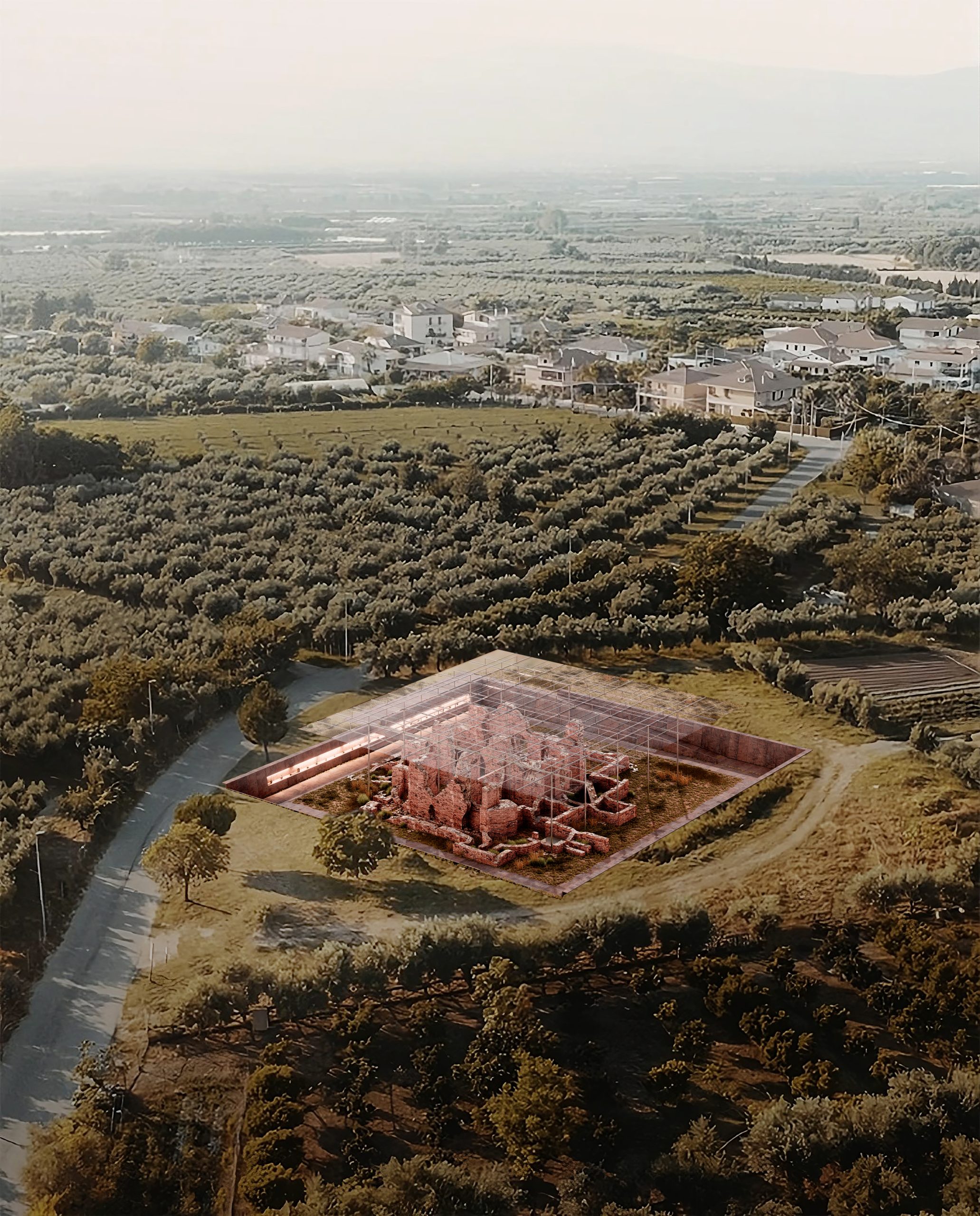
What happens when a modern architecture studio from Argentina takes on an 1,800-year-old Roman ruin in Italy? It becomes more than just a project—it becomes a masterclass in architectural sensitivity.
Today, we’re featuring a deep dive from the Architecture Competitions Yearbook into the “Reuse the Thermae” competition, organized by ReUse Italy. The team (Clara Gallardo, Guillermo Canutti, Lucas Delorenzi, and Marcos Constanzo) takes us behind the scenes of their process for the Roman Bathhouse of Acconia in Curinga. From why you should never throw away your first “ugly” sketches to using archaeological grids as a design tool, this article is a goldmine for anyone interested in heritage, storytelling, and the “adrenaline-fueled” world of international competitions.

COMPETITIONS AS A LEARNING PLATFORM
Designing within the framework of competitions navigates the boundaries of everyday professional practice, as it explores themes, sites, and complexities that are rarely encountered in a typical office setting.
As an architecture studio based in Argentina, we actively participate in local professional competitions, which aim to construct the work and, therefore, have a very rational approach to design, including a precise selection of materials and construction processes. Participation in international challenges—particularly involving a Roman bathhouse over 1800 years old—immerses us in a realm of opportunities very different from our local context, and this is where our interest lies.
An appealing aspect of this practice is the chance to see a variety of responses to the same brief. In this regard, we believe that learning is not only about making the project but also about reflecting on the results of other participants.
Moreover, professional work in this competition format fosters reflection and iteration, in a logic of constant trial and error that leads to finding certainties and, in many cases, starting over. This scenario, combined with the short timeframe and competitive nature, creates an adrenaline-fueled state that is only repeated in the next competition, prompting us to continually seek out new ones. The practice of design is a continuous exercise with no expiration date. Each challenge is unique and unrepeatable, a new learning platform.


WORKING METHODOLOGY FOR AN ARCHITECTURAL COMPETITION
There isn’t a single approach that serves as a universal model, but through repeated experiences with the same team, we’ve developed practices that streamline the process of generating a variety of rapid proposals. These are quickly discarded or refined to gradually arrive at more concrete solutions. We recommend establishing a consistent team and maintaining it over time, as competitions require the agility to respond swiftly and decisively to specific challenges.
Each team member naturally gravitates towards a specific role based on their training or personal interests. It’s not about assigned roles but about how each person naturally assumes responsibilities. One member might define the conceptual direction, another focuses on assembly and scaling, another handles technical and constructional solutions, while someone else is concerned with the pedestrian experience and the communication of ideas. Any architect or student interested in competitions can find their niche within the thematic framework of the contest—it’s all about contributing what you know best.
Competition meetings typically begin with lighter reflections, where we discuss individual interests, experiences, and even early references. As the submission deadline approaches, these meetings become more focused and solution-oriented. Typically, half the team meets in person while the other half participates virtually, often asynchronously, sharing sketches and audio summaries of the day’s conclusions.
We often build physical models, allowing us to touch and see the design. Other times, digital prefigurations prove more useful, enabling us to make and undo changes quickly, assessing the impact of each modification. We prioritize agile rendering of models to indicate materials, textures, shadows, and transparencies. It’s crucial for us to evaluate these spatial qualities early in the process. Lastly, we dedicate significant time and effort to finding the right modulations and grids that perfectly align with the given conditions and proposals. By organizing the process with a metric framework, we ensure control over all project elements simultaneously.
One curious observation is the accuracy of our initial sketches. These quick drawings, which aren’t known for their beauty, are made with tools suited to this type of recording, like watercolors, thick pencils, charcoal, and often a digital tablet. Although vague and erratic, we always revisit these initial scribbles, as they capture the first ideas—unburdened by media, materials, and other rational constraints. We place great trust in these initial impulses, as they often reveal what an idea truly wants to become. Therefore… never discard any drawing during the process! Instead, choose a good notebook where you can document every thought and idea debated throughout the design process.
DESIGNING IN THE RUINS: THE INTERVENTION COMPETITION IN THE ROMAN BATHHOUSE OF ACCONIA IN CURINGA
We are interested in different challenges, particularly those that fascinate us due to their material condition or their sites of implantation. In the competition for the musealization of the ruins of the Roman baths of Acconia in Curinga (Italy), both interests converge in a balanced manner, between the Italian landscape and the material condition of ruin that defines this challenge.
On the one hand, the Italian landscape has undoubtedly been one of the most fertile territories for cultural and architectural heritage worldwide. The large number of these forgotten structures reflects this particular condition, so naturalized in Italy, where geography and archaeology merge into a continuous canvas.
The low programmatic complexity of the brief allows for considering the proposal from other perspectives where functional variables do not dictate the design parameters. In this sense, it was interesting how a deeper investigation into the physical and cultural context provided arguments to develop a situated architectural idea. In the specific case of the Acconia baths, a profound understanding of the context allowed us to highlight not only the architectural features of the bathhouse but also the archaeological site. The goal was to musealize the ruins, making archaeological data also a primary certainty defined in the proposal.
On the other hand, in terms of material, ruins are physical phenomena that disrupt the time-space continuum. They create a clear fracture in the relationship between history and memory of places and encourage reflections free from prejudice and automatism. The condition of deterritorialization that emerges from this historical discontinuity challenges the observer to explore new connections between identity and the history of the object of study.
As architects, it is necessary to develop a sensitivity towards these abandoned structures, which commonly become collective memory and true reference landmarks. Such pre-existences are unique and referential structures within the territory, holding the evocative power of other times while engaging us as spectators in their material and symbolic condition.
From this perspective, a second certainty was recognizing the cultural value of the ruin as such and preserving its condition with minimal interventions to avoid compromising its nature. Additionally, it would be desirable to address all significant pre-existences today, beyond their historical value, in terms of material sustainability and reducing carbon footprint on our territory. As a discipline, we should have a more conscious view of “designing on the built,” rather than necessarily viewing our creative bastion as a new project.

THE DESIGN PROCESS: THE USE OF REFERENCES
We initially work with concepts rather than references. We try to start the design process without formal preconceptions, freeing this initial stage from prejudices, automatism, and whims. Once the theme is conceptualized, we move into a stage of investigation into various references, both from architecture and other arts and disciplines.
Having clarified these cultural references, we begin to translate them into architectural form, associated with conceptual stances, modulations, distributions, uses, materials, etc. Particularly in the case of the bathhouse’s masonry structure, we discovered an underlying geometric matrix that allowed us to align the intervention with the pre-existence, subsequently operating according to clear modules.


Architectural Theory References
Under the previously developed concept of ruin, we found that some Romantic architectural theorists’ thoughts helped clarify and order our understanding of working with a historical ruin. On the one hand, Camillo Boito’s more scientific idea describes monuments as writings, and thus the condition of authorship or authenticity:
“…The monument is a book, a stone testimony… which I intend to read without reductions, additions, or manipulations; I want to be sure that everything written has come from the author’s pen or style…” Camillo Boito (1883)
On the other hand, John Ruskin’s thoughts, more imbued with phenomenology and the senses produced by material over time associated with aging:
“In the golden patina of the years is where we must seek the true light, color, and merit of architecture. Only when a building has acquired this character… when its walls have witnessed our sufferings and its pillars have emerged from the shadow of death, its existence, more durable than the natural objects around it, is fully endowed with language and life.” John Ruskin (1849)
Archaeological References
The ruins of the Acconia baths are situated in a site with current archaeological interventions. Thus, when understanding the physical-spatial problem, we found that in addition to a Roman ruin, there are predominant forms related to contemporary archaeological work.
- Excavation Trench: Over the years, the topography of Curinga has changed such that the original access level of the bathhouse is now below the current road level. Archaeological work has defined an irregular polygonal excavation surface that forms a significant depression in the ground. We found this spatial cut attractive for enhancing the proposal.
- Excavation Grid: In archaeology, a grid refers to an organizational structure for excavating a site. Systematic excavation and precise documentation are essential for understanding the temporal sequence of layers and the spatial distribution of artifacts and remains. Although not present on site currently, it was a suggestive practice for the proposal.
- Archaeological Tent: Further investigation into archaeological work revealed that a tent commonly covers the manual work area, protecting remains and field personnel. This characteristic element also seemed appropriate to incorporate, as the proposal needed to protect the ruin from the elements.
Historical References
- Social Function: In antiquity, baths were social gathering places. Roman culture valued social interaction, and the baths provided a space for people to socialize, discuss current issues, and participate in recreational activities. Some baths hosted cultural events and artistic activities that contributed to the city’s social and cultural life. This historical trace of use guided our proposal to include a large multi-use meeting space, not initially considered in the competition brief.
- Frigidarium: Studying Roman bathhouse typology helped identify a space typically attributed significant meaning among the archaeological remains. This guided us in locating a key point of interest in the proposed pathway.


THE PROPOSAL
Concept
Like a palimpsest, the ruin of the Acconia bathhouse presents itself as a portion of its own historical narrative. Over the centuries, it has been covered with an extensive patina of time that gives it its characteristic unfinished and evocative structure: lines, worn surfaces, and construction techniques intertwine in a complex fabric where the boundaries of time blur.
This intricate, layered history reveals demolitions, additions, and reconstructions, making it a tangible testimony of time. Every corner and crack tells a story, offering a fascinating window into the past.
The ruins are not governed by proportions, hierarchies, or compositional logics; their forms are defined by a series of transformations and amputations throughout their history. The ruins reveal the process of creating the work, showing in their destruction the separated parts of the whole, its techniques, and secrets. The ruins may not represent anything new or beautiful to us, but they provide a pleasurable melancholy from reflecting on grandeur diminished.
Under these considerations, in alignment with the thoughts of Camillo Boito and John Ruskin, we affirm that “the ruin is a ruin.” In other words, there is no interest in transforming the current state into a finished, defined interior spatial domain in the proposal.
Form
In this sense, the project is formally defined with simple and pure geometries, establishing a clear duality between the new and the existing. Addressing the archaeological references and considering the initial cutting situation defined by the excavation trench, the proposal structures itself according to this slope, redefining the hole’s shape into a Platonic figure, establishing a dialectical contrast with the irregular perimeter of the ruin.
Following the excavation grid concept, a rigorous Cartesian modulation—resulting from finding regulatory measures within the masonry structures of the bathhouse—orders and sizes all project elements, offering users an understanding of both the bathhouse as architecture and its condition as an archaeological site.
This grid also defines a series of points that navigate around all preexistentes, materializing slender supports that hold a thin, lightweight covering protecting the bathhouse remains from the elements: an architectural reinterpretation of the archaeological tent. The cover is transparent, giving it a temporary appearance and not altering the ruin’s profile against the sky.


Use
From a functional perspective, the space is conceived as an open-air site museum. A small access plaza—at the current pedestrian level—welcomes visitors at the end of the Via Diocleziano. From this level, the ruin can be observed freely around its perimeter, and there is also a walkway that enters the main nave of the frigidarium without touching the ruin. From this plaza, a ramp descends to the lower level (the original level of the bathhouse) where a peripheral path allows for total observation of the ruins, complemented by display windows that add to the proposed site museum circuit.
Understanding the original social function of Roman baths, the proposal includes an amphitheater on one side, recognizing the ruin of the bathhouse as a backdrop for possible artistic events and site interpretation.


Material
Regarding materiality, discussions among team members always centered on finding a chromatic logic that harmonizes the new with the existing. Thus, a material with a color similar to the bathhouse brick was used, establishing analogous relationships; on the other hand, the cover was designed to be as immaterial as possible, aiming to make it disappear as much as possible.
Taking as a principle the Romantic notion of nature prevailing over reason, working with materials capable of absorbing the effects of time and nature did not seem appropriate. Therefore, for the new excavation trench, we adopted the technology of rough corten steel pieces and structures to highlight atmospheric effects and allow for the intrusion of mosses, lichens, or any biological crust. This material possibility of being marked or invaded by native nature will stain the surfaces over time like glazes in a watercolor, creating the desired patina of time.
The cover was an element that was in doubt throughout the design process. From a formal perspective, it was not ideal to add another project element that would distort the idea of the ruin and compete with the idea of the trench. Regarding requirements, the brief mandated protecting the ruins from weather conditions, so we decided to incorporate it as a necessary protection. Once incorporated, all efforts aimed to make it as light and ethereal as possible, hence its reinterpretation as the archaeological tent.
Communication – Representation
In communicating the proposal, ensuring the best coexistence between preexistence and intervention, it was crucial that the chromatic condition of the ruin predominates. In this sense, we chose to present the proposal through clear and impactful views and graphic pieces with a color tone that sought to associate with the preexistence.


Authors: Clara Gallardo, Guillermo Canutti, Lucas Delorenzi, Marcos Constanzo
Love this deep dive? There’s plenty more where that came from.
This article is just one of many success stories featured in the Architecture Competitions Yearbook.
If you’re serious about winning and want 10+ more case studies, expert interviews, and jury insights on your desk, grab your copy below.
Architecture Competitions Yearbook
The post Designing in the Ruins: Lessons from a Roman Bathhouse appeared first on Competitions.archi.