

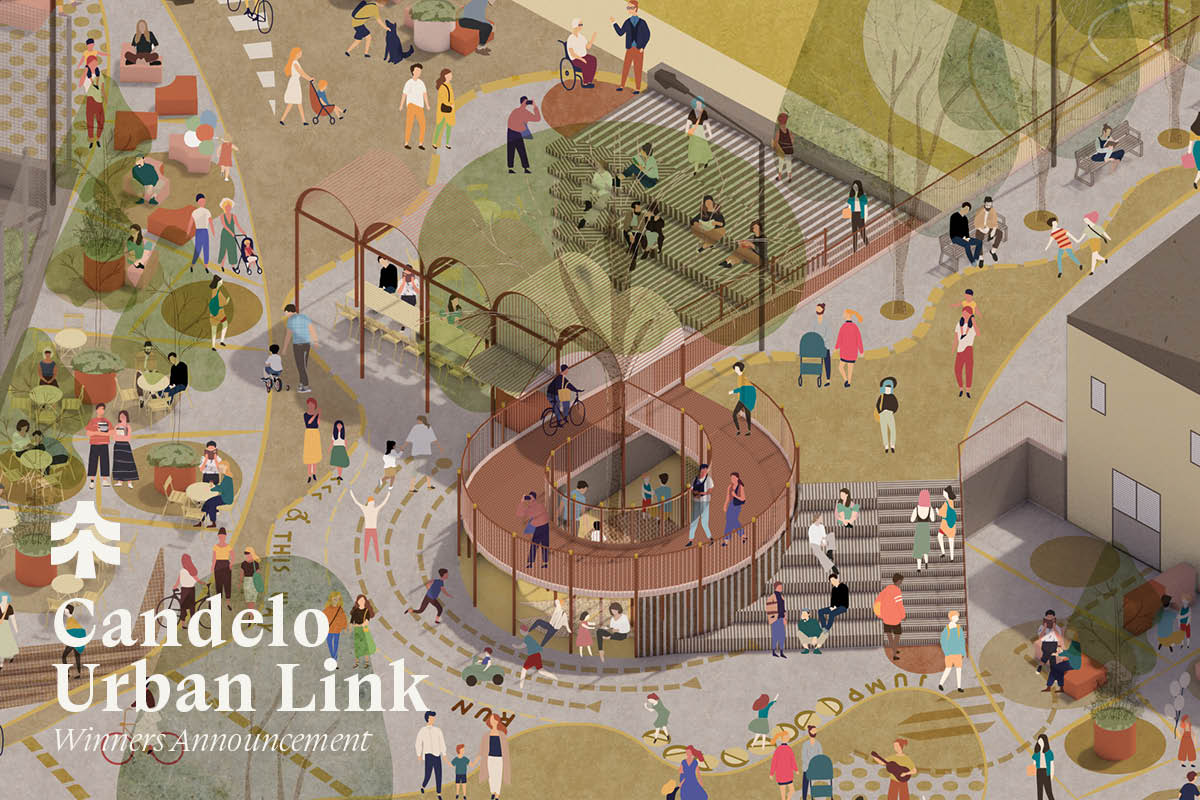
Terraviva has officially released the complete list of awarded projects of the architecture contest entitled “Candelo Urban Link”.
The competition invited designers to reimagine a fragmented square marked by a steep level change and a lack of clear identity into an accessible and multifunctional civic landmark, one capable of serving both as a daily route for schoolchildren and families and as a vibrant gathering place for the broader community. At the core of the challenge was the redesign of the connection between the square’s two levels, replacing or integrating the existing staircase with a ramp system that could become a defining architectural feature. Embracing the principles of Tactical Urbanism, participants were encouraged to propose lightweight, adaptable and cost-effective solutions that combined functional improvement with a strong visual identity, while honoring the historic character of the village.

The awarded proposals were recognized for their ability to transform a simple infrastructural necessity into a powerful urban gesture. The jury praised projects that reinterpreted the ramp not merely as a connecting device, but as an inhabitable architectural element: a place for pause, play and social interaction that reconciles circulation with experience. Some designs stood out for condensing accessibility, public life and identity into a single multifunctional element, creating new vantage points and spaces for gathering. Others were commended for their sensitivity to context, carefully selecting materials that resonate with the historic surroundings while adopting a tactical and economically sustainable approach. Across the selected works, a strong coherence emerged between urban scale and architectural detail, activating neglected areas and reorganizing the square into flexible, engaging thematic zones that foster dialogue and community life.
Terraviva warmly congratulates all participants for their creativity and commitment, whose thoughtful proposals have contributed to redefining public space through accessible, contemporary, and community-oriented design.
The winners were selected by an international jury panel composed by:
• Barbara Acquadro Maran [Candelo, Italy] | Comune di Candelo
• Stefano Recalcati [Milan, Italy] | Arup
• Alice Trematerra [Florence, Italy] | Didacommunicationlab
• Ángel Cerezo Cerezo [Barcelona, Spain] | Cream Estudio
• Emanuele Barili [Prato, Italy] | ECÒL
• Lucia Paci [New York, USA] | Operastudio
• Toufic Rifai [Beirut, Lebanon] | Lombardini 22
• Lucía V. Bocchimuzzi [Turin, Italy] | Mic-Hub

1st Prize
The Knot
Van Tan Quyen Le, Thi Anh Nguyet Tran
Australia


In Candelo, a town shaped by vineyards and time, history is read through cobblestone streets and the dense medieval walls of the Ricetto. As one moves through the town, its evolution unfolds – materials shift, scales change, and architectural languages overlap, forming a layered urban fabric shaped by centuries of adaptation.
Public spaces in Candelo have long been defined by a strong civic character: robust, multifunctional grounds capable of hosting events and gatherings. Yet the everyday presence of vehicles and service infrastructure often renders these spaces uninviting – places to pass through rather than linger.
Confronted with the underused Piazza di Via San Sebastiano, the challenge was not to overturn this civic logic, but to reawaken it: to restore identity and vitality while accepting the realities of contemporary infrastructure. The intervention needed to be simple in means, yet bold in impact – capable of stitching into the existing urban fabric rather than competing with it.
The Knot is our response, both literal and metaphorical.
Conceived as an integrated ramp and pavilion, the Knot provides a fully accessible connection between the upper and lower levels of the square, replacing the former stair-only linkage. More than a circulation device, it is an inhabitable structure – an urban element that gathers, frames, and slows movement. The ramp takes the form of a circular elevated walkway, while the pavilion is a linear shade structure accommodating a café kiosk and spill-out seating beneath a lightly filtered canopy. Where these two elements intersect, they form a spatial knot – an expressive archway and threshold marking arrival into the lower plaza, where movement becomes experience.
The upper entry is open, legible, and direct, reinforcing clarity of access. In contrast, the lower entry is discreet and embedded within the reconfigured plaza, subtly encouraging users to pause, observe, and participate in the life of the square. Circulation is transformed into occupation; passage becomes presence.
Beneath the elevated canopy, a generous cavity is activated as a play landscape. Suspended nets create layered experiences for multiple age groups – spaces to climb, hang, run, hide, and explore – transforming the structure from a passageway into a place of energy, discovery, and social interaction.
Finished in a bold terracotta tone, the Knot echoes the material memory and warmth of Candelo while asserting a confident contemporary presence. More than a piece of infrastructure, it is a catalyst for public life – supporting movement, play, pause, and gathering.
The design of the entire square grows from the idea of fields and yards, reflecting Candelo’s agricultural heritage. For centuries, vineyards and fields have sustained the town, while roads, forest edges, and paths have traced layered flows across the land. These natural and manmade movements weave through various green textures that embrace Candelo.
The vast grey asphalt ground is reorganised as a sequence of adaptable activity fields aligned with movement and use – the Flexible Yard, Civic Yard, Fitness Field, and Sport Field. Together, they transform a once dull and transitional space into a vibrant, social, and memorable civic ground evolving around the new iconic anchor – The Knot.
_________________________________________
About the First Prize – Stefano Recalcati – Arup
“The proposal stands out for the strength of its architectural gesture, concentrating within the “Knot Structure” device a clear idea of threshold, landmark, and urban catalyst, while maintaining solid coherence between the urban scale and the architectural detail. The ramp and the pavilion are not merely functional elements, but instead construct an inhabitable node that transforms circulation into experience and connection into an opportunity for pause, play, and social interaction. The reorganization of the ground into flexible thematic fields reinforces this systemic and contemporary vision, generating a unified space in which all parts engage in dialogue with one another.”
About the First Prize – Lucía V. Bocchimuzzi – Mic-Hub
“The ramp becomes more than a connection, transforming into a place of interaction, while the rest of the plaza is activated through tactical interventions that promote gathering, play and resting areas. The proposal reclaims spaces that are currently neglected, giving them new purposes and vitality.”
2nd Prize
CNDL – nuova centralità urbana: una piazza connessa
Fabio Marchesi, Bea Fratus, Mariasole Facchi
Italy


Il progetto di riqualificazione della nuova piazza di Candelo si colloca in una posizione strategica, a ridosso del centro storico del paese, adiacente alla scuola statale e a pochi passi dal Ricetto di Candelo. L’intervento nasce con l’obiettivo di trasformare uno spazio oggi frammentato e prevalentemente di passaggio in una nuova centralità urbana, capace di accogliere e rappresentare la vita quotidiana della comunità. La piazza viene ripensata come uno spazio multifunzionale, flessibile e inclusivo, in grado di rispondere alle esigenze di diverse fasce d’età: bambini, studenti, anziani e famiglie. Il concept progettuale si fonda sull’idea di apertura e connessione: il ridisegno della rampa pedonale, ribaltata e riposizionata lungo la parete che colma il dislivello tra la piazza e via Libertà, diventa l’elemento cardine dell’intervento. Questa scelta non solo migliora in modo significativo l’accessibilità, garantendo un percorso continuo per persone con disabilità e anziani, ma apre visivamente e fisicamente la piazza verso la città, rendendola più riconoscibile e attrattiva. La rampa, integrata con una scala, si trasforma in uno spazio di relazione e di sosta: un vero e proprio spalto urbano, ombreggiato dalle alberature esistenti e di progetto, da cui assistere alle partite di basket o semplicemente fermarsi ad osservare. I colori della nuova pavimentazione riprendono le sfumature del rosso, del terracotta e del bruciato tipiche delle vie del centro storico, rafforzando il legame identitario con il contesto di Candelo. Gli arredi mobili e modulari in metallo e cemento, materiali resistenti e a bassa manutenzione, contribuiscono alla flessibilità dello spazio, possono essere facilmente rimossi o riconfigurati in base alle esigenze.
La piazza viene organizzata per settori funzionali, ciascuno riconoscibile non solo per l’uso ma anche per il disegno dello spazio e della pavimentazione. La nuova scala con rampa costituisce la principale connessione tra i livelli urbani e il fulcro visivo del progetto. Il campetto da basket viene rifatto e valorizzato come spazio sportivo e sociale, integrato nel disegno della piazza. Una zona dedicata all’urbanistica tattica, caratterizzata da segni grafici a terra e superfici colorate in cemento, favorisce il gioco libero e l’appropriazione informale dello spazio. L’area giochi è arricchita da panchine, vasi alberati e arredi mobili come lampioni, cestini, parcheggi per biciclette e una fontana d’acqua, creando un ambiente accogliente e sicuro. La scala, originariamente prevista per collegare i due livelli della piazza ma non fruibile da tutti, viene mantenuta e integrata nel nuovo assetto progettuale mediante la ripavimentazione con lo stesso materiale utilizzato per la rampa. Questa scelta permette alla scala di armonizzarsi con disegno dello spazio pubblico, rafforzando la continuità percettiva e garantendo un’ulteriore connessione tra le diverse quote.
Infine, un intervento di ridisegno della sezione stradale lungo lungo via San Sebastiano garantisce un collegamento pedonale sicuro e protetto alla nuova piazza. Sia la via che l’area di accesso ai depositi comunali vengono ripavimentate con asfalto drenante, mantenendo i parcheggi esistenti e dando la possibilità di ospitare eventi temporanei come il mercato, rendendola un’area modulabile, rafforzando ulteriormente il ruolo della piazza come luogo di incontro e identità urbana.
_________________________________________
About the 2nd Prize – Lucia Paci – Operastudio
“Through the ram, conceived as the pivotal element of the intervention, the project successfully mends the existing spatial fracture between the two parts of the city. Careful attention to materials, echoing those of the historic center, combined with a tactical urbanism approach, outlines an effective, context-sensitive, user-friendly, and economically sustainable scenario. The graphic representation becomes, in itself, an active narrative device, capable of conveying the renewed urban space in a dynamic and engaging manner.”
3rd Prize
CUNEO
Yi Lin, Andrea Staffolani
Italy


Next to the village of Candelo, defined by its strong historical and cultural identity, there is a square that, by contrast, needs to reclaim its own space and a renewed visibility.
Situated beside an elementary school and already including a sports field, the square is subject to issues caused by the fragmentation on the two different levels, vehicular traffic and general inflexibility. These conditions set the basis for reflections on possible improvements, aimed at restoring to this space a sense of protection, vibrancy, and greater flexibility. A strong argument in favor of a necessary intervention is the mural that runs along the walls enclosing the square. Created as an attempt to revitalize the space, it symbolizes the strong emotional value that, despite everything, this place still holds. It is thus fundamental to the project to preserve and integrate the existing artwork, while adopting a necessary connection between the two levels on a low-cost approach.
The intervention takes the form of an addition: a ramp is inserted punctually on the spot where the current staircase is located. It is straight and oriented toward the school entrance, allowing the creation of a protected area shielded from the vehicular circulation of Via San Sebastiano. The ramp unfolds into the sport field through a stepped seating system that defines the space and gives the place a strong degree of flexibility, creating bleachers suitable for screenings, performances, sports events, or simply waiting for one’s children.
The playing field gains renewed vibrancy through the recoloring of the paving, which enhances the existing surface by adding circles in the same orange and green tones. A dynamic ground is thus generated, where these new geometric figures encourage new games and activities.
In order to ensure greater protection of the newly defined space, a strong green component is introduced along the side facing Via San Sebastiano. Depaving is avoided through the use of circular planters of varying sizes, arranged to create a tree-filtered entrance toward both the square and the school. Beyond offering shade and improving microclimate, the selected planting promotes biodiversity and supports an educational function: in the absence of a school garden, the space becomes an outdoor classroom integrated into daily activities. A sandbox, a fountain, and an aviary further characterize the space.
The ramp element is constructed entirely of treated wooden planks painted blue, designed to be easily, economically, and sustainably built. With the same objectives, the railings are made of perforated corrugated metal sheets which, extending down to the ground, give unity to the architectural element. Lighting is implemented through three poles directly integrated into the body of the ramp.
The limited project area allows the existing space to be enhanced in an economical and strategic manner. The aim of this intervention is to address the site’s numerous critical issues through a single, decisive gesture, using the ramp both as a connection and as a boundary, set above a playful ground and filtered through dense vegetation.
_________________________________________
About the 3rd Prize – Emanuele Barili – ECÒL
“The proposal identifies in the reconnection of the two levels the opportunity to introduce an element with three complementary values: replacing the existing stair to ensure accessibility, creating generous steps to watch the game, and establishing a new iconic presence. This multifunctional gesture condenses infrastructure, social space, and identity into a single architectural device, efficiently and convincingly responding to the brief.”
Golden Mention
FLOWING STAGE
Jinyi Xiao, Danyan Liu, Shiying Wang
France – Netherlands – United States


The square in front of the school in Candelo becomes a Flowing Stage. Inspired by Italy’s theatrical heritage and the idea that life constantly shifts between center and edge, the project reinterprets the ramp not only as infrastructure, but as a civic device. Every stage has a center and a margin, yet these roles are never fixed. Positioned along the edge of the square, the ramp guarantees safe and fluid circulation; yet when viewed from below, it becomes the focal point, a platform where people are visible, present, and active. The observer becomes the performer, and the edge becomes the center. The school itself embodies transition: each year students arrive, grow, and graduate, moving through phases of learning and discovery. The design expresses this continuity through flowing geometry and vibrant color, symbolizing the vitality of childhood and the dynamism of Italian public life.
The Flowing Stage is created through opening and activating the edge, sharing and mixing programs to build Candelo’s public living room for everyone. It’s designed as an open stage that connects people and shares life. Existing materials will be reused for new construction, and part of the asphalt will be crushed for soil regeneration. The square will be built by the citizens of Candelo together, from planting new trees, painting the ground to crafting the furniture. The project introduces two complementary stages: a permanent stage integrated into the school square & a temporary extendable stage near the warehouse, together they could be merged as a big stage for events and markets. They activate the site across multiple scales and occasions.
The intervention strengthens the relationship between the school, surrounding streets, and adjacent public spaces, transforming the square into a connective urban node. By stitching together different levels of the site, the ramp improves permeability, visibility, safety, and full barrier-free access. Its generous slope and integrated seating playing transform circulation into a place of pause, encounter, and informal gathering. The space supports diverse every day and seasonal activities — from sports and play to community celebrations in summer and winter. From school mornings to evening walks, from weekdays to festivals, the square adapts to changing rhythms. Flowing Stage is an open stage where life continuously moves between center and edge, and where everyone is invited to sit, to play and to live & grow together.
Golden Mention
Candelo Urban Link
Daniele Barioglio, Luca Valentini, Davide Fiorenzo De Conti
Italy


Concept e obiettivi del progetto
Il progetto nasce dalla volontà di trasformare un dislivello fisico in un’opportunità urbana, ridefinendo la piazza come spazio accessibile, inclusivo e identitario. Il concept si fonda sull’idea di continuità: tra quote, tra percorsi, tra funzioni e tra persone. L’intervento non si limita a risolvere un problema tecnico di collegamento tra due livelli separati da circa due metri, ma assume il dislivello come occasione per generare un nuovo dispositivo spaziale capace di attivare relazioni e qualità urbana.
La rampa rappresenta il cuore del progetto. Concepita come un elemento unitario integrato nella scalinata, supera la logica della separazione tra percorso per persone con mobilità ridotta e percorso ordinario, proponendo un’unica grande superficie articolata e permeabile. Ogni utente può scegliere liberamente il proprio tracciato, in base alle proprie esigenze e capacità, senza essere indirizzato verso soluzioni marginali o dedicate. L’accessibilità non è trattata come eccezione normativa, ma come principio generativo dell’intero impianto progettuale.
A partire da questo gesto, la riqualificazione della piazza estende la medesima logica di inclusione e continuità. Il disegno dello spazio integra il campo da basket esistente all’interno di una composizione unitaria, affiancando percorsi, sedute e dispositivi ludici capaci di favorire movimento, esplorazione e condivisione. Gli spazi sono articolati in aree aperte e dinamiche, dedicate al gioco e alle attività collettive, e ambiti più raccolti e protetti, pensati per la sosta, il dialogo e l’attesa, in particolare per le famiglie in prossimità dell’uscita delle scuole.
L’elemento circolare diventa la chiave formale del progetto, raccordandosi con linee ortogonali in un sistema coerente che unisce superfici, segnaletica e identità visiva. Questo linguaggio coordinato, ripreso anche nel logo e nella grafica orizzontale, rafforza la riconoscibilità dello spazio e consolida la sua identità urbana.
L’intervento si configura così come un’azione di ricucitura fisica e sociale: un’infrastruttura che diventa luogo, un dispositivo funzionale che assume valore civico. La nuova piazza non è solo uno spazio riqualificato, ma un ambiente inclusivo, capace di generare appartenenza, relazione e qualità urbana duratura.
Golden Mention
Folded Lines: Urban Acupuncture
Lingyu Li, Shengfeng Gao, Zhuohan Zhou
China


The project redefines the stair as the social and spatial core of Candelo’s new urban plaza. Rather than treating the level difference as a technical constraint, accessibility becomes the geometric generator of the space. A fully integrated ADA-compliant ramp is embedded within a folded stepped landscape, shortening circulation paths while creating a continuous and inclusive connection between the two levels. Conceived as both infrastructure and civic device, the stair provides shade, seating, and flexible platforms for gathering, studying, and play. Integrated planting zones introduce vegetation directly into the structure, reducing heat accumulation and improving microclimatic comfort.
The stair’s folded geometry derives from Candelo’s irregular stone walls, building alignments, and subtle topography. These latent diagonal lines are extended to structure the plaza, transforming a residual asphalt surface into a clear and legible urban link. Guided by urban acupuncture principles, the intervention remains minimal and precise. Most asphalt is retained, with painted markings organizing movement and zones. Selective cobble stone pavers integrate drainage channels that direct stormwater toward a southern rain garden, resolving flooding issues while introducing permeable surfaces and trees that mitigate urban heat island effects.
Historically, Candelo emerged as a spontaneous aggregation of structures — a self-organized architectural cluster shaped by collective necessity and shared life. This legacy of cooperation and adaptability informs the proposal as an open and flexible framework rather than a fixed composition. A modular scaffold system becomes the key affordable strategy: lightweight, reversible, and adaptable. During daily use, it provides seating, shade, and protective boundaries; on Fridays, it transforms into a cinema and wine bar; on weekends, into a farmers’ market. The scaffold echoes the town’s viticultural heritage, reinterpreting vineyard trellises as contemporary civic infrastructure.
Material continuity reinforces this rooted approach. Cobble stone paving, especially within the stair and selected ground interventions, recalls Candelo’s distinctive textures and extends its existing material language. Through low-cost, strategic, and reversible interventions, the project transforms an overheated asphalt field into an adaptive civic landscape shaped by both design and community life.
Golden Mention
SI ACCENDONO I LUMI
Andrea Sbernini, Alessandro Biacca
Italy


“S’accendono i lumi nella sera,
rapido cala il crepuscolo;
passa un’ombra leggera,
trema un ultimo frullo”
(G. Pascoli)
L’ambito di progetto si trova in uno spazio diaframma tra la periferia del centro storico e la più recente espansione residenziale e industriale della cittadina di Candelo, delimitato da proprietà private e da una scuola elementare, che definiscono il suo contorno.
Per ottenere una mutazione a livello del quartiere proponiamo di sfruttare lo stato del sito, ossia i limiti fisici della piazza, come il salto di quota che divide fisicamente due ambiti: sopra e sotto. Il progetto si basa su quattro ecologie strutturanti – la piazza-playground, la foresta urbana, il padiglione e l’estensione del bar – definite ciascuna da un elemento di luce verticale, i Lumi, ispirati all’etimologia e all’iconografia del comune stesso, che ricuciono la discontinuità visiva ed esperienziale della piazza esistente.
La piazza-playground reinterpreta le mura del ricetto, dove la rampa, nuova metafora del bastione-torre, diviene l’elemento ordinatore del progetto: un dispositivo di connessione che ridefinisce le relazioni tra alto e basso, riorganizzando i flussi di attraversamento e di uso dello spazio. La scala esistente, elemento di chiusura spaziale e visiva, viene eliminata a favore di una tribuna metallica, pur mantenendo il collegamento tra i due livelli di quota differenti.
La foresta urbana si configura come un dispositivo ecologico e spaziale capace di reintegrare il sistema del verde e dei microclimi all’interno di un contesto minerale, assumendo un ruolo strutturante nell’organizzazione dello spazio urbano. Essa guida e contiene la viabilità carrabile nell’unica porzione del livello inferiore accessibile ai veicoli, trasformando un’esigenza funzionale in un elemento integrato del paesaggio costruito.
Il nuovo padiglione “Acqua di Candelo” conserva integralmente la propria funzione originaria, ma viene reinterpretato come infrastruttura urbana ibrida. All’impianto esistente si innesta una pensilina, che estende il padiglione nello spazio pubblico e ne rafforza il ruolo di dispositivo di servizio alla scuola e alla piazza. Parallelamente, l’edificio assume il valore di cellula energetica primaria, come nodo generatore che alimenta i nuovi interventi diffusi nella piazza.
L’estensione del bar si configura come dispositivo urbano temporaneo, capace di ridefinire il rapporto tra spazio pubblico e margine. Attraverso la riappropriazione periodica e puntuale dell’area destinata alla sosta veicolare, si è deciso di sfruttare la recinzione esistente, per creare un sistema che opera come infrastruttura effimera, in grado di alternare funzioni di filtro visivo e spaziale a configurazioni più aperte, destinate ad usi collettivi, a eventi di carattere sociale o commerciale.
Sopra i cerchi più distanziati definiscono aree ibride, utilizzabili come parcheggi o spazi per eventi temporanei. I cerchi più fitti connotano le aree pedonali, potenziandole, qualificando lo spazio pubblico e limitando il traffico. Sotto, il disegno viene ripreso per delineare spazi e introdurre un elemento ludico per la comunità, diventando segno riconoscibile del progetto e, attraverso il colore, strumento di differenziazione e riconoscibilità delle quattro ecologie.
I dispositivi generano nuove centralità e riorganizzano lo spazio pubblico in chiave accessibile e inclusiva, restituendo alla piazza vitalità, continuità e libertà di movimento.
Golden Mention
Candelo-Urban-Link
Ivan Okhapkin, Maria Repkina, Anastasia Agafonova, Maria Fedotova, Aleksandra Ustinova, Anastasia Kolosova, Daria Mamskova
Spain


“Constructor on Wheels” is a flexible kit of parts of wheeled mobile modules that create a reconfigurable public square. Principles: adaptability and tactical urbanism — the square responds to users’ needs and specific event scenarios.
The system comprises universal modules that operate autonomously or in combinations, allowing incremental delivery as programming needs evolve. Modules sit on a 3×3 m grid, enabling rapid reconfiguration and precise integration with the existing site without major civil works.
Scenarios include sporting events, weekend markets, concerts, film festivals, civic celebrations and everyday public life. Module types: amphitheatre seating, planter tubs, market pavilion, ramp, projection screen and stage. The stage reconfigures into three independent units — a platform, a children’s play area and a sandpit. Modules are dimensioned in 3 m increments to preserve existing surfacing and simplify placement.
Materials and surfacing: the square retains its existing paving; instead of large scale reconstruction, the surface is refreshed with a durable, wear resistant coating and line graphics applied to the existing substrate. A graphic 3×3 m grid organises layout, cuts cost and speeds implementation.
Interactive markings: an overlay of graphics defines play and sports zones — children’s games, coordination drills, team activities and informal sport. These markings can act as a standalone programme: the square can instantly function as a playground or sports court even without modules.
Graphics extend vertically onto retaining and boundary walls, integrating horizontal and vertical planes into a coherent composition. Walls thereby become functional elements for play tasks, training exercises, tactile engagement and visual zoning.
Urban benefits: economic efficiency, simple fabrication, interchangeability, mobility and rapid transformation. The modular system minimises storage and maintenance costs and supports phased implementation. The public realm shifts from static to operational — a responsive urban instrument that adapts to seasonal change and community initiatives while enabling quick event mobilisation with low long term infrastructure cost.
Accessibility and the ramp: the concept’s central element is a mobile ramp creating a step free environment and universal access. A 5% gradient (1:20) ensures comfortable circulation. The ramp is mounted on a wheeled chassis with locking devices, aligns with the 3×3 m grid and integrates built in storage bays for furniture, AV and market fittings — eliminating separate warehousing, accelerating set up and simplifying operations. The existing staircase is retained; lightweight tables and chairs fit within its geometry so it can partially function as amphitheatre seating.
Landscape development:
Next steps include harmonising the colour palette of adjacent buildings and the nearby school with the square to form a cohesive ensemble. Digital activation — a social page or fixed camera — can document changing configurations, boost engagement and give the place continuous digital life.
Additionally: a social media page for the place would showcase changing scenarios and announce events — from everyday activities to major city gatherings. Content can be resident generated or recorded via a fixed camera documenting life on the square. This creates a sense of continual renewal, enhances community engagement and gives the place a new digital life.
Honorable Mention
Urban Ring : A Framework for Everyday Interaction
Meryem Kübra Uluç Tolba, Nadine Elsayed
Turkey – Egypt


Honorable Mention
Living Ribbon
Keteryna Karpovska, Matylda Grojec
Poland


Honorable Mention
Scaffold Social
Isaac Contreras Padilla, Nicoll Rey Romero
Colombia


Honorable Mention
CAU Candelo Urban Link
Ray Agung Sucika Pratama, Ahmad Alfu Ihsan, Faris Raihan Friadi
Indonesia


Honorable Mention
El Ricetto Apperto
Pernot Pierre-Antoine, Paf Architecture
France


Honorable Mention
Up’n Down
Idil Mersin, Emrecan Bostan
Turkey


Honorable Mention
ADAPTIVE INFRASTRUCTURE: Re-stitching Candelo for a Resilient Future
Muyao Zhou, Yuehan Li
China


Honorable Mention
Un posto dove vuoi passare, un posto dove restare
Nataliia Murashova, Maria Knutova, Evdokia Eremeeva
Russia


Honorable Mention
Banco Di Corallo
Nathan Ma
Hong Kong


Honorable Mention
Campetto
Agnieszka Filipowicz
Poland


SHORTLISTED PROJECTS

The post Results: Candelo Urban Space appeared first on Competitions.archi.