

Buildner is pleased to announce the results of the Concrete Pavilion competition, an international design challenge dedicated to exploring the architectural, structural, and environmental potential of concrete.
As part of our ongoing Material Studies series, this edition invited architects and designers to reconsider one of the world’s most ubiquitous building materials and to reimagine its role in shaping contemporary public space.
Participants were asked to design a pavilion of up to 50 m² that could function as both a spatial experience and a demonstration of material innovation. Beyond formal expression, proposals were encouraged to engage with sustainability, construction methodology, tactile quality, and the broader cultural implications of building with concrete. The brief sought projects that would test assumptions about weight, permanence, and rigidity while advancing new approaches to performance and craft.
The response was ambitious and wide-ranging. Submissions explored thin-shell structures, earth-cast processes, adaptive reuse strategies, and infrastructural reinterpretations. Many projects challenged the conventional image of concrete as heavy and inert, presenting instead porous, luminous, and context-sensitive structures that engaged climate, landscape, and community.
Following review by an international jury panel, prize winners and honorable mentions have been selected for their conceptual clarity, technical ingenuity, and spatial impact. Together, the projects reflect the evolving possibilities of concrete as both material and medium, demonstrating how experimentation can expand its spatial, structural, and cultural potential.

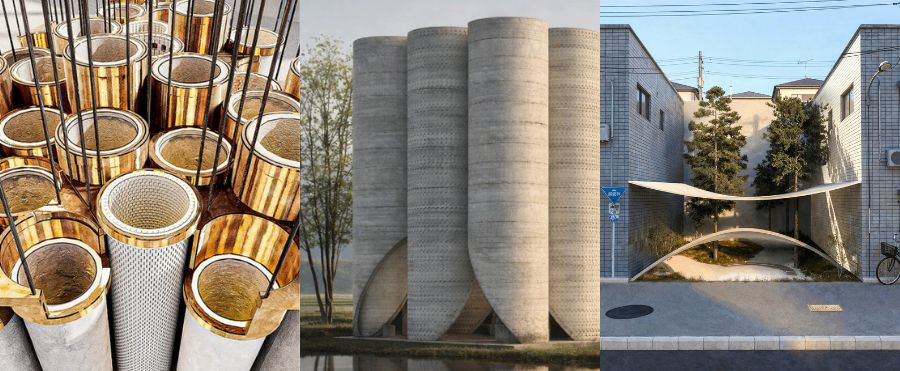
1st Prize was awarded to Hamid Karimiantakbolagh, Saber Karamzadeh, Leila Nikjoosafa, and Amirmohammad Taheri (Austria). Their proposal, set within a former industrial hall, suspends a clustered composition of cylindrical concrete elements beneath existing steel trusses, creating a layered landscape of light, shadow, and tactile thresholds.
2nd Prize went to Nuttapol Techopitch (Thailand) for “Cultivating Pavilion,” which merges vertical water storage infrastructure with a shaded communal space. Twelve cylindrical silos form a porous and thermally moderated interior animated by filtered daylight.
3rd Prize was awarded to Koh Noguchi and Ssu-Kuo Lo (United Kingdom) for a small pavilion inserted into a narrow urban void, where an earth-formed concrete shell and lightweight canopy transform residual space into an intimate micro-landscape for gathering and play.
1st Place
Re-Maze
Hamid Karimiantakbolagh, Saber Karamzadeh, Leila Nikjoosafa, Amirmohammad Taheri
Austria

“We participate in architecture competitions because they provide a critical platform for experimentation, learning, and dialogue. Competitions allow us to explore ideas beyond the limitations of conventional practice, question established norms, and test innovative design approaches. They also encourage collaborative thinking and push us to clearly articulate concepts within specific constraints of time, site, and program. Through this process, we strengthen our ability to respond creatively and responsibly to complex architectural challenges. Most importantly, competitions offer an opportunity to engage with broader architectural discourse, receive critical feedback, and contribute ideas that address social, cultural, and spatial issues. For us, they are not only a means of professional growth, but also a way to refine our architectural position and design methodology.”
_________________________________________
JURY FEEDBACK summary
Installed within a former industrial hall, this pavilion reinterprets concrete as an atmospheric and spatial medium rather than a purely structural one. A clustered triangular arrangement of cylindrical concrete elements forms a suspended volume beneath the existing steel trusses, hovering slightly above the ground plane. Each cylinder varies in height, opacity, and internal treatment, generating a porous interior landscape of light wells, shadow gradients, and layered thresholds. Suspended cables articulate the verticality of the intervention while referencing the industrial logic of the host structure. The composition operates both as object and environment: from afar, it reads as a dense geometric formation; at close range, it dissolves into tactile surfaces, apertures, and intimate chambers. Through rotation studies, connection diagrams, and material detailing, the project positions itself as a careful dialogue between heavy materiality and perceived lightness within a reclaimed industrial context.
2nd Place
Cultivating Pavilion
Nuttapol Techopitch
Thailand

JURY FEEDBACK summary
“Cultivating Pavilion” reinterprets the rural vertical water tank as a dual-purpose architectural intervention, merging agricultural infrastructure with public space. Composed of twelve cylindrical concrete silos arranged in a compact cluster, the project preserves the essential function of water storage while carving out a shaded communal interior beneath the suspended tanks. Strategic voids at the base and selective cuts within the cylinders transform solid mass into a porous spatial field, allowing light, air, and filtered views to animate the interior. Transparent acrylic inserts and light-conducting fibers introduce calibrated daylight below the water mass, creating a contemplative atmosphere shaped by thermal inertia and diffused illumination.
3rd Place
Pull
Koh Noguchi, Ssu-Kuo Lo
United Kingdom

“We enter competitions to explore new ideas that are not constrained by the gatekeepers of academia or by clients in professional practice. They give us the freedom to tackle any brief that piques our interest and approach it in our own way.”
_________________________________________
JURY FEEDBACK summary
Inserted into a narrow residual gap between two existing buildings, this small pavilion transforms an overlooked urban void into a sheltered micro-landscape for informal gathering and play. The intervention operates through two primary gestures: a shallow, earth-formed concrete shell that shapes the ground into a soft inhabitable topography, and a thin suspended canopy that stretches lightly between the flanking walls. The lower shell is cast using the excavated ground as formwork, producing a tactile surface that invites sitting, climbing, and lingering, while the canopy introduces shade, compression, and moments of framed sky through circular apertures.
Buildner Student Award
Folding Concrete
Yi Yang, Chun Zhou
United States

“We participate in architecture competitions as a space for constant experimentation and growth. Competitions allow us to test ideas that may be difficult to pursue within conventional academic or professional constraints, pushing us to challenge assumptions about form, structure, and spatial experience. They encourage innovation—not as novelty, but as a disciplined process of questioning, prototyping, and refining. Each competition becomes an opportunity to explore new technologies, fabrication methods, and design logics, while sharpening our ability to communicate ideas clearly and rigorously. For us, competitions are not about a single outcome, but about sustaining a mindset: always experimenting, always challenging ourselves, and always innovating through design.”
_________________________________________
JURY FEEDBACK summary
“Folding Concrete” proposes a compression-dominant concrete shell canopy generated through graphic statics and sheet-folding logic. The pavilion reimagines thin-shell concrete construction by subdividing a curved surface into foldable plywood formwork panels, enabling robotic milling, transport in pieces, and on-site assembly. Supported by slender steel columns and post-tensioned elements, the shell aims to achieve structural efficiency with minimal thickness while maintaining architectural clarity. Beneath the canopy, rotating display panels create an open-air gallery condition, framing views toward the surrounding landscape and skyline. The project positions itself as both a material experiment and a fabrication study, arguing for a digitally informed workflow that expands the feasibility and accessibility of thin concrete shells.
Buildner Sustainability Award
Earth Moves
Lain James Maxwell
Australia

“As practices that span professional projects and academic research, we see competitions as wonderful vehicles through which to test our more fundamental research endeavours. Further, competitions offer a model of peer-review that is specific to design-led research and as such they provide a valuable framework to measure impact. Finally, we also greatly appreciate the communities that participate in and share their knowledge via competitions. Advancing architectural practice demands both opportunity and forums of dissemination and for us competitions, even perhaps more so than conferences, facilitate both.”
_________________________________________
JURY FEEDBACK summary
“Earth Moves (eM)” is a thin-shell earth-cast concrete pavilion embedded within the landscape of Somersby, Australia. Conceived as both event space and cultural infrastructure, the project draws on local soil, on-site excavation, and First Nations-led principles to establish a construction methodology rooted in place. Rather than relying on conventional fabricated formwork, the pavilion is shaped through an earth-mound casting process: soil is formed into sculpted berms, scanned and refined, then coated with a thin shotcrete layer before excavation reveals the final shell. The result is a series of intersecting compression arches that frame fire, sky, and gathering space. By treating the ground itself as temporary formwork, the project positions construction as landscape transformation, reducing material waste while reinforcing a reciprocal relationship between architecture, material sourcing, and Country.
HONORABLE MENTION
GROUND ZERO_Concrete as Witness
Roxana-Andreea Irimia, Mihai Bogdan Ionită
Romania

“Competitions serve as a platform for us to explore fresh ideas, challenge ourselves, and experiment with cutting-edge design concepts. They grant us the freedom to think creatively and approach problems in unconventional ways, which fosters a culture of innovation within our team. This environment also enables us to continuously refine our skills as we engage with diverse design briefs and problem-solving scenarios, offering a sense of growth and development. Moreover, competitions provide an opportunity to inspire others and, in turn, increase our visibility and recognition within the architectural community and beyond. This exposure can significantly enhance our presence and reputation, amplifying our impact on the field. In essence, participating in architecture competitions resonates with our commitment to innovation, collaboration, social responsibility, and historical preservation. It empowers us to stretch the boundaries of our creativity, advance professionally, expand our professional network, gain acknowledgment, and contribute positively to our society.”
HONORABLE MENTION
Kiwa
Chae Eun Kim, Chae Lin Kim
South Korea

“Competitions allow Architecture to return to its conceptual essence. Competitions create space to test ideas that may not emerge in conventional practice. For us, they are opportunities to refine our own Architectural philosophy and express cultural narratives through design.”
HONORABLE MENTION
Archive of Aggregate
Diane Yun Choi, Yuka Imada
United States

“We participate in competitions as a space for exploration beyond the formal boundaries of academic institutions or professional practice. Competitions allow us to engage directly with a defined brief, site conditions, and constraints such as budget and program, while still operating with intellectual and creative freedom. They function as both a testing ground for ideas and a method of developing our own design positions through focused research, experimentation, and collaboration.”
HONORABLE MENTION
One Foot
Junyub Kim
Switzerland

“Competitions allow a degree of freedom that daily practice often cannot afford. They provide a concentrated moment to test ideas, experiment with material strategies, and articulate architectural positions with clarity. For young practices especially, competitions open access to public agendas that might otherwise remain distant. For us, competitions are opportunities to refine questions and sharpen our position within architectural discourse.”
HONORABLE MENTION
Re:Concrete
Shivani Rastogi, Jialu Hou, Kaixin Su, Taoyu Han
United Kingdom

“Competitions provide a space for exploration and experimentation that is often difficult to access within conventional practice. They allow us to question assumptions, test alternative material strategies, and respond to urgent global challenges such as environmental resilience and circular construction. They also create opportunities to contribute to broader architectural discourse and engage with ideas beyond immediate project constraints.”
HONORABLE MENTION
Cast in Reverse
Yanchen Yu, Hua Chai
United States

“We participate in architecture competitions as a way to explore ideas that extend beyond the constraints of conventional practice. They provide an opportunity to test new approaches to materials, construction, and the relationship between architecture and site.”
SHORTLISTED PROJECTS

The post Results: Concrete Pavilion appeared first on Competitions.archi.