

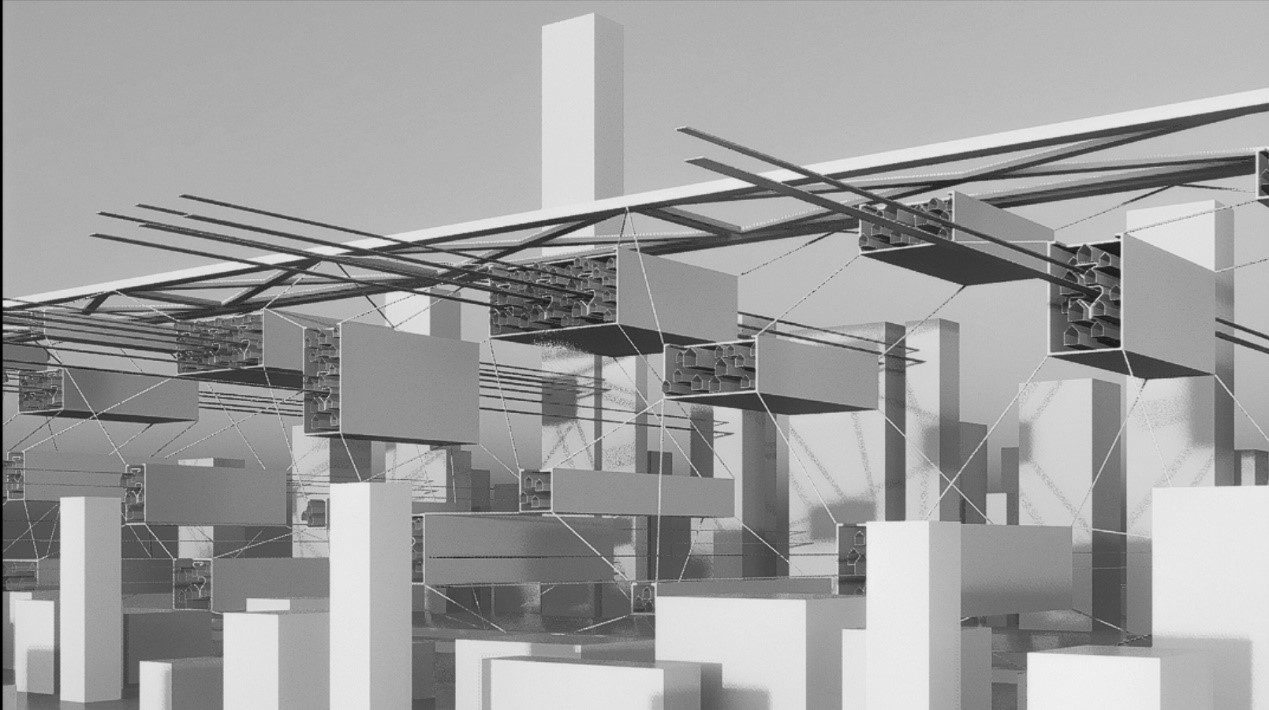
What does it take to win 1st Prize in a world-class architectural competition? Most think it’s just a “eureka” moment, but for the team behind Urban Intercropping, it was a journey through frustration, intense debates, and a radical rethinking of the skyscraper.
Today, we’re sharing a fascinating, behind-the-scenes look from the Architecture Competitions Yearbook at a project designed for Urumqi, China. Inspired by agricultural intercropping, this design doesn’t just build “tall”—it fills the urban gaps. From using parametric software to bridge sci-fi inspiration (think The Fifth Element) with real-world sustainability, the authors break down their entire workflow. They even share the “painful days” of brainstorming and how their MARS mentors pushed them to prioritize a high degree of finish over the trap of perfectionism. If you’ve ever felt stuck in a project, this is the reality check you need.
Design process for URBAN INTERCROPPING
Abstract:
The design aims to address urbanization challenges in Urumqi, Xinjiang, and other Central Asian cities. Inspired by the agricultural intercropping system, the design integrates this concept into urban planning by inserting architectural structures into the “gaps” of the city, creating a decentralized urban development model. By vertically integrating agricultural industries into high-rise buildings, space and resources are maximized. The design also incorporates ecological corridors and specific plantings to protect the environment, alleviate traffic, and address housing issues. The use of modular units and optimized structures enhances urban efficiency and sustainability.
Design Process:
In the early stages, our team focused on creating a skyscraper that connects with traditional architecture amidst a downturn in the construction industry. Recognizing that conventional skyscrapers contribute to urban challenges, our team aimed to develop a building that is functionally complex rather than simply tall or visually striking, to better support urban development.
The concept of agricultural intercropping—growing multiple crops in the same field to maximize space and resources—inspired our team to apply this idea to urban design. Instead of vertical expansion, the building horizontally extends across existing structures, filling in the gaps. This approach not only saves land but also diversifies building functions, addressing issues of underutilization in traditional high-rise buildings.

[picture_1] The initial concept diagram
Site Selection:
Our team chose Urumqi, the political, economic, and cultural center of Xinjiang, a region often overlooked compared to rapidly developing eastern Chinese cities. The design addresses issues such as inefficient resource use, poor living conditions, and limited agricultural land, offering a non-traditional skyscraper design that could benefit urbanization in both western China and Central Asia.
- Environmental Protection:
In western China, where deserts and harsh climates dominate, cities often expand at the expense of green spaces, which struggle to combat dust storms. The design incorporates vertical greening into the building facade through platforms and hanging plants, which not only purify the air and reduce the urban heat island effect but also shield the city from frequent dust storms.

[picture_2] Concept drawing by our team
- Water Resource Utilization:
Given the scarcity of rain in the region, water management is crucial. The design includes a system of rainwater-harvesting nets between buildings, composed of capillary tubes. These nets collect and filter rainwater for drinking during the wet season and provide shade or even artificial rain during dry periods.

[picture_3] The rendering image by our team
Multi-level Traffic Design:
Inspired by the flying cars navigating between building blocks in Luc Besson’s sci-fi film “The Fifth Element”, our team explored ways to elevate street traffic while ensuring adequate sunlight for living spaces. This approach aims to create more comfortable and affordable housing to accommodate growing urban populations.

[picture_4] The Fifth Element
- Vertical Living Spaces:
The design separates living units into two categories: human living spaces in well-lit areas, and spaces for crops and livestock in varying light conditions. This creates a self-sufficient building, where residents can enjoy organic food without leaving their homes, greatly enhancing convenience. The units are connected by escalators for accessibility, and ecological corridors link the buildings, with adjustable membranes to regulate temperature and create habitats for wildlife.

[picture_5] The rendering image by our team
- High-rise Building Retrofits:
Research showed that skyscraper usage decreases with height, so the design introduces ecological corridors at strategic levels to reconnect floors, effectively “breaking” the skyscraper into smaller,more functional segments. This significantly improves overall building utilization.
 [picture_6] The mapping diagram
- Urban Development Paradigm:
Our team emphasized the generalizability of this approach. The buildings are fully designed using parametric software, allowing the system to adapt to various urban environments while maintaining consistent design logic. This creates a new paradigm for anti-skyscraper urban development, addressing a broader range of urban challenges.

[picture_7] Urban Development Paradigm
- Design workflows and methodologies:
The introduction of the workflow and methodology is generally consistent with most of the participants, including the three major categories of scheme, modeling and drawing. Perhaps different designers have different working habits and specialties, but from our team’s point of view, they are actually very similar. However, since we have participated in many competitions before, this first prize is also closely related to our previous competitions. Winning a world-class architectural competition may be a kind of reward for effort, but winning the first prize in a world-class architectural competition must be a recognition of the cognitive level, so after winning the prize, I also thought about what is the cognitive level behind this experience. In the end, I concluded that there were only two things that contributed to winning the first prize. The first was that the various parts of the design process overlapped and drove each other forward, for example, using modeling to promote concepts, and attempting to render compositions to promote modeling, which created a chemical reaction between the various parts of the process, and in fact, strengthened the integrity of the workflow. The second aspect is that under the guidance of our MARS mentors, we have always adhered to three main principles, namely 1) clever concepts, 2) high degree of finish, and 3) eye-catching renderings. Under the guidance of these two major aspects, our progress was well organized and the finished results were inspiring. I will explain these two aspects in more detail below.
Many participants may spend more time on concepts and plans, thinking that the core of an architectural concept competition is the plan, and therefore neglecting the importance of modeling and drawing. In fact, everything is too much, especially when it comes to conceptual competitions, which are closer to artistic creations. Almost half of our team’s overall time was devoted to the definition of the proposal, but the teachers of the MARS team didn’t just discuss the ‘concepts’ on paper, instead, every time we discussed the proposal directly through modeling, every team member’s proposal discussion was at least based on a sketch, and the sketch was not an over-simplified, scribbly one. In fact, we can even achieve half of the progress of the final detailed model in the preliminary sketch. That is to say, our ‘over-emphasis’ on proposals and concepts in the early stage has a basic principle of high expressiveness, high communication, and ease of presentation, because my team members and the MARS team mentors have a common understanding of a competition entry that reaches the award-winning level, and it generally contains three major elements: firstly, a clever and eye-catching concept; secondly, a high degree of completion; and thirdly, a high level of quality. So we try to find ways to ensure these three things at the very beginning.
For the first point, we all know that we are more likely to refine a really clever concept by using the model directly to express and refine our concept. For the second point, given the time constraints, the high level of completion dictated that we could not strive for the ultimate in all aspects and that there should be some trade-offs, but fortunately my group members and the MARS tutors all did their part and worked diligently to complete their part of the task. For the third point, the graphic representation is obviously crucial to the final result, so all the members also reserved nearly 10 days for the rendering of the rendering, which was mainly done by An Jiang, and through various attempts over nearly 7 days, the final result was achieved to the satisfaction of every member of the group.
In essence, when each part of these three points was completed, we obviously produced a high degree of recognition of it, especially when the rendering was completed, we all felt sure that we could win the prize, we just didn’t expect that we could really get the first prize, maybe this is also because our perception of the two aspects of the conceptual architectural competition was correct. Below is a more detailed account of the workload and some of the details of the work process.
In the pre-design stage, our team collected images on pinterest that opened up people’s eyes, and we also collated the winning entries of the Evolo competition in recent years. We summarized and refined the typography of the previous years’ competition entries, and made the first draft of the competition drawings in the early stage, which also improved our efficiency when we started to draw the analysis diagrams after building the model.
In many competitions, we have found that our team members often disagree with each other during the discussion, and a lot of time is wasted on unnecessary topics. In order to make the discussion more efficient, we turned the traditional face-to-face discussion into an online workflow where we could share and edit ideas with colleagues on the platform, so that the discussion was not disordered due to the large number of people in the group, and we could edit and organize our own design concepts and ideas, and then sort them out one by one in order according to the group leader. After we have edited and structured our design concepts and ideas, we reported them one by one according to the order of the group leader, so that everyone’s views could be well presented, and the views of the group members could also collide with each other for more targeted expansion.
Below is a screenshot of our brainstorming session on the Fabrie website, which greatly improved the efficiency of our discussion:

[picture_8] Collaboration platform
We have made a review and summary of this competition in order to make the whole process relatively smooth. In fact, the most practical workload should be can be divided into the following six steps:
- initial brainstorming
- Targeted expansion of concepts
- Sketching
- Sketch modeling
- Model refinement
- Analysis + rendering drawing and layout
The initial brainstorming was mainly an online organization of cases and some reference images, and some literature going through the process, which allowed us to deepen more parts of the competition theme than a purely formal design. This was mainly done on the Fabrie website.
What is the concept of targeted expansion? Our group members certainly each had one or two ideas in the preliminary discussion, and these ideas were relatively scattered. So the first thing we did after the brainstorming was to classify the ideas and concepts of the group members into similarity categories, and then make side-by-side comparisons, and choose one or two concepts that are the most innovative and easier to deepen down to sketching and modeling as the main design concepts in the end.
Sketch drawing and sketch modeling can be generally carried out at the same time, so that timely changes can be made to the design to see how the overall effect of our design complement each other. The main software used for modeling is rhino and grasshopper.
The process of adjusting the sketch and the sketch is shown in the figure below:


[picture_9] Sketch and mold adjustment process based on Rhino and Grasshopper
A sketch of the design process is shown below:


[picture_10] Rough drawings
The drawing process of the analysis diagram fell mainly in the first month of the New Year holiday and the first month of the school year, so the time was relatively tight. We all come from different schools, so before the year through the online Tencent meeting we made a good division of labor for each piece of the drawings, and set a date for our team members to submit the final date earlier than the competition, which can be convenient to check the drawings of the problem at the same time also easy to modify. The analyzed drawing was mainly made by rhino exporting the base drawing and then designing in Photoshop. The rendering was mainly achieved through Vray combined with Photoshop workflow.
The drawing planning before using Vray rendering is as follows:


[picture_11] Sketch for pre-rendering out planning
The rendering process was also full of choices and stumbles, and in the end we chose the real-life compositing method for the post-production of the rendering, which was mainly done by An Jiang.

[picture_12] Rough drawing Vray rendering of the main effect
Below is the post photoshop process, which we will illustrate with a process diagram.


[picture_13] Post Phototshop Process
Key points:
- No matter what, we can only get clever concepts if we keep on pushing.
In the face of the eVolo Architecture Competition, all of us in the design team were filled with a sense of confusion in the early stage of the process. Although there were four or five preliminary proposals and even modeling, we were not confident in them. Even the three mentors from MARS were at their wits’ end during the brainstorming process. It was a time of frustration and bickering, even questioning the new solutions proposed by the MARS mentors. I remember the painful feeling of those difficult days.
From time to time, the MARS mentors would tell us, ‘The more difficult and even quarrelsome a design team is in the early stages, the more likely it is to produce outstanding work, and the probability of winning an award will be high.’ In fact, we didn’t take it seriously at the time, we just thought that they were comforting us.
It’s only in retrospect that we really realize that no matter what perseverance really is the gist of a design process. And something crucial as I learnt on this project.
- Completion is important
Anyway, after the pain of the conceptualisation stage, you don’t need to do too much ‘thinking’, ‘dwelling’ and so on, you should do your best to ensure the completion of the work, and present a complete work as far as possible, rather than a perfect work. It is wrong to pursue perfection in the design process, as perfection is often achieved in the pursuit of completeness, not in the pursuit of perfection, which is good for our physical and mental health. Even this point was a key point for us to be able to win the first prize.
Just like China’s ’Journey to the West’, I have always believed in the saying, ‘Embarking on the path to fetch the scriptures is always more important than getting the real scriptures.’ In our endeavor to pursue completion, and also with the help of teacher Jimmy Li、Shiliang Wang and An Jiang’s group members, we really got the first prize, which, in a way, is reaching a state of perfection that is unattainable.


Authors: Penghao Zhao, Hanyu Sun, Sinuo Jia, Jingxuan Li, Songping Jing, Yibo Gao, YuJie Zeng, An Jiang

Feeling inspired to tackle your next big challenge?
The “Urban Intercropping” workflow is a perfect example of the high-level cognitive thinking we celebrate in the Architecture Competitions Yearbook 2025. This article is part of our curated collection of the year’s most groundbreaking work, including full process diagrams, technical sketches, and professional insights. Keep this resource on your desk to remind yourself that the path to a winning project is rarely a straight line—but it’s always worth the journey.
Architecture Competitions Yearbook
The post High-Stakes Design: The “Intercropping” Strategy That Won eVolo appeared first on Competitions.archi.