

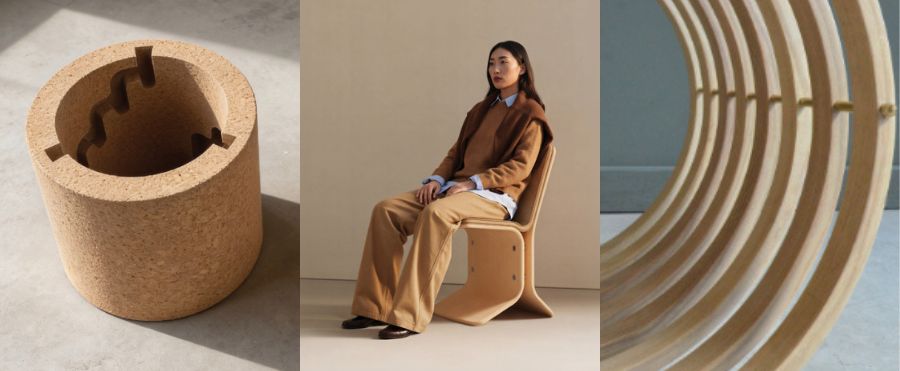
Buildner announces the results of The Architect’s Chair #5 competition, an international design challenge exploring the chair as a fusion of architecture, materiality, and human experience.
his year’s competition attracted an exceptionally diverse range of submissions, reflecting the enduring relevance of the chair as both a functional object and a powerful design statement. Across the entries, participants explored a broad spectrum of approaches, from highly minimal and structurally efficient solutions to more expressive designs rooted in cultural references, material experimentation, and sculptural form. Many projects demonstrated a strong understanding of how furniture can operate at the intersection of architecture and product design, where proportion, joinery, structure, and tactile experience become equally important.
Material exploration emerged as a particularly strong theme throughout this edition. Designers worked with wood, bent veneer, cork, woven fibers, leather, and hybrid material systems, often using material behavior as a central driver of form and construction. Several proposals focused on reducing complexity through simplified assembly systems, visible joinery, and modular construction strategies that emphasized repairability, flat-pack efficiency, and long-term sustainability. Others drew inspiration from vernacular craft traditions, translating historical references and local construction methods into contemporary furniture pieces with strong visual identity and cultural depth.
The jury particularly appreciated projects that successfully balanced conceptual ambition with technical resolution. The most compelling entries demonstrated not only strong visual presence, but also a convincing understanding of ergonomics, manufacturability, structural logic, and long-term usability. Across the submissions, it was clear that the strongest chairs were those in which formal clarity, comfort, material intelligence, and construction logic worked together seamlessly.
The Architect’s Chair #5 once again highlighted the chair as a uniquely challenging design object, requiring precision, restraint, and a deep understanding of both human use and material behavior. This year’s submissions demonstrated an impressive range of ideas and design approaches, reaffirming the chair’s continued importance as a vehicle for innovation, craftsmanship, and architectural thinking.

The first prize was awarded to Oscar John Xavier Lahiff (Hong Kong) for Helical, an adjustable stool defined by a cork monolithic form and an innovative internal helical mechanism that enables height adjustment without conventional hardware, emphasizing simplicity, sustainability, and material honesty. The second prize went to Marcus Hannibal Sigvardt (USA) for Cantilever, a refined reinterpretation of the cantilever chair using two bent veneer shells that balance structural clarity, comfort, and efficient flat-pack construction. The third prize was awarded to Sunmin Kim (South Korea) for La Chair, which combines a timber frame with a suspended vegetable leather seat, drawing on traditional Korean architectural principles and highlighting repairability, modularity, and material contrast.
1st Place
Helical
Oscar John Xavier Lahiff
Hong Kong

JURY FEEDBACK summary
“Helical” proposes an adjustable stool that reduces seating to its most essential components: form, material, and mechanism. Built around a cylindrical monolithic geometry, the project uses an internal helical interlocking system to allow manual height adjustment without relying on conventional hardware, gas lifts, or complex mechanical systems. Instead, the stool operates through a simple rotational movement, revealing a carefully integrated logic of grooves, friction, and alignment. Cork serves as the primary material, giving the object a warm tactile quality while reinforcing the project’s emphasis on sustainability, material honesty, and recyclability. The design balances utility with sculptural clarity, maintaining a consistent visual identity across all height positions. Through its restrained formal language and thoughtful mechanical simplicity, the proposal presents a furniture piece that is quiet, intuitive, and grounded in both functional efficiency and material sensitivity.
2nd Place
Cantilever chair
Marcus Hannibal Sigvardt
United States

JURY FEEDBACK summary
“Cantilever” explores the classic cantilever chair typology through a refined and highly reduced formal language. The design is composed of two primary bent veneer shell elements—seat/back and base—connected through a minimal set of structural fasteners and spacers that create both visual lightness and structural stability. The chair balances sculptural clarity with functional comfort, using soft curves, thin profiles, and subtle cushioning to create an object that feels both architectural and approachable. Particular attention is given to manufacturability, transport efficiency, and long-term usability, with the design broken into a limited number of components suitable for flat-packing and efficient assembly. Through its careful balance of ergonomics, material efficiency, and structural simplicity, the project presents a contemporary interpretation of seating that is equally suited to residential, commercial, and institutional environments.
3rd Place
La Chair
Sunmin Kim
South Korea

JURY FEEDBACK summary
La Chair explores the relationship between frame, suspension, and material contrast through a deliberately reduced architectural language. Drawing from traditional Korean architectural principles, the design is organized around a rigid timber structure paired with a suspended vegetable leather seat, creating a clear dialogue between solid and flexible elements. The chair relies on a minimal palette of materials, white oak and leather, with the seat functioning as both structural and comfort element. Its construction emphasizes visible joinery, modular assembly, and the ability to disassemble or replace components, reinforcing themes of repairability and longevity. Through the interplay of orthogonal timber members and the softer suspended seat, the project creates a chair with strong visual clarity, material warmth, and a distinct structural identity.
Buildner Student Award
Jige Chair
Cho Hyuna, Hyunwoo Ha
South Korea

JURY FEEDBACK summary
The Jige Chair draws from the structural logic and visual language of the traditional Korean jige, reinterpreting this vernacular carrying tool as a contemporary seating object. The design translates the original object’s distinctive tripod-like stability, diagonal bracing, and structural efficiency into a chair defined by lightness, openness, and material restraint. Built from a minimal set of wooden elements with a woven seat surface, the chair balances structural clarity with visual softness, combining curved and linear geometries to create a calm but distinctive presence. Traditional craft techniques, particularly the woven seating surface, introduce warmth and tactile richness while reinforcing the project’s cultural grounding. By merging vernacular references with a refined contemporary aesthetic, the chair develops a strong identity rooted equally in craftsmanship, structural expression, and functional simplicity.
Buildner Sustainability Award
Anastasia
Clay Anthony Te Bokkel
Canada

“I enjoy architecture competitions because they offer a chance to explore ideas in a focused and playful way. I was drawn to the smaller scale and the conceptual challenge of this competition, which was an opportunity to engage in something specific and bespoke. I see competitions as a great way to explore my own processes, refine skills, and improve how clearly I can represent ideas. They are a valuable way to keep learning, experimenting, and growing as a designer.”
_________________________________________
JURY FEEDBACK summary
“Anastasia” reinterprets a lounge chair through a highly reduced geometric language, combining bent wood elements with a live-edge slab backrest to create a piece that balances structural rhythm and material contrast. The chair is constructed from repeated curved slats that form the seat and base, generating both visual lightness and ergonomic support through their continuous loop geometry. This repetitive structure is paired with a singular vertical back element, creating a clear dialogue between fluid curvature and planar solidity. Material selection plays a central role in the project, with the use of Emerald Ash Borer-affected ash introducing both a sustainability narrative and a distinct visual identity. The chair emphasizes simplicity of form, visible construction, and strong material expression, resulting in a piece that feels sculptural while maintaining a clear functional purpose.
HONORABLE MENTION
Passo Chair
Tommaso Ugolini, Alberto Luzardi
Italy

HONORABLE MENTION
Incline
Kaiwen Liu, Yuhe Wang
United States

HONORABLE MENTION
Arch Chair
Rachel Lapidot
Israel

HONORABLE MENTION
Telaio
Fabio Baldo
Portugal

HONORABLE MENTION
Otto
Muhammet Sami̇ Yeni̇
Turkey

HONORABLE MENTION
Weavy Weavy Weavy
Didier Alejandro Iriarte Fattel
Australia

SHORTLISTED PROJECTS

The post Results: The Architect’s Chair #5 appeared first on Competitions.archi.