

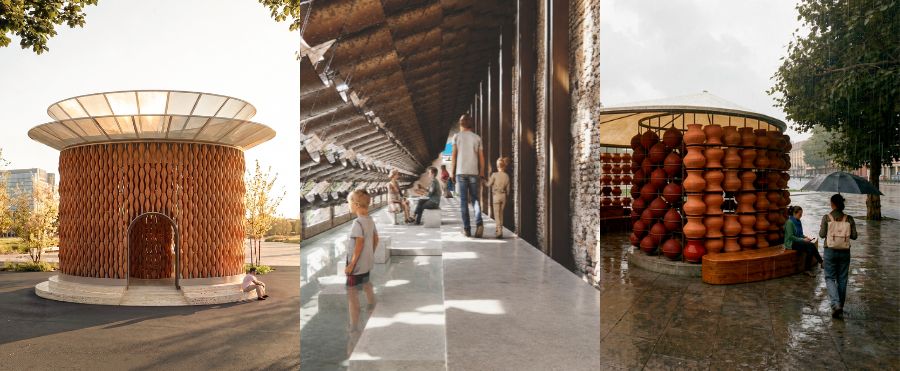
Buildner is pleased to announce the results of the Rome Rain Rooms architecture competition, an ideas challenge inviting architects and designers to reconsider one of Rome’s oldest relationships: that between the city and water.
For millennia, water has been fundamental to Rome’s identity, from its aqueducts and cisterns to the fountains, baths, courtyards, and gardens that made water part of civic life. Today, hotter summers, longer droughts, and increasingly intense storms create a new challenge: how might architecture transform rainfall from something quickly diverted away into a useful and celebrated urban resource?
The competition invited participants to design a small, reversible pavilion capable of collecting and storing at least 5 m³ of rainwater per storm, while making its journey through the architecture visible, audible, and engaging. Collected water could support nearby trees, planting, or other non-potable uses, while the pavilion itself was expected to provide shade, cooling, gathering, and reflection during both wet and dry conditions.

Participants could either respond to a specific location in Rome or propose a modular system adaptable across the city. The resulting submissions explored a broad range of relationships between water, public space, and Rome’s architectural heritage, frequently reinterpreting familiar elements such as domes, oculi, atriums, archaeological fragments, terracotta, roof tiles, and traditional water vessels through contemporary environmental design.
Across the competition, water itself emerged as an architectural material. Roofs became collection surfaces, while channels, vessels, pools, planting, and porous or suspended elements made rainfall perceptible through sound, movement, light, humidity, and touch. Many proposals also demonstrated how environmental performance could be achieved through relatively simple means, including gravity-fed irrigation, passive cooling, vegetation, reclaimed or locally familiar materials, and lightweight, reversible construction.
The strongest submissions went beyond rainwater collection to consider the pavilion as a genuine piece of civic space. They explored how an intervention activated dramatically during a storm could remain useful throughout Rome’s long dry periods as a shaded meeting place, garden, passage, or place of rest. At the same time, the competition highlighted the importance of balancing poetic ideas with credible solutions for storage, overflow, structure, maintenance, accessibility, and long-term durability.
The results suggest that even small interventions can combine environmental performance, historical awareness, material experimentation, and memorable public experience, continuing Rome’s centuries-old tradition of making water an integral part of urban life.
Buildner thanks all participants and jury members for their contributions to the competition and congratulates the awarded teams.
1st Place
Pluvia
Daniele Carlini
Italy

_________________________________________
Jury feedback summary
Pluvia proposes a circular rain pavilion that reinterprets the Roman tempietto and the atmospheric qualities of historic thermal spaces through a contemporary environmental system. Rainwater is captured by the broad roof, stored beneath the pavilion, and recirculated through a porous enclosure of 3D-printed terracotta modules. Drawing on the principle of graduation towers, water moves across the ceramic surface to encourage evaporation, producing cooling, humidity, sound, and changing patterns of light. Salt crystallisation gradually alters the terracotta itself, allowing weather and water to become visible through material transformation. A steel supporting structure and integrated hydraulic system make the pavilion demountable, while the stepped interior creates an intimate communal room centred on water and passive climatic comfort.
2nd Prize
Xylophone
Jun Ho Lee
United Kingdom

“Competitions give me the freedom to ask architectural questions before knowing what the final form should be. Rather than beginning with an image, I use competitions to investigate a brief, a place, and its particular conditions, and to search for an architectural response that could only emerge from them. The limited timeframe is also valuable: it forces an idea to become precise enough to be communicated through architecture rather than explanation. For me, a competition is therefore less an opportunity to produce an extraordinary object than a testing ground for architectural ideas.”
_________________________________________
Jury feedback summary
Xylophone transforms rain into an architectural event through a linear pavilion positioned alongside an existing archaeological wall in Rome. Rather than reconstructing a lost building, the proposal evokes its memory through a lightweight timber frame and a suspended field of reclaimed Roman roof tiles. The tiles are separated into two inclined layers, allowing rain to cascade rhythmically from one surface to the next before reaching a long reservoir below. This movement makes water simultaneously visible and audible, turning the pavilion into an instrument whose character changes with the weather. In dry conditions, the same fragmented roof filters sunlight and air to produce a shaded passage and gathering space. The intervention is conceived as reversible and deliberately restrained, using recovered material, water, light, and the existing wall to establish a dialogue between contemporary occupation and Rome’s archaeological fabric.
3rd Prize + Buildner Student Award
Channeling Amphorae
Mennaalla Mohamed Mostafa Soliman Abas; Rina Seida; Synnove Patricia Grao
Italy

“As students, we see competitions as a way to test our ideas beyond the academic environment. They push us to think critically, communicate clearly, and recognise both our strengths and weaknesses. More than winning, they are a chance to learn, experiment, and gradually develop our own architectural voice.”
_________________________________________
Jury feedback summary
Channeling Amphorae reinterprets one of Rome’s most recognizable material traditions – the terracotta vessel – as both the enclosure and environmental infrastructure of a small rain pavilion in Piazzale Flaminio. Hundreds of suspended amphorae form two curving walls around a sheltered central space, filtering sunlight while creating varying degrees of transparency and enclosure. Rainwater is captured by the lightweight roof, directed through perimeter channels and downpipes, and incorporated into a system intended to irrigate nearby trees. Different vessel geometries introduce an acoustic dimension, allowing visitors to interact with the amphorae and hear variations in resonance. The proposal therefore combines water collection, shade, evaporative cooling, sound, and a familiar Roman material into a pavilion conceived as a sensory refuge within a busy urban setting.
Buildner Sustainability Award
Romantic Dome
Lee Kwangmin; Sooyoung Shin; Jonghwa Hwang
South Korea

_________________________________________
Jury feedback summary
Romantic Dome transforms the familiar geometry of the Roman dome into a lightweight, planted pavilion conceived as a piece of collective urban infrastructure. A timber rib structure rises toward a central oculus, while tiers of planters made from reused containers create a living outer envelope. Rainwater remains deliberately visible as it moves down through the planting system by gravity, irrigating vegetation before excess water is collected in tanks integrated into the perimeter seating. Drawing simultaneously on the Pantheon and the Roman domestic atrium, the project shifts water collection from a private function into a shared civic experience. Its combination of planting, rain, shade, seating, and citizen participation proposes a pavilion that changes over time through both natural growth and the involvement of its users.
Honorable Mention
Pluvial Cloud
Yiyang Sang; Senmiao Yang
United States

“In everyday practice, we are constantly responding to schedules, codes, budgets, clients, and many practical requirements. Those constraints are important, but competitions give me a different kind of space — a chance to step outside of my daily work, ask questions again, experiment, and take risks with ideas that may not have an immediate place in a real project. For our team, competitions are not simply about winning. They are a way to keep myself curious. They remind us of why we became a designer in the first place: to imagine possibilities that do not exist yet, and to explore how architecture can turn those possibilities into reality.”
Honorable Mention
Rome Rain Rooms
Oskar Emmrich
Switzerland

Honorable Mention
A contemporary impluvium
Alexandra Maria Afrasinei; Andreea Elena Istrate
Italy

“Architecture competitions offer us a valuable space for experimentation, where research and design can come together around a specific place, question or programme. They allow us to investigate an idea through the act of designing, to test relationships between context, space, material and use, and to explore architectural possibilities. In this sense, the competition becomes not only a way of proposing a project, but also a way of thinking through architecture.”
Honorable Mention
Rain on Rain
Hongrun Che
Australia

“I have always been deeply fascinated by nature, its creativity, and human imagination, and I believe they are essential to finding meaning in life. I nurtured this curiosity during my university years while studying architecture, and it is something I definitely do not want to lose as I grow older and become more immersed in professional life. Architecture competitions are a form of continued learning that I intentionally chose after graduation. They give me the opportunity to keep imagining, experimenting, and exploring ideas freely—and to hold on to that sense of curiosity and creativity beyond everyday practice.”
Honorable Mention
Climate Veil
Kenji Kurt Schmidt; Chenyu Hu; Ayse Sirin Karoglu; Alara Başak Köse
Italy

“Most of us had not participated in an architecture competition before, but we had always been interested in the opportunity to explore architecture competitions. When this competition came up, we saw it as a valuable opportunity to challenge ourselves. Through the freedom of the competition and the many discussions within our group, we learned a lot about what we truly value in architecture. Looking back , the competition was therefore not only about producing a final proposal, but also about discovering and refining our own values as designers through experimentation, discussion, and collaboration.”
Honorable Mention
Specula Aquae
Simone Campora
Italy

“We participated in the Rome Rain Rooms competition following the recommendation of our Architectural Design Studio professor, Enrico Molteni, lecturer at the Department of Architecture and Design of the University of Genoa”.
SHORTLISTED PROJECTS

The post Results: Rome Rain Rooms appeared first on Competitions.archi.