

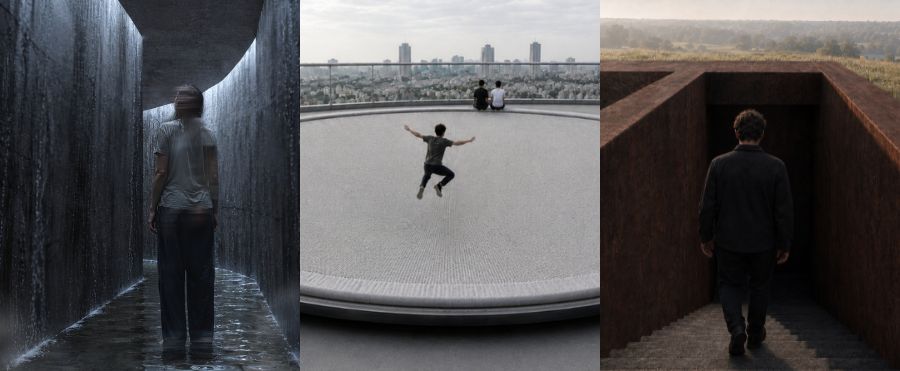
Buildner is pleased to announce the results of the Museum of Emotions Edition #8 competition, which invited participants to explore how architecture can generate contrasting emotional experiences through space
As a silent competition, submissions communicated entirely through visual material, asking participants to use scale, sequence, light, material and other architectural tools rather than written explanation to convey their ideas.
The submissions approached emotion through a wide variety of spatial strategies. Movement and sequence emerged as recurring themes, with transitions between openness and confinement, light and darkness, activity and stillness used to alter perception over time. Water, landscape, changing scale and physical interaction also became tools for establishing distinct atmospheres without relying on conventional museum displays or explanatory narratives.
Several projects explored a more direct relationship between contrasting emotions, allowing different experiences to coexist or influence one another rather than simply placing positive and negative spaces side by side. In other cases, familiar activities and environments gradually acquired different meanings through framing, enclosure and context. These approaches demonstrated how emotional response can develop through the visitor’s movement and interpretation rather than through a fixed architectural condition.

The jury also highlighted the importance of transitions, entrances and circulation in supporting these ideas. While strong imagery could establish an atmosphere immediately, the more developed proposals considered how visitors arrived, how conditions changed along a route, and how architectural elements supported the intended emotional progression. The silent format placed particular emphasis on this clarity, requiring drawings and images to communicate both the concept and spatial experience independently.
Across the results, the competition demonstrated how relatively simple architectural operations can produce complex responses when movement, environmental conditions and perception are considered together. The selected projects offer different interpretations of this relationship, showing how architecture can frame not only space, but also the way an experience changes as it unfolds.
1st Place + Buildner Student Award
The Loop Within
Tal Ben Barak; Salma Bsul
Israel

“Architecture competitions give us the freedom to explore ideas beyond the constraints of a conventional client or program. For The Loop Within, this meant exploring emotion and the cycle of human life through architecture — moving between openness and enclosure, light and darkness, joy, uncertainty, fear, and acceptance. Our collaboration was also an important part of the process. Coming from different cultural and religious backgrounds, we became interested not in emphasizing what separates us, but in exploring the experiences that ultimately make us alike. Competitions give us the freedom to test these ideas and develop our own architectural voice.”
_________________________________________
Jury feedback summary
The project is organized as a continuous circular route that connects two contrasting spatial conditions through water. At landscape level, a shallow open channel forms an accessible path through a planted field, while the route gradually descends into a darker, enclosed space where water falls from above and the relationship with the exterior is reduced. The same architectural element therefore shifts between an exposed landscape condition and a confined interior one, using changes in light, enclosure, temperature, sound, water and movement to establish the two emotional environments.
2nd Prize
The Weight of Joy
Karim Hamed
Egypt

“I participate in architecture competitions to see a wide range of projects and ideas from diverse environments and to explore ways to use these ideas to help my community. They are also an opportunity to test myself in front of people who are recognized for their excellence and leadership in the field.
_________________________________________
Jury feedback summary
The project divides the museum vertically between an open rooftop environment and an enclosed space below, with a large circular trampoline forming the physical interface between them. The upper level is exposed to the skyline and accommodates jumping and recreational activity, while the lower level is dark and largely without external views. Movement on the trampoline deforms the membrane overhead and becomes visible from the space below, creating a direct relationship between the activity of visitors in the two environments and allowing one person’s movement to alter another person’s spatial experience.
3rd Prize
The Weight of Pleasure
Kim Sunbin; Jung Hwanseok
South Korea

“We love taking on new challenges. Since architecture reaches into every part of how people live, we don’t want to stay within one field. That’s why we enter competitions on all kinds of themes and face questions we rarely come across in our everyday work. The Museum of Emotions was a completely new challenge for us. With no text allowed, only images, it gave us the opportunity to test whether space alone could convey an emotion.”
_________________________________________
Jury feedback summary
The project places a linear dining environment within a pastoral landscape occupied by grazing cattle, with most of the architecture embedded below the surrounding field. Visitors approach through a narrow descending passage before entering a dark interior organized around a long communal table and a large opening toward the landscape. The exterior remains visually continuous with the agricultural setting, while the interior frames diners, food and cattle within the same view, using the relationship between the act of eating and the animals outside as the basis for the project’s emotional contrast.
Honorable Mention
Blow it up!
Luis Johannes Meyer; Angela Bianca Ballheimer; Sophie Maria Rodriguez Schurer
Austria

“We participate in competitions because none of us had much experience with the competition process before, and we wanted to experience it for ourselves. We like that competitions create a very specific working environment: there is a clear task, a fixed deadline and a set of constraints. At the same time, there is a lot of freedom in how you approach the problem and develop your own idea. Of course, the competitive aspect is part of the attraction. But we are equally interested in the process itself and in seeing how far we can develop an idea within a limited amount of time. For us, it is also a way to test different ways of working together and to see how we can turn an initial idea into a coherent architectural proposal.”
Honorable Mention
The Weight of Joy
Kunnapat Wongthavornman; Lonsai Kangkhao
Thailand

“Exploring design apart from our everyday context is what drives us to take on these challenges. Competitions offer a unique opportunity to step outside our conventional routine and break free from familiar design habits, while creating an architectural conversation among societies. Beyond sharpening our problem-solving skills, they push us to engage with architecture through a boundaryless, global lens.”
Honorable Mention
2×2
Sahar Hakimpour; Lhanzi Gyaltsan; Khadija Waheed
Canada

“After graduating and starting to work in architecture, competitions became a creative outlet that we missed from school. In practice, there are often project constraints and deadlines that shape how you approach design, whereas competitions give us a chance to step back and explore ideas more freely. We see them as an opportunity to keep challenging ourselves, try different approaches, and continue developing our creativity and skills as designers.”
Honorable Mention
Tides of Mind
Brandon Ong Hing
United States

Honorable Mention
Toward
Jung Sungbeen
South Korea

“I participate in competition because I learn a lot from seeing how others respond to the same brief. After working through the same challenge myself, I learn a lot from studying the winning entries”
Honorable Mention
Lunar Euphoria
Mahmoud Mohamed Ahmed Faris; Hamza Abdelwahab; Mohamed Abdelgawad
Egypt

“The competitive intensity gives our creative energy focus and pushes us to question what we believe we are capable of. It encourages us to challenge our first ideas, test unfamiliar approaches, and keep developing a proposal beyond the point where we might otherwise stop. Working through that process together often reveals limits in our thinking that we had not recognised, and possibilities we would not have discovered without the challenge.”
SHORTLISTED PROJECTS

The post Results: Museum of Emotions #8 appeared first on Competitions.archi.