

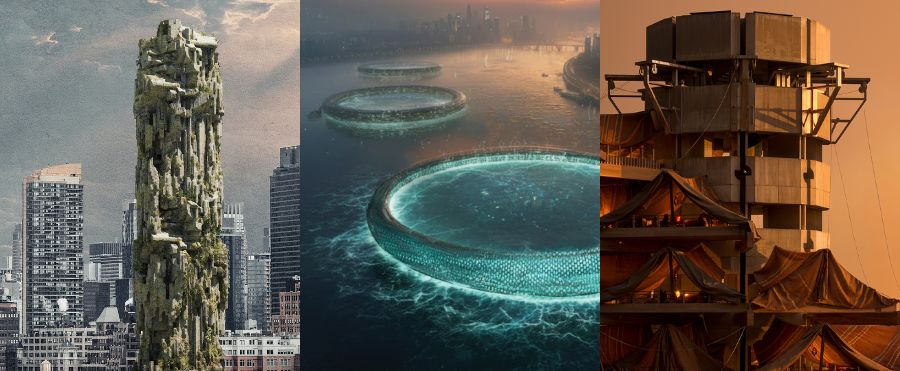
eVolo Magazine is pleased to announce the winners of the 2025 Skyscraper Competition. The Jury selected 3 winners and 14 honorable mentions from 149 projects received. The annual award established in 2006 recognizes visionary ideas that through the novel use of technology, materials, programs, aesthetics, and spatial organizations, challenge the way we understand vertical architecture and its relationship with the natural and built environments.
The FIRST PLACE was awarded to Changsi Wang from the United States for the project THE LIVING REFUGE– a skyscraper in Manhattan designed as a habitat for humans and endangered pollinators.
The recipients of the SECOND PLACE are Nasim Bakhshinejad, Sheida Ghelichkhany, Alireza Agah, Negar Hashemol Hosseini, Fatemeh Peysepar, and Fatemeh Malemir from Canada, Italy, and UAE for their project MICROBIOME SWARM NET, which imagines an aquatic skyscraper designed to clean microplastics from oceans.
The THIRD PLACE was awarded to Danny Elachi Elsaadi and Dima Elachi Elsaadi from Saudi Arabia for their project THE RETURN– a skyscraper conceived as an open structure with amenities for nomad Bedouin communities.
The Jury was formed by Nici Long [Co-Founder, Cave Urban], Davide Macullo [Director, Davide Macullo Architects], Juan Pablo Pinto [Co-Founder, Cave Urban], Wenyuan Peng [Director, Yuan Architects], and Leonid Slonimskiy [Director, Kosmos Architects].

1st Prize
The Living Refuge: A Symbiotic Sanctuary For Humans And The Vanishing Pollinators
Changsi Wang
United States


The Living Refuge addresses one of the most urgent ecological crises in dense urban environments: the accelerating endangerment of pollinator species. In Manhattan—where habitat fragmentation, chemical exposure, and extreme urbanization sharply amplify this decline—the project reframes the skyscraper as a vertical ecological, scientific, and educational infrastructure. The proposal operates through three integrated strategies: restoring habitat, advancing scientific knowledge, and raising public awareness.
REGENERATIVE POLLINATOR HABITAT SYSTEM
The first goal of The Living Refuge is to reconstruct stable, continuous habitats for pollinators high above the chemical-treated and fragmented ground plane of Manhattan. The 3D-printed façade becomes a vertical ecological landscape. A dual-material system—composed of a structural mix and an ecological mix—is deposited by a mobile robotic printing arm operating along vertical rails and horizontal truss tracks.
The complex façade geometry forms ecological pockets that retain moisture, accumulate organic matter, and slow air movement. These microclimates become vegetation colonization hotspots, allowing pioneer species such as mosses, lichens, and fungi to establish. As vegetation grows, reduced wind speeds support pollinator landing, foraging, and nesting. Small façade openings allow pollinators to move freely between nectar-rich exterior vegetation zones and the tree-stump–like interior cavities of the pollinator habitat system, whose 3D-printed geometries replicate natural hollow stump nests ideal for larval development.
Separated from chemical pollutants and supported by stable microclimates, the skyscraper transforms into a protected vertical sanctuary where plants, microorganisms, and pollinators can gradually colonize and co-evolve.
SCIENTIFIC OBSERVATION & DATA COLLECTION SYSTEM
A second core objective is to address the global shortage of primary scientific data on pollinators. Compared to mammals or birds, pollinator species remain understudied largely because reliable, real-time field observations are extremely difficult to obtain.
To counter this, the tower integrates an internal scientific observation and data collection system. Infrared cameras, temperature–humidity sensors, and other monitoring devices allow researchers to study pollinators directly within the ecological façade. One-way observation glass enables non-intrusive viewing of nesting behavior, foraging cycles, and larval development. Environmental conditions can be adjusted based on collected data, allowing scientists to actively maintain ecological stability while generating unprecedented, high-resolution records of urban pollinator life.
The building thus operates as a research institution embedded within a living ecosystem, turning the skyscraper into a continuous generator of primary ecological knowledge.
PUBLIC EXHIBITION & AWARENESS SYSTEM
A third critical issue is the lack of public awareness surrounding the pollinator crisis. Most urban residents have limited understanding of pollinators, their ecological roles, and the severity of their decline. This knowledge gap contributes directly to the worsening crisis.
To confront this, the tower incorporates a public exhibition system, functioning as a vertical natural history museum. Visitors experience live pollinator activity through observation chambers, transparent ecological corridors, and curated displays explaining how extinction risks threaten global food systems and biodiversity. By providing real-time, visceral encounters with pollinators, the building fosters public empathy, awareness, and long-term engagement in conservation efforts.
Through education, transparency, and immersive ecological storytelling, the skyscraper becomes a civic platform for environmental literacy.
ECOLOGICAL COLONIZATION & SYMBIOSIS
In its mature state, The Living Refuge becomes a site of ecological colonization and symbiosis. Vegetation takes root across the façade, microorganisms enrich the substrate, and pollinators occupy the interior cavities—forming a dynamic, evolving network of habitats. Positioned far above pesticide exposure and insulated from ground-level habitat fragmentation, the skyscraper operates as a regenerative ecological engine for Manhattan.
By merging construction technology, habitat formation, scientific research, and public education, The Living Refuge imagines a future where architecture actively repairs, supports, and regenerates the ecological systems.
2nd Prize
Microbiome Swarm Net
Nasim Bakhshinejad, Sheida Ghelichkhany, Alireza Agah, Negar Hashemol Hosseini, Fatemeh Peysepar, Fatemeh Malemir
Canada, Italy, United Arab Emirates


In an era when the boundary between matter and data has blurred, particles smaller than our imagination can conceive are quietly shaping and eroding the future. Nanoparticles, resulting from the coexistence of humans and machines, now permeate every layer of life: in the air, water, soil, and even within the human body. This crisis does not arise from scarcity but rather from an excess of artificial presence. Urban rivers are currently facing a growing environmental crisis. Microplastic pollution, once too small to see and easy to overlook, has infiltrated every part of aquatic life, damaging ecosystems in ways that modern cities are unprepared to address. Guangzhou, home to one of the most polluted rivers in Asia, now stands at a critical intersection of urban expansion, industrial history, and ecological decline. Here, microscopic plastic fragments travel freely through the water, evading conventional filtering systems. These particles do not decompose, and with every rainfall wave and river flow, they infiltrate deeper into the ecosystems that sustain both human and non-human life.
The project begins with a fundamental question: Can architecture function like a living organism, capable of sensing, responding to, and actively combating microplastic pollution? To explore this idea, we studied microbiomes, biofilms, and the collective behavior of Bacteria. In nature, bacteria have remarkable swarm-like intelligence. They move toward polluted areas, gather together, multiply rapidly, and enhance their metabolic degradation of these pollutants. This adaptive intelligence became the conceptual foundation for our proposal: an architecture that acts not as a mechanical machine, but as a living filter.
The system consists of three main architectural and biological concepts. The first is an external layer resembling dragon scales, inspired by Chinese symbolism and natural protective surfaces. This textured layer slows the river’s flow, creating soft whirlpools, directing particles toward the interior, and increasing contact between the water and the filtration layers. It functions like a sensitive outer membrane that feels alive.
Inside its protective shells, spiral rings create a complex pathway for water. This unique geometry increases the time the water spends in contact with microplastic particles and the system’s active layers. The spiral motion emulates natural filtration processes seen in shells, ocean currents, and vortex patterns, transforming the chaotic movement of the river into a more organized and efficient cleaning cycle.
At the center of the system lies an intelligent bacterial nano-net: a fine, adaptable mesh woven between the spiral rings. Acting like a living fabric, it traps microplastics that pass through it while hosting colonies of degradative bacteria that form biofilms over time. These colonies amplify their activity in areas with the highest pollution concentration, following the logic of swarm behavior. As they metabolize plastic particles, their biochemical processes produce a soft green-blue bioluminescence, an organic signal indicating the zones where the architecture is actively purifying the water.
Overall, the project does not represent a skyscraper in the traditional sense; it is an underwater organ of purification, a structure that breathes in rhythm with the river. Drawing from microbiome science, biomimicry, Chinese cultural motifs, and material innovation, it addresses one of the most urgent yet overlooked environmental threats of our time. More than a singular intervention, it provides a replicable model for global cities facing similar crises, an architecture that adapts, senses, and collaborates with nature in the ongoing battle against microplastic pollution.
3rd Prize
The Return: Reclaiming The Right To Move
Danny Elachi Elsaadi, Dima Elachi Elsaadi
Saudi Arabia


For centuries, Bedouin communities shaped their lives through a deliberate rhythm of movement. Seasonal routes, shared stopping points, and portable dwellings formed a refined spatial system grounded in environmental knowledge and reinforced through oral tradition and craft. Mobility organized social life around cooperation, hospitality, and mutual responsibility, an intentional and adaptive way of inhabiting the land, never a product of limitation.
Today, the spatial conditions that once sustained this worldview have been largely erased. Fixed borders, land ownership, and permanent settlement have rendered nomadic routes almost invisible and stripped historic stopping points of recognition. Yet the Bedouin ethos persists in poetry, hospitality, craftsmanship, and tents still raised during gatherings and seasonal rituals. What threatens is not cultural irrelevance, but the spatial framework that once allowed it to be lived.
What stands to be lost is not only a dwelling tradition, but a knowledge system, ecological intelligence, resource-light construction, oral memory, and a social ethic rooted in dignity and hospitality. These rely on cycles of gathering and returning; without spatial conditions that support them, a living culture risks becoming static heritage.
The Return proposes a territorial system that restores mobility’s place within the contemporary landscape. Permanent anchors placed along historic routes acknowledge a mobile people, reinstating a network long absent from contemporary mapping. When families arrive, temporary tent towers rise around these anchors, enabling communal life, ritual, and craft to reassemble before dissolving as the community departs. The tower consolidates shared services, energy, water routing, and essential support, introducing a level of mobile infrastructure never before available to nomadic communities while preserving the transient character of settlement. It sustains a culture that appears, gathers, and returns.
The spatial logic unfolds through four states of activation.
First, “Mapping the Routes” presents the desert as a network defined by historic movement, with anchors re-establishing former stopping points as recognized elements of the landscape.
Second, “Arrival at the Anchor” activates each site for temporary use, providing orientation and initiating community assembly.
Third, “Community Assembly” expresses the proposal’s core principle: the architecture is intentionally incomplete without the people who activate it. Through coordinated construction, the tower gains form and meaning.
Finally, “Temporary Settlement” describes the tower in its inhabited state, a reversible vertical camp for gathering, activity, and ritual. When the community departs, the structures are removed, the land resets, and the anchor returns to latency.
The architectural form draws directly from Arabian Bedouin tent typologies defined by pole count, from single-pole shelters to eight-pole communal structures. Translating this heritage vertically required a geometry capable of accommodating different family scales while preserving cultural clarity. A radial system provided this adaptability: beams extend from a central core to support tent modules. The initial circular geometry evolved into a hexagon to align with straight modular platforms while retaining the radial logic. Families select between one and eight platforms, mirroring the expansion logic of pole-based tents; each platform attaches to two dedicated beams, allowing households to assemble only what they need while maintaining modular integrity.
The tower is built entirely by hand through a passive mechanical system: carefully engineered slots receive the beams, pulleys lift them, and each beam rotates into a specially designed geometric lock that secures it without hardware. Platforms and rails follow the same tool-free logic, allowing the tower to be erected, inhabited, and dismantled without machinery.
The Return offers an architectural framework through which Bedouin culture can remain legible and enduring, an infrastructure that restores mobility to visibility and supports a people whose identity is rooted in the cycle of appearing, inhabiting, and returning.
Honorable Mention
Golmok-gil Sky Commons: Reconnecting The Hyper-Individualized Society
Daeun Kang, Dongwook Han, Sign Jeong
South Korea


Honorable Mention
Nebkha Skyscraper
Amirsadra Seddighigildeh, Aria Kakavand, Iman Haji Abolghasemi, Isun Ranjpourazarian, Navid Kakavand, Sahar Safardoost
Italy


Honorable Mention
Icarus: Artificial Eclipse – Distributed Vertical Swarm Architecture For Climate Scale Cooling
Golnoosh Darziramandi, Alireza Agah, Ali Jamali, Hosein Amery, Hosein Mosavi, Mohsen Bokaei
Canada, Germany, United Arab Emirates, United States


Honorable Mention
The Landfill-Scraper
Kim Kyungmin, Hong Yewon, Lee Byeonghyeon
South Korea


Honorable Mention
The Celestial Forge
Maria Murokh, Daria Bondarchuk
Russia


Honorable Mention
Ascending Archive
Yuyi Shen, Ingrid Liu
United States


Honorable Mention
Mechanical Reforestation
Seonggeon Lee, Inseo Park, Yuran Jo, Beomseok Go, Seungeon Kim, Wonsup Lim
South Korea


Honorable Mention
Riverborne Citadel
Nam Anh Nguyen, Gia Linh Pham, Cat Tuong Tran
Australia


Honorable Mention
The Regenerative Tower
Pardis Taji, Movahede Amirmijani, Milad Shahin, Niloufar Rezaei, Shahin Etminan, Mohsen Shabani Ravari, Amir Tahmoures
Italy


Honorable Mention
The Detritus Engine
Dorsa Shahim, Mohamad Mobin Yousefi, Rana Karimibavandpour, Abolfazl mahdavi, Fateme Sadat Hoseini, Samin Soleimani
Austria, Belgium, Canada, Estonia, Italy, Netherlands


Honorable Mention
The Missing Tree: Fire Ends Where This Tree Begins
Mohamed Noeman, AbdelRahman Badawy, Toka Hassan, Pierre Atef Ghattas Saweris, Mariam Ahmed Hassan Elkashatt, Toqa Mahmoud Lotfy Elkhazragi, Haneen Ali Sobhi Ali, Habiba Kamal Mahmoud, Salma Shehab Mohey El-din, Sama Hazem Ragab
Egypt


Honorable Mention
Neo-Ark Skyscraper
Jiaying Gao, Junda Lu, Chenhao Lin, Anqi Cai, Huiyang Zhong, Weikeke Feng, Yuhang Zheng, Yuanchuan Yang
China


Honorable Mention
Project Selene: Lunar City
Zheyi Yang, Zhao Zhou, Jieying Luo, Yuxin Gu, Jinglei Xu
China


Honorable Mention
Slope-Rise: An Alternative Tower Typology On Sloped Terrains
Calvin Ho Sze Yin
Hong Kong


VISIT ORGANIZER’S WEBSITE

The post Results: 2025 Skyscraper Competition appeared first on Competitions.archi.