

Buildner is pleased to announce the results of the Kinderspace Edition #3 competition, an international design challenge inviting architects and designers to rethink the environments in which early childhood learning takes place.
The competition called for proposals that move beyond conventional educational models, envisioning spaces that support curiosity, independence, and holistic development through architecture that is both nurturing and adaptable.
Participants were tasked with designing an educational facility that accommodates young children across multiple age groups, alongside educators and support staff, integrating spaces for learning, play, rest, and interaction. The brief emphasized the importance of child-centered design, encouraging proposals that engage scale, materiality, and sensory experience while fostering a strong relationship between indoor and outdoor environments. Rather than treating education as a purely programmatic requirement, the competition sought to explore how architecture can actively shape developmental processes through spatial organization and environmental quality.

The diversity of submissions revealed several recurring themes. Many projects approached the kindergarten as a small community or village, breaking down the overall mass into clusters of intimate, house-like volumes that create a sense of belonging and familiarity. Others focused on the role of nature as a fundamental component of learning, integrating gardens, courtyards, and productive landscapes as extensions of the classroom. A number of proposals explored architecture as a pedagogical tool in itself, exposing materials, construction systems, and environmental strategies to make learning tangible and experiential. Across multiple entries, flexibility and adaptability emerged as key concerns, with spaces designed to evolve throughout the day and respond to different modes of play, teaching, and social interaction.
Following review by an international jury panel, prize winners and honorable mentions have been selected for their clarity of concept, spatial intelligence, and thoughtful engagement with the brief. Together, the selected projects demonstrate how architecture can support early childhood education not only through function, but through atmosphere, material presence, and the creation of environments that inspire exploration, imagination, and a lasting connection to the world around them.
1st Place + Buildner Student Award
UpCycle Garten
Sama Osama Nassef Tawfik, Marly Azmy, Mariam Khaled
Egypt


“We decided to participate in this competition because we found its scope interesting and different from what we usually work on. It presented an opportunity to explore new ideas and challenge ourselves creatively. In general, we enjoy participating in architecture competitions because they encourage imagination, learning, and healthy competition. They allow us to test new concepts, develop our design thinking, and learn from other participants.”
_________________________________________
JURY FEEDBACK summary
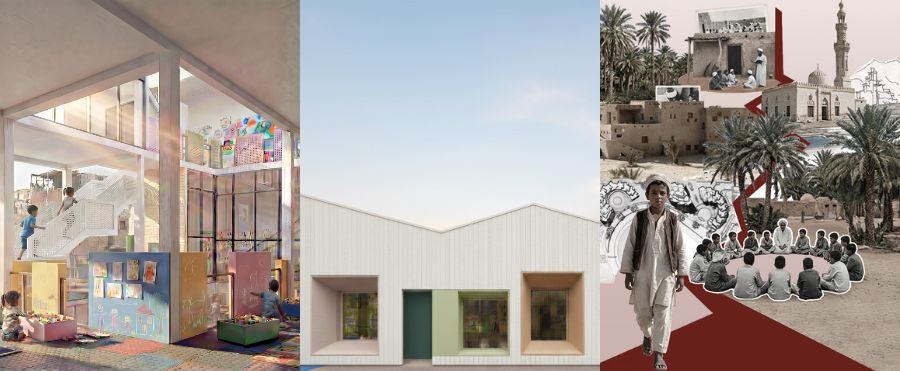
UpCycle Garden proposes a vertically organized kindergarten embedded within the rooftops of a dense informal settlement, transforming underutilized surfaces into a network of learning, play, and community spaces. Rather than occupying scarce ground-level space, the project builds upward through a series of lightweight, modular interventions that connect adjacent roofs into a continuous educational landscape. The spatial organization is conceived as a layered system of clusters—educational, social, and service spaces—interlinked by a dynamic circulation path that encourages movement, discovery, and interaction. Play becomes an architectural driver, with rooftops activated through climbing structures, gardens, and interactive installations that support both physical and cognitive development. The use of locally informed construction methods and recycled materials reinforces a low-impact approach, while phased growth strategies allow the project to adapt over time. By integrating urban agriculture, flexible classrooms, and communal gathering areas, the proposal seeks to redefine the kindergarten as both an educational environment and a catalyst for community engagement. The architecture operates as an extension of everyday life, reclaiming overlooked spaces to support childhood development, social cohesion, and environmental awareness.
2nd Place
Pixels
Michaela Maresch-ast
Austria


JURY FEEDBACK summary
Pixels proposes a kindergarten organized as a modular system of small-scale architectural units, forming a cohesive yet diverse learning environment embedded within the urban fabric of Vienna. Drawing inspiration from the spatial logic of the Naschmarkt’s historic market stalls, the project reinterprets this typology into a child-centered educational landscape composed of interconnected “pixel” volumes. These units are arranged along a central axis, creating a clear and legible organizational structure while allowing for variation in scale, function, and atmosphere. Each pixel accommodates specific activities (learning, rest, play, or care) while collectively forming a rhythmic sequence of spaces that encourage exploration and interaction. The architecture emphasizes material warmth through the use of timber construction, soft natural light, and carefully framed views, producing calm and supportive interior environments. Courtyards and transitional spaces mediate between inside and outside, reinforcing the relationship between the building and its surroundings. Through its modular logic and contextual sensitivity, the project balances flexibility with clarity, offering a kindergarten that is both adaptable and deeply rooted in its urban and cultural context.
3rd Place
Oasis of Halaqat
Mazen Eid, Mohamed Khaled Mohamed Farouq Ahmed, Youssef Mohamed Mohamed Dahy Abdalla, Yousef Mohamed Ramadan Mohamed
Egypt


“Competitions offer something that the academic studio, for all its value, cannot fully replicate — genuine stakes. Your work is seen and judged by people who do not know you, who have no context for your process, and who owe you no encouragement. For us as students, that exposure matters. It pushes us to be more deliberate, more honest, and more ambitious in our thinking.”
_________________________________________
JURY FEEDBACK summary
Oasis of Halaqat proposes a kindergarten deeply rooted in the social, climatic, and cultural fabric of Siwa, Egypt, reinterpreting traditional forms of collective learning as the foundation for its spatial organization. The project draws from the halaqat system—informal circles of teaching often held in mosques or shaded outdoor spaces—translating this into a sequence of interconnected courtyards and clustered classrooms arranged along a linear spine. Anchored by its relationship to the adjacent mosque, the proposal extends existing patterns of community life, positioning education as an embedded, everyday activity rather than a separate institutional function. A continuous canopy of lightweight fabric defines the project’s identity, filtering light, reducing heat, and creating a unified microclimate across indoor and outdoor spaces. The architecture employs low-tech construction methods and local materials, including kershif (mud and salt-based walls), ensuring both environmental responsiveness and cultural continuity. Elevated classroom volumes and shaded ground-level spaces allow for flexible use, supporting play, gathering, and informal learning. Through its integration of passive environmental strategies, vernacular construction, and community-based spatial logic, the project offers a resilient and contextually grounded model for early childhood education.
Buildner Sustainability Award
Tiny Explorers Village
Alicja Anna Zioło, Hanna Weronika Lechowska
Poland


“We believe that working on projects is highly valuable and enriching—it broadens our horizons and provides a great sense of satisfaction. Our previous project work has allowed us to develop our creativity and explore new solutions. Architectural competitions offer the opportunity to experiment with ideas, materials, and spatial strategies, often in a freer way than in everyday design work. We were also eager for the competition projects to enhance our portfolio.”
_________________________________________
JURY FEEDBACK summary
Tiny Explorers Village proposes a kindergarten conceived as a small, self-contained settlement of house-like volumes, translating the scale and familiarity of domestic architecture into a learning environment centered on exploration and autonomy. Organized around a shared central playground, the project forms a compact yet articulated cluster where individual classroom units function as distinct “homes,” each tailored to specific age groups and activities while remaining visually and spatially connected. This arrangement creates a clear and legible plan that balances collective gathering with moments of retreat, encouraging both social interaction and independent learning. The architecture is grounded in a strong environmental agenda, combining timber construction, hempcrete insulation, and passive ventilation strategies to achieve a low-impact and healthy indoor climate. Material systems are deliberately exposed and didactic, allowing children to engage directly with construction processes through elements such as clay plasters and rammed-earth features. Interior and exterior spaces are closely intertwined, with sliding partitions and outdoor extensions enabling flexible use and continuous movement between learning and play. Through its integration of bioclimatic design, modular clarity, and hands-on educational principles, the project establishes a cohesive and pedagogically driven environment rooted in both sustainability and human scale.
HONORABLE MENTION
The Learning Grove
Fiorella Estefanía Holguín Paz, Lady Tantaquispe, Mariana Alejandra Ruiz Campos, Alicia Johanna Velasquez Perez
Peru


“We participate in architecture competitions because they offer a space for exploration and creative freedom. Competitions allow us to test ideas, experiment with different approaches, and develop our design thinking. For students and young designers, they are also an opportunity to engage with global architectural discussions and continue learning beyond the classroom.”
HONORABLE MENTION
DEN – Modular Kindergarten
Julia Helena Sordyl
Poland


“I take part in architectural competitions because they allow me to test and develop the skills I acquired during my studies. The element of competition that naturally emerges in this context increases my motivation to pursue and refine my ideas. Unlike many standard design processes, competitions often encourage proposals that move beyond conventional frameworks and provide an opportunity for individual artistic expression. Furthermore, by participating in competitions and observing the design solutions proposed by other participants, I am able to revisit the subject from different perspectives — often equally valuable ones.”
HONORABLE MENTION
Through the Meadow
Angela Vasilevska, Andrijana Volcheska, Sara Jovanoska
Macedonia


“We engage in architecture competitions because they offer a rare space to explore design ideas in their most conceptual and uncompromised form. Partially freed from the constraints of investors or clients, we can focus on the principles and spatial strategies we have studied, testing the relationship between form, function, and context. Competitions allow us to critically examine architectural questions, experiment with innovative solutions, and reflect on the broader role of architecture in shaping social and environmental experiences. For us, they are not just exercises in design, but opportunities to develop a thoughtful, research-driven approach and to cultivate a distinctive architectural voice as emerging practitioners.”
HONORABLE MENTION
Vessel
Aleksandra Lepetkina
Germany


“In a way, I participate for the ‘love of the game’ — the chance to push design thinking further and see how a concept resonates within the international architectural discourse. Competitions provide a rare opportunity to explore ideas that might not emerge within the constraints of everyday practice. They create a space for experimentation, research, and critical thinking.”
HONORABLE MENTION
Foodiegarten
Yuhong Li, Jianing Li
China


“We participate in architecture competitions because they provide a unique platform for collaboration. Competitions allow us—an architect and an educational researcher —to engage with each other’s expertise, exploring ideas that bridge theory and practice, and developing concept-driven designs, such as those for early childhood educational environments, that might not emerge in everyday practice.”
HONORABLE MENTION
Flower Hill
Minseong Kim
South Korea


“Competitions serve as a preliminary validation process for my academic theories. They provide a valuable platform to practically apply and test my ideas on spatial innovation before introducing them to the real world.”
SHORTLISTED PROJECTS

The post Results: Kinderspace #3 appeared first on Competitions.archi.