

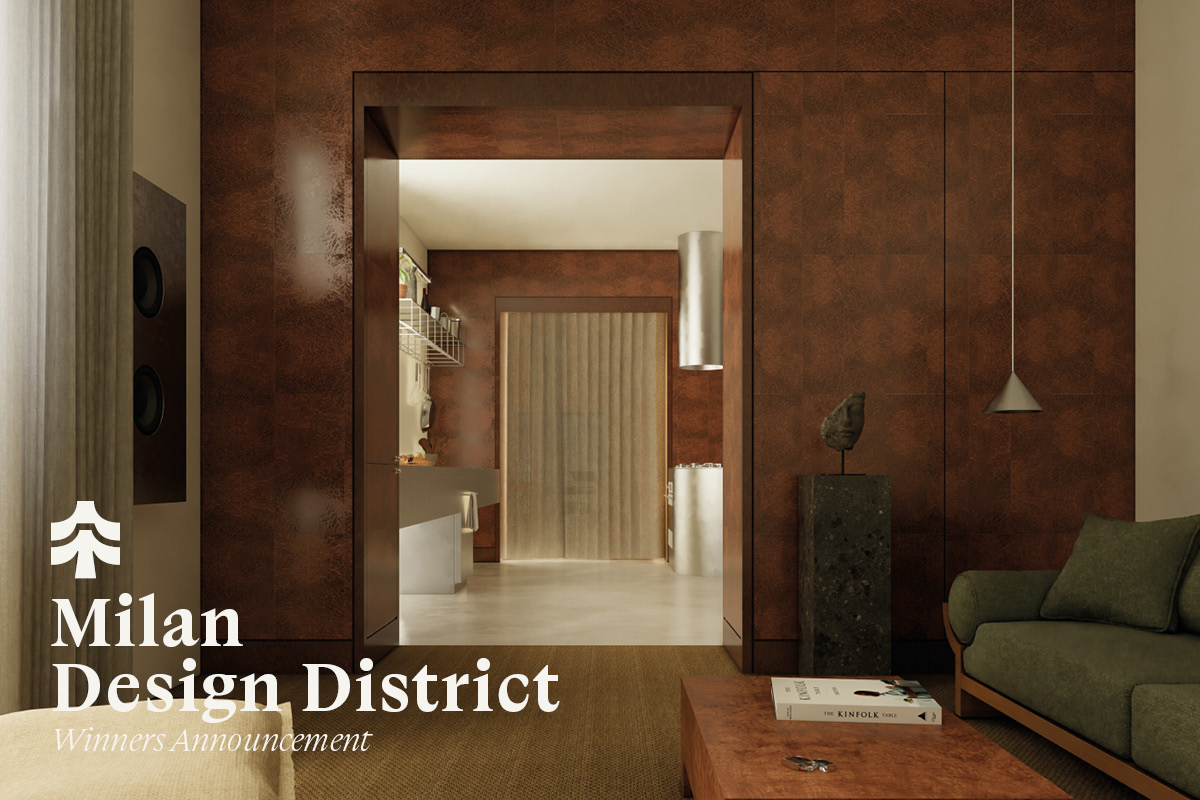
Terraviva has officially released the complete list of awarded projects of the architecture contest entitled “Milan Design District”.
The competition invited designers to reimagine everyday living by transforming a traditional Milanese apartment into a contemporary expression of creativity and innovation. Set within a classic Casa di Ringhiera in the vibrant Isola District, the challenge called for projects that could bridge Milan’s rich architectural heritage with its forward-looking design culture. Participants were encouraged to go beyond aesthetics, exploring how interiors can foster both community and individuality and how design can connect past and future through spatial experimentation. The competition sought to celebrate bold ideas capable of redefining domestic space in one of the world’s most dynamic design capitals.

The winning proposals were commended for their refined sense of materiality, spatial clarity, and thoughtful detailing. The jury praised projects that achieved elegant simplicity through balanced proportions, cohesive color palettes and a sensitive use of materials. Some designs stood out for their functional innovation, rethinking layout and circulation to create fluid, livable spaces, while others captured attention through their interplay of form, light and texture, elevating the quality of inhabitation. Together, these proposals offered a compelling vision of contemporary living rooted in Milan’s design legacy yet open to new ways of experiencing home.
Terraviva congratulates all participants for their creativity, innovation, and valuable contribution to this inspiring exploration of Milanese interior design.
The winners were selected by an international jury panel composed by:
-
- Joachim Stumpp (Stuttgart, Germany) | Material Bank
- Stefania Carraro (Milan, Italy) | SDA Bocconi
- Harrison Stallan (Rotterdam, Netherlands) | OMA
- Tatiana Dimou (Patras, Greece) | Tatiana Dimou Architects
- Giulio Ubini (Milan, Italy) | TUC Studio
- Hannes Bäuerle (Stuttgart, Germany) | Material Bank
- Mark Adamson (Belfast, Northern Ireland) | Formative Architects
- Lucia Paci (New York, USA) | Operastudio

1st Prize
It’s a Home
John Ridderstolpe
Sweden


What makes a home?
This project begins with that simple but complex question. A home is never just the result of striking design gestures or iconic furniture. Instead, it emerges from the interplay of many elements that come together to form a whole. Materials, colors, light and shadow, the marks of time and everyday use, all contribute to its atmosphere. It is through care in every detail, both large and small, that a home gains its character and becomes more than the sum of its parts.
The apartment in Isola originally presented a dark and conventional plan, with each room holding only one or two windows. The result was a disconnected sequence of spaces with little flow. This proposal rethinks the layout by introducing larger openings along the façade, allowing daylight from multiple directions to overlap and spread throughout the apartment. What was once a series of isolated rooms becomes a more fluid and coherent whole, with light as the primary organizer of space.
Dividing walls are reimagined as functional, built-in elements. These storage walls not only provide essential utility but also contribute to the architectural identity of the home. Clad in dark burl veneer, they stand in deliberate contrast to the white painted walls, creating a rhythm of rich and neutral surfaces. In this way, boundaries are not barriers but active layers, they organize storage, shape circulation, and contribute to the material expression of the home.
The material palette reinforces this balance. Wood and veneer bring warmth and tactility, stainless steel introduces a cooler, reflective counterpoint, while the bathroom develops its own identity through handmade tiles, green marble flooring, steel fixtures, and a wooden tub.
By opening the plan, activating boundaries, and layering materials, the design creates a rational framework that remains expressive. The design embraces the presence of art, books, and objects, allowing the atmosphere of daily life to shape the space. In this way, the home balances clarity with warmth, offering a setting where life can unfold.
_________________________________________
About the First Prize – Harrision Stallan – OMA
“Excellent use of materiality, spatial scale, and a simple curation of key elements such as the kitchen counter and bed platform. The proposal could benefit from more integrated storage, although adding this might compromise the elegant simplicity of the design. Overall, a beautiful project that succeeds through its thoughtful design and use of materials.”
About the First Prize – Giulio Ubini – TUC Studio
“A clean, cohesive plan with a refined balance of shapes, colors, and materials.”
2nd Prize
Green Dot Milano
Linda De Giacomo
Germany


GREEN DOT MILANO
Green Dot Milano reinterprets the historic „Casa di Ringhiera“ apartment in Isola as a flexible and adaptive living environment that reflects contemporary lifestyles. The project is rooted in the dialogue between tradition and innovation, using architecture as a tool for customization and identity.
Existing condition
The original apartment consisted of compact, disconnected rooms: a separated kitchen, a small living area, and a single bathroom. This layout reflected the early 20th-century communal model but does not respond to the needs of a creative, urban couple today.
Transformation
The intervention focuses on spatial openness and functionality:
_ The kitchen has been relocated to the center of the plan, becoming a social hub that connects living and dining.
_ The former living room on the north side has been transformed into a generous bedroom, while the wall between the two rooms was completely opened to enhance natural light and create a fluid atmosphere.
_ The bathroom has been reconfigured into two distinct areas: a compact guest WC and a spacious private bathroom for everyday comfort.
Circulation has been clarified, improving the overall flow of the apartment.
Concept: the dot system
At the heart of the design lies the green dot wall system: modular perforated panels that cover the walls and function as an interactive infrastructure. Hooks, shelves, lighting elements and even pet-friendly accessories can be positioned freely, allowing the space to evolve with its inhabitants. The walls are no longer static backdrops but active participants in daily life.
Atmosphere
Furniture pieces are kept essential and bold: a round dining table as a convivial centerpiece, a modular mustard-colored sofa for gathering, and a low wooden bed as a serene retreat. Together with the vibrant green shell, they establish a strong visual identity while maintaining flexibility.
Impact
Green Dot Milano responds to the dynamic needs of contemporary living:
Individuality through customization
Flexibility between work, leisure, and hosting
Inclusivity with discreet pet-friendly features
Identity through a coherent and characterful design language
Ultimately, the project creates more than a renovation: it is a model for urban living in Milan, where history, craftsmanship, and experimentation merge into a vibrant, adaptable, and personal home.
_________________________________________
About the 2nd Prize – Mark Adamson – Formative Architects
“An impressive presentation with clear, well-executed drawings and an excellent plan, highlighted by unique interior design features that transcend simple functionality.”
3rd Prize
CASA ICONICA
Maria Odolczyk-Sawicka, Katarzyna Jagiełło-Wróbel
Poland


CASA ICONICA
Casa Iconica is an apartment for a contemporary Milanese couple, located in the heart of Isola — a district where history and innovation live side by side. Set within a traditional Casa di Ringhiera, the project embraces the building’s communal spirit while transforming the interiors into a bright and open home that reflects the creative energy of today’s Milan.
The original layout was respected, with only two key changes: the removal of a partition wall between the dining and living area, and the lowering of the doorway lintel between the dining room and bedroom, aligning it with the rhythm of the windows. These subtle changes open the apartment, enhancing light and flow while preserving its architectural identity.
The interior palette, dominated by yellows and blues, draws inspiration from the works of Gio Ponti. Terrazzo floors, darker in the entrance and lighter in the living areas, create depth and continuity, while yellow and blue accents add vibrancy. The bathroom layout was reworked: the bathtub now takes center stage on the wall opposite the entrance, while a concealed WC with hydrobrush ensures practicality without compromising style. The bathroom door, crafted with fluted glass arranged in an alternating pattern, adds texture and lightness.
Throughout the apartment, timeless icons of Italian design are celebrated — from Ponti’s Leggera chair to Vico Magistretti’s Maralunga sofa — complemented by custom-made furniture pieces tailored to maximize space. Lighting was curated as a central design element. Castiglioni’s most emblematic pieces — Parentesi, Frisbi, Gatto, Toio, and Diabolo — are joined by Magistretti’s Teti, Dafne Koz’s Circus, and Constance Guisset’s sculptural Vertigo, ensuring a layered, atmospheric effect.
The hallway, clad in darker terrazzo and deep-blue wooden panels, contrasts with the light-filled apartment. A bespoke storage system integrates a wardrobe section for outerwear, and another section housing the washing machine and household items. A light shelving divider separates the dining area from the living room, where an entire wall has been transformed into a library with sliding panels. The kitchen was designed as fresh and airy, elevated on legs, without tall cabinetry, featuring a freestanding refrigerator. In the bedroom, linen curtains frame the windows, while a custom upholstered wardrobe is paired with a bed inspired by Ettore Sottsass, both unified through matching fabric.
Heating was treated as design. Columnar and horizontal Milano radiators complement the artistic living spaces, while the bathroom combines underfloor heating with two electric heated towel rails.
As Carlo Scarpa once noted: “If the architecture is any good, a person who looks and listens will feel its good effects without noticing.” This project seeks to embody that quiet elegance — bright, spacious, and authentically Italian. Ultimately, Casa Iconica offers a holistic environment: practical yet poetic, intimate yet rooted in the spirit of Milan. By blending tradition and innovation, it creates a home that is timeless, personal, and unmistakably Italian — a contemporary reflection of the city where design and everyday life have always been inseparable.
_________________________________________
About the 3rd Prize – Tatiana Dimou – Tatiana Dimou Architects
“An elegant synthesis of form, light, and materiality, enhancing the quality of inhabitation.”
Golden Mention
Mormorio, Whispers of Milan
Fabian Ponce, Giulia Celano
Mexico – Italy


Mormorio, Whispers of Milan
For many, Milan is merely a city to pass through—but for those who choose to inhabit it, the city slowly reveals itself through subtleties. Behind its reserved façades lies a layered experience, where courtyards, corridors, and display windows become part of an unspoken language. This project captures that quiet immersion—an architectural mormorio—by distilling the city’s essence into an interior that is refined, introspective, and unmistakably Milanese.
The apartment draws from three urban generators, each extracted not through mimicry, but through deliberate abstraction of spatial and sensory logic. Together, they articulate a space that feels both local and timeless, embedded in the character of the city without overt symbolism:
Fashion—Curated Ritual
Shop windows in Milan evoke a scenographic logic where every object is curated and composed. This is translated into bespoke, museographic shelving systems—architectural displays hosting books, objects, and daily rituals with refinement. Slim bronze profiles and warm timber define the composition, establishing a composed rhythm across the space.
Galleries—Material Containment
Milanese galleries, with their tonal balance and soft light, inspired the use of oak and ash cladding. These panelled surfaces structure the space while concealing elements like closets, a minibar, and a flushed bathroom door—preserving clarity and inviting discovery. Timber slat ceilings extend the material language, evoking—at a smaller scale—the expansiveness of Milanese vaults.
Hidden Cortili—Introspective Greens
The charm of Milan’s cortili—verdant courtyards behind stone façades—inspires the palette of kitchen and bathroom. These spaces are clad in sage and olive tones, paired with green stone and ceppo di gré. Bronze fixtures echo the quiet presence of the Vedovelle—Milan’s iconic fountains—urban artifacts noticed by those who take time to observe.
The layout follows clarity and logic. A seamless entrance corridor draws the gaze to a museographic shelving wall anchoring the space. The bedroom is placed close to the corridor, enhancing functionality and avoiding public-private overlap. A walk-in wardrobe acts as a disimpegno, improving intimacy and acoustic separation. Soft tones in the sleeping area foster a sense of retreat.
Living, dining, and kitchen unfold in a fluid, open gesture. A bronze-tinted glass partition frames the kitchen as a contemplative vignette, connecting to the shelving system, which includes a bench for reading—or for four-legged companions—and a built-in desk offering flexibility for contemporary living.
Furnishings combine custom pieces with selections from Minotti, Poliform, PLH, Apparatus, and Jee-O, chosen for elegance and tactile quality. Lighting is warm and subdued, turning the space into a hushed retreat.
Natural and tinted oak, bronze profiles, ceppo di gré, green stone, lacquered joinery, and soft textiles in beige and forest tones form a cohesive palette that mirrors the layered narrative of the project.
The apartment becomes a gentle convergence of Milanese rhythms. Fashion offers the logic of display. Galleries provide stillness. Cortili evoke intimacy. Together, they form a home designed not to impose, but to reveal itself slowly. A mormorio, heard only by those who choose to listen.
Golden Mention
CALEIDOSCOPIO
Sofía Arrizabalaga
Spain


The design concept is based on the idea of a kaleidoscope, as a metaphor for a gaze that transforms, reinterprets, and combines fragments of the past with forms of the present.
From the sobriety of the Milanese façade —a witness to time, history, and restrained elegance— the interior of the apartment becomes a journey that deconstructs that heritage and recombines it with new ways of living. Like a kaleidoscope, each step reveals a different pattern: the geometry transforms, light multiplies, the colour interacts with the space.
Inspired by the work of Gio Ponti, a master of integrating architecture, furniture, and the art of living, the project embraces his playful, structured, and poetic spirit. Here, furniture becomes architecture, and architecture is permeated by design gestures that balance the classic and the contemporary.
In this space, tradition and modernity do not oppose each other, but come together, creating a domestic universe that is, like a kaleidoscope, ever-changing and profound: a house not meant to be seen just once, but continuously rediscovered.
The layout of the apartment is divided into the same parts as a kaleidoscope: a tube with mirrors, colored fragments and a light input.
VARCO: a threshold suspended between reflections, where everything is about to be revealed and time dilates. The beginning of a sensory transition, like the first turn of a kaleidoscope.
FRAMMENTI: after passing through the tube, the space opens and breaks down: light fragments, colour unfolds, and geometry finds its echo in new forms of living.
Colour is no longer a surface: it is structure, its furniture, it is architecture; design becomes choreography. As Gio Ponti did, furniture does not decorate, it constructs.
Like the moving crystals of a kaleidoscope, the rooms are ordered, rotated, and transformed.
LUCE: a white stripe runs along the façade, weaving together the fragments of the kaleidoscope. It is not just transit; it is possibility, light that activates movement. Here, architecture is silenced so that life can dwell. A space that does not impose itself, it offers itself. A blank canvas for the unexpected.
Where the light is born and everything comes to life.
The rooms are defined by large units that serve as both storage and dividers. These modules create a 33cm gap with the false ceiling, so that, despite being independent spaces, they are connected by this gap in height. Furthermore, this gap allows natural light to enter all spaces.
Golden Mention
CONFINI VIVENTI
Belen Lahore, Emilia Migali
Argentina


“Confini Viventi” explores contemporary architecture responding to today’s dynamic and evolving ways of living, while preserving an ongoing dialogue with the past honoring the memory of the place, neighborhood, and city. The design balances tradition and innovation, reinterpreting the historic identity of its surroundings through a contemporary lens that continuously rethinks unique modes of inhabitation.
Inspired by old workshops that defined the area’s industrial character, flexible spaces designed for simultaneous uses… the project proposes a home organized around a large, dynamic central space. Daily activities and their environments are arranged with adaptability in mind, allowing spatial boundaries to shift according to use, offering varying degrees of separation or connection.
These boundaries are created through sliding guides and panels, forming visually permeable spaces. Frosted glass allows natural light to filter through existing windows, ensuring limited daylight reaches every corner. This produces luminous spaces that maintain privacy, fostering ambiguity suggesting more than it reveals. Similarly, transitional areas like the hallway and entrance feature mirrored surfaces that double reflections and enhance spatial perception. Incoming light is amplified, filling and illuminating the interior.
Material choices connect strongly to Italian architectural tradition, with mosaics in the kitchen and bathroom recalling historic interior design. Stainless steel furniture references the industrial aesthetic typical of the Isola district, weaving local context into a contemporary architectural language.
The intervention intentionally blurs boundaries: walls are dematerialized and reassembled using lightweight, repetitive construction details defining “quadrants,” the space’s core. These quadrants divide into sub-spaces; for example, the living room can be fully enclosed and transformed into an additional bedroom using carefully selected furniture like a sofa bed. A dedicated yoga and gym space encourages introspective and playful living, supporting personal modes of inhabitation. A desk facing the exterior supports work and study routines of a creative couple.
Surrounding these flexible areas are fixed zones: kitchen, bathroom, entryway, and bedroom. While their locations remain constant, their relationships to other spaces evolve. The bedroom is physically separated but maintains visual and light connections through frosted glass screens, preserving privacy without isolation. The kitchen can close off entirely or open using a mobile “artifact table” adapting to different needs.
Furniture design embodies both mobility and fixed elements. A fixed piece runs along the apartment’s main façade, creating a sober, orderly backdrop essential in compact living. This structure fosters functional complexity supporting daily activities.
This built-in unit stores and conceals sliding panels when open and highlights existing windows, enhancing visual connection to the outside. Along its length, it integrates multiple uses: storage and workspace for the kitchen, curtain tracks, gym and yoga space, desk, shelving, and bedroom storage. In the bedroom, furniture centers around the bed, forming a cohesive element incorporating lighting fixtures, daily-use surfaces, and closet space resolving many functions in one elegant design gesture.
“Confini Viventi” embodies a thoughtful balance between past and present, creating a flexible, contemporary home honoring its historical context while embracing modern living’s evolving nature. It reflects architecture attuned to memory, adaptability, and the personal experience of space.
Golden Mention
Milan Wall
Michela Quadrelli
Italy-Germany


This project reimagines the main living space as a flexible architecture, centered on a “wall” that becomes the true protagonist of the apartment. Conceived as a system of hidden compartments and mobile elements, the “wall” allows the space to evolve continuously, adapting to the rhythms and desires of Milan’s metropolitan life. More than a static partition, it is an active infrastructure that defines, organizes, and transforms the domestic environment.
It accommodates the rituals of everyday living as well as quintessential expressions of Milanese cosmopolitan culture: convivial dining, music and gatherings, work and creation, cinema and exhibitions, self-expression and repose. Each transformation mirrors the city’s multifaceted identity, where tradition and innovation coexist in a constant state of dialogue.
The wall integrates the kitchen, together with storage for personal belongings and the compartments of the walk-in closet. Except for a few niches next to the step-storage unit, every element can be hidden, creating a seamless surface that can act as a display backdrop or as a screen for projections and performances. This ability to alternate between exposure and concealment gives the space an adaptable character, balancing openness and intimacy.
The corridor follows the same concept: a built-in wardrobe conceals both everyday storage and household appliances, reducing visual clutter and allowing the architectural lines to remain pure and continuous. The bathroom maintains its overall configuration, but with the repositioned door the perception of space becomes more generous, improving circulation and comfort.
Even the dining table participates in this strategy of flexibility. It incorporates stools that can be stored neatly underneath, instantly freeing up additional room in the kitchen and underlining the multifunctional spirit of the apartment.
The colors and materials have been carefully chosen to reflect the eclectic character of a city like Milan, positioned at the intersection of fashion, design, nightlife, and economic vitality.
Through this interplay of concealment, adaptability, and integration, the design achieves a balance between efficiency and expressiveness. The apartment becomes not only a place to live, but also a stage for evolving lifestyles, capable of responding fluidly to the complexity of contemporary urban living.
Golden Mention
Magnolia Within
Xanthi Tsekou
Greece


Project: Magnolia Within
The proposal takes its starting point from the century-old magnolia tree that stands in the center of the courtyard of Casa di Ringhiera. In the life of the building, the tree has acted as a point of orientation and gathering, around which daily encounters have unfolded. Inside the apartment, this role is reinterpreted through a large stainless-steel island placed at the centre of the new living space. The island is conceived not only as a kitchen element but as a nucleus for a wide range of activities: cooking, dining, informal gatherings with friends, working, or even model making. Its professional-grade materiality supports these multiple uses and allows the space to adapt to the needs of its young inhabitants, a couple of architects at the beginning of their careers.
The existing layout was modified to open the living room and kitchen into a single continuous environment. The closed room adjacent to the living area was removed, extending the space and allowing the central island to dominate as a multifunctional hub. Around the island, the kitchen and living zones are organised, with natural light and colourful surfaces giving the room a bright and playful character. Italian terrazzo flooring ties the elements together, grounding the space in a material with strong local associations.
The spatial narrative continues through a series of arches that soften transitions and reinforce the language of curves that permeates the apartment. On one side, the bedroom is accessed through such an arch. Here, a deep burgundy ceiling and wall create an intimate, immersive atmosphere, balanced by a mirrored wardrobe that amplifies natural light and visually expands the room.
On the other side of the living area, another arched passage leads into a corridor. The corridor, also painted in burgundy tones, incorporates built-in storage along its length and directs movement towards the bathroom. The bathroom combines a bathtub, walk-in shower, and double sinks. The layout retains the position of the WC along the same wall in order to maintain the original drainage line. Burgundy surfaces extend throughout, with Calacatta Viola marble highlighting the bathtub and the threshold to the shower. Stainless steel elements in the vanity unit and sanitary ware add contrast, while the floor is finished in palladiana.
The apartment as a whole is characterised by the dialogue between open communal areas and enclosed private ones. The stainless-steel island, like the magnolia tree in the courtyard, becomes a symbol of gathering, resilience, and creativity—a new center around which life circulates. Color, materiality, and form are used to create distinct atmospheres, while remaining connected through recurring elements such as curves, reflective surfaces, and strong tonal choices.
In this way, the project seeks to offer a contemporary living environment within the framework of the historic Casa di Ringhiera, drawing on its sense of community while responding to the everyday needs of its new inhabitants.
Golden Mention
Milan Design District
Patrycja Badura
Poland


As the apartment is located in a vibrant and diverse neighbourhood, and its owners are a couple professionally involved in architecture and design, the interior naturally reflects both the character of the area and their personal passions — their lifestyle and deep appreciation for design.
The space is an eclectic mix of styles, mirroring the multifaceted nature of the surrounding district. One can imagine the owners as passionate treasure hunters, spending weekends browsing flea markets in search of iconic pieces of Italian and European design.
These carefully selected design objects were placed against a backdrop that aligns with the classic aesthetic of a historic townhouse: herringbone wooden parquet flooring, baseboards extending into elegant door frames, and stone countertops. This traditional framework is complemented by iconic furniture and lighting from renowned Italian and European designers.
Among the pieces featured in the apartment are a Franco Albini desk for Knoll,
a Pelleossa chair from Miniforms, a Muuto sofa, lighting by Artemide, Flos, Ferroluce, and Nemo, as well as a coffee table and nightstands by Minotti. The details are equally refined — such as Mandelli door handles and Dedar Milano upholstery fabric used for the bed’s headboard.
The layout of the apartment has been preserved, though the arrangement of individual zones was reconsidered to better suit the owners’ needs.
Upon entry, a hallway leads directly to the kitchen, which now serves as the central heart of the home. Positioned at the end of a visual axis defined by Via Francesco Arese, the kitchen opens up toward the dining and living areas. Enlarging the door openings between rooms allowed for the creation of one spacious, open living zone — ideal for relaxing, working, and entertaining.
The private area of the apartment is “hidden” behind the kitchen. A newly added corridor creates a sense of separation, leading to a walk-in wardrobe and a more discreet bedroom entrance. This layout reinforces the feeling of a secluded, intimate zone designed exclusively for the residents.
Overall, it creates a sense of a refined yet relaxed interior – cozy, intimate, and ready for the unfolding narrative of daily life.
Golden Mention
Time Fold
Ilke Yilmaz
Turkey


An interior that stages dialogue between retro textures and contemporary precision, where the richness of marbles, leathers, and polished woods is not quoted but reborn and sharpened into clarity, reframed into bold geometries, curved thresholds, and sculptural frames.
Set within the pulse of Milan’s Design District, the project does not seek nostalgia but reinvention. It gathers fragments of a twentieth-century palette; the scalloped beam, the deep red stone, the warm grain of wood and reshapes them into a dwelling that embodies duality: retreat and stage, intimacy and openness, tradition and innovation.
Here, design is conceived as lived experience before construction: an architecture of atmosphere. Retro materials become contemporary tools; their tactile memory preserved, their weight offset by clarity of line. Aluminium leans against marble; scratched wood reveals plaster; ice-bevelled glass cuts into green Anasian stone. Surfaces peel open, exposing hidden layers, as if Milanese textures themselves were speaking through form.
Geometry becomes language. Curves confront lines, frames break into thresholds, sharp bevels fold into softened edges. Each gesture echoes Milan’s identity; rigid yet fluid, monumental yet intimate. The composition is not a fixed arrangement but a conversation, a continuous unveiling of what lies beneath.
This is a home for the young Milanese creative a space to live, to work, to host, and to reflect. It holds the quiet of retreat yet vibrates with the city’s rhythm, absorbing its cosmopolitan energy while offering moments of pause. The project dares not to resolve contradictions, but to sharpen them staging frictions where memory collides with progress, and where atmosphere becomes the true architecture.
Here, design translates material into memory, and memory into space.
A resonance between past and present.
A breath between retro and now.
Golden Mention
being [a]part
Mario Abruzzese, Giulia Benedetta Bet, Marta Zanardi, Tomás Enrique Davis De Luca, Martina Massacesi
Italy


The project stems from the desire to interpret the identity of Milan, a city in constant evolution and a laboratory of avant-garde experimentation. The goal is to translate this dual soul – memory and innovation – into an apartment that engages with the tradition of the casa di ringhiera while addressing the needs of contemporary living.
Habits and housing models have changed over time, but the configuration of spaces and typologies has not always ‘kept pace’ with the evolution of society. The proposal takes inspiration from these transformations: while furnishings and materials reinterpret tradition and the Masters of Italian design, the layout has been conceived to provide flexibility capable of adapting to different life scenarios. A couple becoming a family, a new owner with different needs, a professional wishing to transform part of the home into a studio: the space is ready to accommodate long-term changes without compromising its original framework.
Flexibility also emerges in everyday use. Fixed furnishings run along the perimeter of the two main rooms, freeing the central space. Tables, seating, and mobile modules can be repositioned to host different activities, transforming the environment from residential to convivial, and opening it to moments of sociality with friends and neighbors. The sense of community, rooted in the casa di ringhiera, thus permeates the interior of the apartment.
The long entrance corridor is conceived as a promenade: a pathway connecting the ballatoio – the quintessential communal space – with the intimate dimension of the home. This filter guides the visitor, marking the transition from public to private.
Special attention was devoted to the choice of materials and construction techniques. To ensure sustainability and reversibility, the intervention was designed to minimize demolition, envisioning two large neutral environments equipped with flexible systems and modular furnishings that can adapt to new needs countless times throughout the apartment’s life cycle. A radiant floor heating and cooling system ensures comfort, while the electrical and plumbing networks have been conceived as flexible and expandable systems, with multiple activation points concealed behind continuous wall cladding.
This cladding is made of a modular system of okumé wood panels, wrapping the perimeter of the rooms like an elegant contemporary boiserie. Removable and replaceable, the panels allow access to the systems, integration of new technologies, or the attachment of furniture elements (kitchen modules, wardrobes, shelves, desks, drawers). A functional and decorative device at once, capable of generating ever-changing scenarios.
The continuous flooring, made with a mix of sand, gravel, cement, and water, recalls traditional terrazzo floors while also functioning as the screed, limiting construction work. The surface treatment of the floor is conceived as a material gradient: from a rough texture, reminiscent of the ballatoio’s cement, to a finely polished finish in the central area of the apartment. A material that becomes a direct bridge between the collective exterior and the domestic interior.
The result is a project that combines contextual sensitivity and typological innovation, constructive tradition and experimentation. A home that interprets the essence of Milan: communal, dynamic, flexible.
Golden Mention
[IN]SIDE OUT
Selene Barisione, Chiara Tassano
Italy


The apartment is conceived as an open ecosystem, designed to expand the living experience through a flexible and adaptable philosophy. In a city like Milan, where greenery is often scarce, the domestic space transforms into a living landscape, a threshold connecting interior and exterior, fostering dialogue between humans, nature, and urban fauna.
The project’s layout develops according to a linear arrangement, based on a grid of 36×36 cm modules that establishes functional hierarchies. The dwelling is conceived as a modular container, where independent elements organize daily activities but can be removed or reconfigured over time, ensuring sustainability and reusability and transforming the home into an organism capable of adapting to the evolving needs of its inhabitants. Two furnishing systems, each 2.50 meters high, structure and guide the organization of the apartment. The first, extending from the main entrance toward the window, transforms the previously dark and unused corridor into a functional spine integrating storage, circulation, and niches for pausing, working, or socializing. This axis continues beyond the apartment’s perimeter onto the balcony via a lightweight metal structure that supports climbing vegetation and facilitates bird passage, becoming a visible manifesto of the connection between resident and urban community.
The living area is thus configured as a spacious and luminous environment, designed to accommodate multiple functions: lounge, meeting space, and shared area. Mobile and multifunctional furnishings – including a modular counter and a sectional sofa – allow variable configurations and extend the functional area outward.
The second furnishing system develops around a load-bearing wall, strategically lightened by a new opening, forming a double-sided unit that serves both the living room and the kitchen. The kitchen overlooks a winter garden, created by retracting the northern façade and inserting new glazing, a domestic green space equipped with vertical self-irrigating systems, introducing natural light, food cultivation, and a new sensory dimension to living. The sleeping area maintains visual and functional continuity with the rest of the apartment, separated only by a lightweight textile element that preserves luminosity and spatial fluidity. An adjacent fitted niche doubles as a workspace accessible from both the living room and bedroom, reinforcing the multifunctional character of the environment. The bathroom has been rationalized into an anteroom, sanitary area, shower, and service laundry, a compact layout optimizing available surfaces and enhancing functionality.
A suspended LED strip illuminates the path above the functional furniture, emphasizing perceptual continuity throughout the interior. In terms of materials, the floor extends onto the walls, incorporating the furniture’s base level, while neutral tiles also cover the ceiling, inverting traditional roles of finishes and creating an enveloping sense of continuity. Integration of smart technologies enables system management, providing flexibility and adaptability to the inhabitants’ daily needs.
The project thus shapes a fluid and versatile interior, capable of opening the home to the city and community. It is a space that fosters coexistence between different species, highlighting the inhabitant as an active protagonist, modulating the environment according to their daily needs.
Golden Mention
SCIGHERA – The Poetry of Fog
Veronika Merlin, Baoshan(Theresa) Xue, Michele Corna
Italy – United States


Fog is neither air nor water: it is a liminal, suspended matter that dissolves edges and transforms everything it envelops. “Scighera”, the Milanese word for fog, is the conceptual heart of this project: an interior imagined as an atmospheric landscape, a threshold between past and future, between the visible and the invisible, between refuge and openness.
Fog is transition, between what belongs to memory and what is yet to come. It is suspension, erasing the horizon and rendering space continuous, free from rigid boundaries. It is protection, a veil that shields from the visual noise of the world, creating intimacy and interiority. But it is also slowness, inviting one to move with care, to dwell on nearby details; and it is creative stimulus, blurring forms to free imagination and open infinite interpretations.
At the entrance, conceived as a “Genkan” (threshold of Japanese houses, a symbolic space between the outer world and inner sanctuary) and small alcove, a photograph encapsulates the essence of the project: bodies and colors emerging from the indistinct. From here, a corridor punctuated by perforated steel portals unfolds, like the arches of Milan’s Central Station leading into a city wrapped in haze.
The apartment is not divided into traditional rooms, but instead unfolds as a single large space where functional “islands” take shape: areas that become, in turn, places for eating, working, listening, gathering, or resting. These areas are not enclosed, but separated by curtains, furniture, or screens that conceal and reveal gradually, like headlights or neon signs emerging from a foggy veil. The home reveals itself slowly, without haste, along a contemplative path.
The material palette translates the qualities of fog into tangible form: smoked, opaline, and satin glass; airy and soft fabrics; resin, mirrors, minute mosaics, stainless steel. Lighting is indirect, diffuse, and reflected, as if filtered through suspended particles. Then, one by one, sudden flashes of color emerge: pink, red, blue, yellow, like streetlamps in the mist, a passing tram, or headlights flickering in the night.
The furnishings, chosen among design icons and bespoke pieces, become true domestic landmarks. From the Osaka sofa (LaCividina) to Panton’s Living Tower, from Munari’s Falkland lamp to the custom-designed pink kitchen, each element recalls the city itself: the Velasca Tower, the Metro, the Pirellone. And, as in Metaphysical painting, space is composed of pure geometries, evoking suspension and mystery.
Scighera is a living, mutable space, capable of adapting to the contemporary rhythms of its inhabitants or of those who stumble into it, perhaps after losing themselves in the city. It is a personal refuge and, at the same time, a place of encounter, an environment that speaks the language of Milan: the one preserved in memory, and the one still waiting to be discovered. It invites slowing down when the world outside is rushing forward.
And just like fog, ephemeral, resisting any definitive definition, Scighera invites imagination, and the daily reinvention of one’s own living space.
SHORTLISTED PROJECTS

The post Results: Milan Design District appeared first on Competitions.archi.