

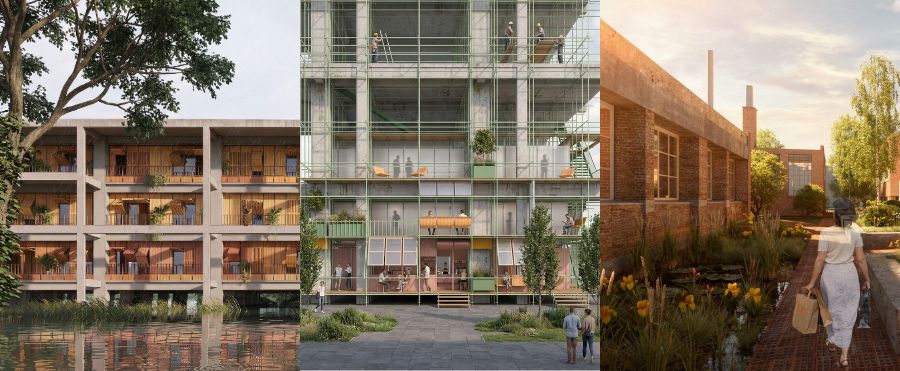
Buildner is pleased to announce the results of Re:Form – New Life for Old Spaces, Edition #2, an international architecture competition focused on adaptive reuse within spaces under 250 square meters. Building on the success of its first edition, the competition invited architects and designers to transform existing, often underused structures into meaningful, sustainable spaces. This year’s submissions explored a wide range of ideas—from housing and community spaces to flexible, modular systems—highlighting the growing importance of reuse, circular design, and small-scale interventions with broader social impact.
The competition asked participants to select a site anywhere in the world and propose an adaptive reuse intervention within a compact footprint, encouraging thoughtful, small-scale transformations with broader social and environmental impact . With no fixed program, submissions explored a wide spectrum of uses, from housing and community spaces to cultural and hybrid civic programs. The brief emphasized sustainability, functionality, and contextual integration, challenging designers to balance creative ambition with practical and material awareness.
Across the submissions, several shared themes emerged. Many proposals approached adaptive reuse not as a singular architectural object but as a process: phased, incremental, and capable of evolving over time. Others focused on systems rather than forms, developing modular strategies that could be replicated, adapted, and scaled across different contexts. A strong emphasis was also placed on material reuse and circular thinking, with projects exploring how existing structures, demolition waste, or local materials could be reassembled into new spatial frameworks. At the same time, a number of entries highlighted the social dimension of reuse, framing architecture as a tool for rebuilding community life, supporting collective activity, and reactivating forgotten urban and rural sites.
The selected winning projects reflect these tendencies while each advancing a distinct interpretation of the brief. Together, they demonstrate a shift in architectural thinking—from replacement to transformation, from permanence to adaptability, and from isolated interventions to systems that engage broader environmental and social conditions. Following careful evaluation by an international jury panel, the awarded proposals stand out for their clarity of concept, depth of investigation, and ability to translate complex challenges into coherent and compelling architectural strategies.

The first prize was awarded to Made Artha Krisiantara and Angga Batistuta Meldina (Indonesia) for Seeds in Forgotten Soil, a scalable post-disaster housing system combining existing concrete structures with modular timber units. Second prize went to Wenzhuo Cai, Ruoxi Li, and Yi Wei Chen (United States) for Plug-In Protocol, a flexible framework for reactivating unfinished buildings through lightweight, incremental additions. The third prize and Sustainability Award were given to Julia Mytnik (Poland) for The Future Factory, a mixed-use transformation of an abandoned industrial site grounded in circular economy principles. The Student Award was presented to Hojun Jung (South Korea, Sungkyunkwan University) for Postel 1953, which reimagines coastal guard posts as modular shelters for trekkers.
Together, the winning projects demonstrate a shift in architectural thinking toward adaptability, reuse, and long-term sustainability.
1st Place
Seeds in Forgotten Soil
Made Artha Krisiantara, Angga Batistuta Meldina
Indonesia

JURY FEEDBACK summary
Seeds in Forgotten Soil proposes a post-disaster housing strategy based on the adaptive reuse of abandoned concrete structures combined with modular timber insertions. The project operates as a scalable system rather than a single building, using existing structural frames as a foundation for new residential units organized around shared circulation and communal spaces.
2nd Place
Plug-In Protocol
Wenzhuo Cai, Ruoxi Li, Yi Wei Chen
United States

Read full interview
______________________
JURY FEEDBACK summary
Plug-In Protocol proposes a phased strategy for the reactivation of unfinished and abandoned building structures through a system of lightweight, modular insertions. Rather than completing the original construction as intended, the project introduces a secondary scaffold-like framework that attaches to the existing concrete skeleton, enabling incremental occupation and transformation over time.
3rd Place + Buildner Sustainability Award
The Future Factory
Julia Mytnik
Poland

“Competitions provide room to grow, to explore one’s own creativity and expand its boundaries. Through registering for the competition I wished to challenge myself, test my own creative thinking abilities and feel inspired to think boldly and create something meaningful. What I value in architectural competitions are their unique themes that often inspire to delve deeper and seek creative answers that may shape future architecture.”
_________________________________________
JURY FEEDBACK summary
The Future Factory proposes the adaptive reuse of an abandoned industrial complex as a mixed-use civic and productive environment, reactivating the site as a place of community, collaboration, and material transformation. The project retains and works within the existing structural framework, introducing new programs such as workshops, co-working spaces, housing, and public amenities to create a diverse and active ecosystem.
Buildner Student Award
Postel 1953
Hojun Jung
South Korea

“The competition theme reminded me of a 5-day trek I took along the Korea Trail last summer with my friends. While walking along the coast, I noticed many abandoned military guard posts. They were old and neglected, but I believed they held significant historical and symbolic value. At the same time, I realized the trail really lacked basic infrastructure for hikers. I thought that repurposing these outposts into trekking hubs would be a great way to preserve history while solving a practical social problem.”
_________________________________________
JURY FEEDBACK summary
Postel 1953 proposes the transformation of abandoned coastal guard posts along the Korean border into small-scale shelters for trekkers, reframing a landscape historically defined by surveillance and division into one of movement, reflection, and public access.
HONORABLE MENTION
JARDI D’ALZINA / Roots of resistance
Dmitrii Morozov
Spain

“Competitions provide a unique platform for “Pragmatic Utopianism.” They allow us to test spatial strategies and innovative hypotheses for a “planet in transition”—ideas that will eventually become market standards. They are opportunities to engage in global architectural discourse and bridge the gap between theory and practice.”
HONORABLE MENTION
From Introvert to Extrovert: Reform as Social Condenser
Tsz Hung Hu
Hong Kong

“To me, participating in architectural competitions is an important form of communication—an opportunity to articulate one’s architectural ideologies and to narrate one’s stance in the built environment. Equally significant is the act of listening: when confronted with the same brief, the diversity and contrast of architectural responses reveal how varied interpretations, values, and priorities can emerge. This plurality—often marked by debate, controversy, and heterogeneity—is among the most compelling and valuable aspects of architecture, driving critical reflection, innovation, and the continuous evolution of the discipline.”
HONORABLE MENTION
Railway Basilica
Etienne Gary, Nasrdin Chiuti
France

“Above all, it is a pretext to give us the opportunity to reflect on themes that interest us and to experiment freely, helping us shape our perspective as young architects and find our place within the discipline.”
HONORABLE MENTION
The Egg never Opened
Sara El Moussaoui
France

“In professional practice, architecture is often shaped by multiple constraints; budget limitations, regulatory frameworks, and the expectations of clients and local authorities. These parameters are essential, but they can sometimes restrict the exploration of more experimental or unconventional ideas. Participating in architecture competitions, especially ideas competitions, offers a different space. It allows me to step outside these constraints and explore architecture as a field of research and speculation. It is an opportunity to test new approaches, challenge assumptions, and push my creativity further than what is usually possible in everyday practice. Competitions also allow me to position myself critically, towards the city, towards current ways of building, and towards the role of architecture itself. They become a platform to propose alternative visions, to question existing models, and to imagine more ambitious or sensitive responses to contemporary challenges.”
HONORABLE MENTION
Veil and Void
Naeimeh Seyedhosseini, Fahimeh Seyedhosseini, Mona Pourmohammadi Sani
Italy

“Architecture competitions are not only opportunities for recognition, but also occasions to deepen our design approach, strengthen collaboration, and evaluate our work within a broader cultural and architectural discourse. By participating in architectural competitions, we are offered a valuable space for experimentation, research, and critical thinking, allowing us to challenge ourselves beyond the limits of everyday practice, develop ideas, and engage with architectural questions in a more open and exploratory way, helping us grow as architects. Among all competitions, it is especially important for us to engage with those whose criteria align with our professional interests and values. We deeply believe that the approach promoted by this competition can help meaningful ideas take shape and contribute to creating a better world.”
HONORABLE MENTION
Class-W Tea-Room
Aaris Katsoulakis, Angus P Robson
Australia

“We participate in architectural competitions to maintain strengths in creative and critical design practices. Within the workforce it’s often easy to get bogged down and focused on the practicalities of everyday design. We wish to be not only architects that can see a building through its construction, but also designers that can create a piece of architecture through study and research.”
HONORABLE MENTION
Reverse Exposure
Kim Chanhui, Seojin Kim, Yejin Lee
South Korea

SHORTLISTED PROJECTS

The post Results: Re:Form – New Life for Old Spaces #2 appeared first on Competitions.archi.