

Terraviva has officially released the complete list of awarded projects of the architecture contest entitled “Rising from Ashes”.
Set within a Californian region deeply affected by the wildfires of early 2025, the competition addressed the urgent need for a new spiritual and communal landmark. In a context where several religious buildings were lost, participants were invited to envision a contemporary Christian church for the community of Altadena, one that is open, inclusive and deeply rooted in its landscape. The challenge called for a place of worship able to host 400 people, rethinking sacred architecture as a sensory and symbolic experience where liturgy, social life and everyday use converge. More than a religious building, the competition sought a meaningful architectural response capable of supporting collective healing, memory and renewal.

The awarded proposals were recognized for their depth of thought, emotional resonance and architectural clarity. The jury highlighted projects that offered comprehensive and well-resolved interpretations of the brief, integrating worship spaces with communal functions and exterior environments to form cohesive micro-urban ensembles. Some proposals stood out for their material consistency and warmth, using restrained palettes to create unity while responding effectively to local climatic conditions. Others explored absence, void and silence as powerful architectural tools, translating loss and memory into spatial sequences shaped by light, mass and enclosure. Across the awarded works, a strong narrative coherence emerged where symbolism, form, and procession worked together to create sacred spaces of dignity, reflection and quiet strength.
Terraviva warmly congratulates all participants for their thoughtful contributions and commitment, whose projects offered profound and inspiring visions for reimagining sacred architecture in a time of recovery and resilience.
The winners were selected by an international jury panel composed by:
-
- Marco Rampulla [Cordoba, Argentina] | Marco Rampulla Arquitecto
- Ana Lina Klotzman [Rosario, Argentina] | Navello Klotzman Arquitectas
- Valerio Poltrini [Milan, Italy] | Studio Nebbia
- Iuliia Tambovtseva [San Francisco, USA] | Jayson Architecture
- Lara Andrea Pendino [Rosario, Argentina] | FAPyD
- T. R. Radhakrishnan [New York, USA] | Interboro Partners
- Weiyu Xu [New York, USA] | KPF Associates
- Davide Casaletto [Turin, Italy] | Fluidiforme

1st Prize
Axis vitae
Justine Beaurain, Charles Cartier-Bresson
France


AXIS VITAE
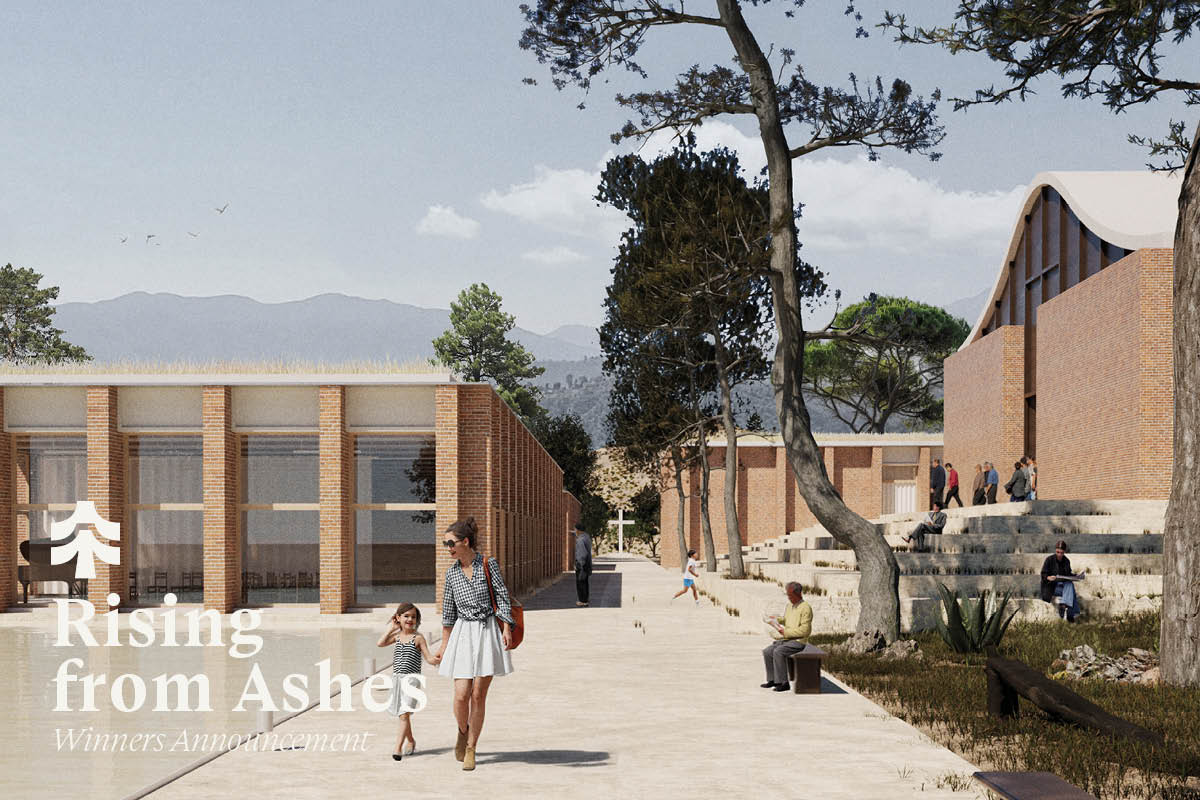
AXIS VITAE envisions a space dedicated to the community, where multiple functions coexist in synergy. From this emerges the idea of a true urban promenade weaving through various natural environments, a continuity that gives the project its name.
Organized around two structuring pedestrian axes and aligned with the natural slope of the site, the project strengthens its connections to the road network while offering a pathway between nature, spirituality, and new uses. One of these axes extends toward a landscaped cross, a belvedere overlooking the mountains. This place of retreat welcomes meditation, contemplation, and collective celebrations.
The architectural ensemble is composed of autonomous volumes, allowing each program to function independently while expressing a shared identity through careful material choices. Brick, selected for its durability and fire resistance, forms the pillars, flat vaults, and façades. In complement, a white veil acts as a light and adaptable element: it shapes atmospheres, creates contrasts with the mineral quality of the brick, and introduces an almost dreamlike dimension.
Green roofs help create a cool island and enhance the project’s integration into the landscape. The layout generates a diversity of outdoor atmospheres : a refreshing water feature, a tree-filled park, and two natural areas enriched by new plantings.
At the heart of the project, the church, visible from the main axes as well as from the street, subtly reinterprets traditional architectural codes. Rather than deconstructing the typology, we chose to preserve its essence and reveal new qualities. Resting on its forecourt and accessible from several sides, it overlooks broad steps. The brick monumentality engages in dialogue with the lightness of the white roof, which seems to descend from the sky, where light subtly reflects. A play of light and shadow also shapes an asymmetrical spatiality. To the north, thick brick walls inside and stepped façades outside reinforce this character. To the south, mobile white screens allow the building to open widely onto the park: the church can then host open-air celebrations, letting songs and prayers resonate across the site. A vertical light shaft marks the position of the priest, creating a compelling scenography: the projected cross, constantly shifting, evolves with the seasons and the movement of the sun. At the rear, private liturgical spaces unfold discreetly, concealed behind a stage curtain. Two individual prayer rooms and a mezzanine for the organ complete the volume.
The community hall, designed as a generous and traversing space, offers fluid circulation. Fully adaptable, it accommodates both daily use and large community events.
The school revisits the cloister typology to offer a variety of learning situations. The nursery, independent yet integrated into the whole, completes this space dedicated to the youngest users.
The administrative building, positioned at one of the entrances, includes shared workspaces with the possibility of extending activities into the garden.
Finally, two additional facilities enrich the project and serve the community:
– an exhibition pavilion, dedicated to the memory of the city and capable of hosting photographic archives and exhibitions ;
– a small library, a peaceful place for gathering and reflection, also serving to preserve documents related to the history and surrounding territory.
_________________________________________
About the First Prize – Nicolas Campodonico – Nicolas Campodonico Arquitecto
“The proposal is presented as a complete project through evaluated aspects. It gives a clear and harmonious response to the current situation. The programmatic division is successful in understanding the different needs presented by the requested program, along with the addition of a library and a memorial space, complementing the program of needs which are related and nourished by the exterior space between the buildings. The almost exclusive use of brick not only generates unity to the whole complex and provides warmth to its spaces, but also presents itself as a good material to respond to the local climatic circumstances.”
About the First Prize – Ingo Krapf – Hochschule Trier & IKID
“Extremely comprehensive, elaborately detailed design covering all aspects of the brief, seamlessly integrated into the former urban and landscape setting as a micro-urban development solution, incorporating all liturgical and communal functions of a church and community centre, presented in a fascinating and comprehensible layout.”
2nd Prize
EMOTIONS ON EARTH
Juan Pablo Lopez Isabella
Uruguay


EMOTIONS ON EARTH
Months have passed since those red and overwhelming nights, and calm seems to be slowly returning to that clearing nestled among the Altadena mountains. The place takes on a new meaning. The sparse vegetation, the few trees, and the isolated tufts of grass timidly encourage visitors to stay. The large balcony is at the mercy of the intense sun and the valley wind that carries the ashes before it, still lingering after the fire.
Nothing will ever be the same, but we realize that some things have always been and always will be present. By establishing an intimate relationship with the landscape and maintaining a keen interest in the elements that still give it life, we can respect its resilient spirit and materialize the idea that animates it through architecture, making everything more exciting, simple, and coherent.
The architecture erodes in harmony with the place, accepting its imperfections and sculpting a series of new spaces with emotional content, evoking faith and memory. Earthen structures that take root in the ground, blending in with rocks and bare branches, creating a second skin. Dense, simple, enveloping us with their physical presence, yet never overwhelming, always shadowy and protective.
The grandeur of the sacred space is articulated through subtle inflections, moments sheltered within walls, terraces, and stepped platforms that follow the curves of the site. Courtyards and galleries where souls contemplate the nature of water and fire in solitude or communion, giving rise to a rich environment of pure geometries that simultaneously emerge and camouflage themselves, silently aligning to create a metaphysical landscape. A haunting sparseness is perceived from the outside, where bodies expand horizontally, establishing a different perception of time, one that breathes intensity despite the apparent absence of activity.
A modest massing and a subtle prelude introduce the ritual. The serene quality of the interiors, scenes that unfold and build upon various masses, spreading out in broad and calm structural rhythms, reinforces the concept of a minimal architecture somewhere between primitive and ancestral, introducing a sense of contemplation. This feeling intensifies in those shadowy spaces that selectively pursue the light of the sky. These layers concentrate a warm and mystical atmosphere, bathed in light and shadow—effects that influence the visitor’s mood and encourage reflection and the recreation of the purest feelings of the spirit. Stripped-down spaces in profound stillness, coexisting with the intangible, seem to return to their origins, where the divine is reflected in the experience of eternity.
The silence of the sacred is not only audible, it is also visible.
_________________________________________
About the 2nd Prize – Amanda Iglesias – The Architecture of Prayer
“The “Emotions on Earth” project is richly informed by a long history of desert monasticism within the Christian church. The architecture suggests a presence of absence, telling the story of regional memory and of loss through a series of voids: apertures, openings, negative spaces, enclosures. The project’s muted exterior and desert vernacular creates a sensitive “village of forms” that is understated and non-assertive in its sacrality. This is an architecture that understand the wisdom of hiddenness.”
3rd Prize
Monument of the land
Xin Yi, Han Yi
China


Monument of the land
Ashborne memories
This land, once woven with the gentle rhythms of human and nature, now bears the scars of the wildfire, holding the shared memory of devastation and bearing witness to life’s fragility as well as its stubborn will to endure. The design concept draws inspiration from the “tombstone” – a memorial for the departed and an ode to renewal. Instead of using traditional design patterns, it aims to create a “monument”. It does not attempt to conceal the traces of disaster, but to transform trauma into a place of healing, death into a vessel of memory. The materials also emphasize “heaviness”, using dense, rustic, deep black stone that rises from the land, creating a grounded, contemplative space that bridges heaven and earth, the sacred and the mundane, the individual and the community.
Way down we go
The strategy of design does not seek to dominate the landscape, but to adapt to it. All the functional spaces spread along the hillside, featuring seven resting platforms (referring to the Seven Last Words from the Cross), creating a pilgrimage path from high to low. This downward journey is not merely a physical movement – it is a tribute to Jesus, a heartfelt humility, eventually opening a path of spiritual elevation. This downward path also links the relatively gentle activity areas at the top of the slope with the steeper natural landscape at its base, serving not only as a space of worship but also as a catalyst for revitalizing the entire area.
Orderliness—Narrowness
“Enter through the narrow gate. For wide is the gate and broad is the road that leads to destruction, and many enter through it. But small is the gate and narrow the road that leads to life, and only a few find it.”(Matthew 7:13-14)
The space emphasizes the concept of “narrowness”. With axial layout , it creates a sequential, guided, and introspective experience. The main hall, 10 meters wide and 70 meters long, has a strong vertical orientation that irresistibly directs people’s gaze and movement towards its terminus. The dim corridors on both sides heighten the sense of ritual and consciousness of decision-making when “entering” other functional spaces. Several long, independent linear spaces are combined together, each serving a different function and receiving its own beam of light from above. The purity of the spatial sequence and the sense of direction further promote the user’s concentration and introspective awareness. It departs from the conventional church layout, which favors spacious and comfortable interiors, deliberately choosing a narrow, long, and dynamic spatial sequence, inviting every visitor to personally experience the essence of faith in the “narrow gate”.
_________________________________________
About the 3rd Prize – Jordi Espinet – Mesura
“The project demonstrates strong conceptual clarity and coherence between narrative, form, and spatial sequence. The emotional intent is legible and consistently translated into massing, light, and procession. Its restraint is a strength, giving the architecture presence and gravity.”
Golden Mention
Sanctuary of Renewal
Isaac Vaarzon Morel
Netherlands


Sanctuary of Renewal
The project embraces nature as both a formative force and a source of renewal, at once powerful, threatening, and profoundly life-giving. The building’s volume follows the contours of the terrain, gently carved into the hillside to dissolve the boundary between architecture and landscape. This embedded form creates a seamless transition between ecological zones, allowing the structure to exist as an extension of the ground itself.
By slipping into the topography, the project generates two spatial typologies: outward-facing rooms that open to the valley, and inward-focused chambers oriented toward enclosure and quietude. These dual conditions foster both individual introspection and moments of collective gathering, oscillating between privacy, spirituality, community, and solidarity.
Reflection becomes the central device binding the natural and the artificial. Pools of water and slender metallic slats capture and redistribute light, animating the interior with shifting patterns. These mirrored surfaces generate a dialogue between roof and floor, creating a doubled plane that unites the earthly and the transcendent, an architectural articulation of layered spiritual realms.
The roof functions as a hybrid terrain, allowing an “artificial nature” to fold back into the earth. The sanctuary below remains completely open, conceived as a transitional and temporary zone held within the ground’s embrace. Here, the natural environment is not excluded but integrated, becoming a protective presence and a symbol of renewal.
Rammed earth walls anchor the architecture to its terrain, their mass storing warmth through winter and releasing coolness in summer. As a quiet reminder of rising from ashes, the primary structural walls are infused with ash, giving the material a subtle depth, an alchemy of renewal embedded in the very substance of the building. In the more intimate interior spaces, the rammed earth rises without admixture, its untouched strata recalling the familiar textures of exposed ground. The floor is rendered in stabilized earth, allowing the surrounding landscape to flow seamlessly into the architecture. In this way, the building does not merely touch the land, it becomes an extension of it, a sanctuary shaped by soil, memory, and the hope of regeneration.
Golden Mention
The Ashen Vine
Lorenzo Valdes, Leonardo Lot
Italy


THE ASHEN VINE
“To build means, first of all, to listen to what a place is asking for.”
Pope Francis – Vatican City.
The Ashen Vine is born from this premise: to intervene in a territory marked by the fire of January 7. The project takes the landscape as its primary matrix while maintaining a discreet presence. The volume follows the contours of the hills and remains below the dominant sightline toward the San Gabriel Mountains, establishing a calibrated relationship between architecture and geography. The double-curved roof emerges from the intersection between the local slopes and the need to channel controlled zenithal light into the interior spaces.
The vineyard surrounding the church is not a mere landscape element: it functions as an environmental infrastructure. The vegetated bands filter heat, mitigate the microclimate, and define an agricultural threshold that increases the soil’s resistance to the spread of wildfires. The use of the vine also takes on a symbolic and spiritual role, recalling the tradition of Californian monastic settlements, which produced wine from their own vineyards.
The heart of the complex is the elliptical nave. The choice of geometry responds to liturgical and acoustic criteria: it optimizes the distribution of the congregation, reduces the perceived distance from the altar, and supports a more participatory liturgy. Natural light is regulated by skylights integrated into the curvature of the roof, ensuring a controlled variation of light throughout the day. Around the nave runs a continuous museum path—an encircling ring that preserves the memory of the fire and symbolically embraces the faithful. A gesture that transforms the wound into a shared narrative.
The two lateral volumes house the community functions: educational rooms, offices, services, and the parish canteen. They are conceived as autonomous yet integrated structures, capable of operating independently from the liturgical hall, making the church a civic as well as a religious anchor.
The materials root the building in its place. The structure is made of white concrete mixed with aggregates sourced from the very hills of Altadena, establishing a direct link with the local geology. The exterior pavements employ stones recovered from rural walls damaged by the fires, restoring a tactile memory of the territory within the project. Inside, cedar wood—typical of the region—evokes the forests that once covered the surrounding slopes.
The roof, conceived as a double-curved structural concrete shell, represents the most innovative element of the project: it manages light and shadow, optimizes natural ventilation, and ensures stable thermal performance. Completing the system are climate-resilience strategies: passive orientation, cross-ventilation, shading surfaces, and the integration of the vineyard as an ecological infrastructure.
The building thus behaves like a silent infrastructure: it organizes the land, regulates the microclimate, and defines civic spaces and collective rites. Its form is a consequence. The Ashen Vine becomes a permanent device for the care of both landscape and community.
Golden Mention
Afterlight
Derin Kinacigil
United Kingdom


Afterlight – Rebirth through Light and Landscape
Emerging quietly from the suburban hills of Los Angeles, Afterlight embodies the gentle strength of renewal — a sanctuary where light and landscape come together to heal, nurture, and reconnect community and faith. Conceived as a rebirth through light and landscape, the project reimagines the local chapel as a place of shared belonging, rising humbly from the ashes to restore hope and continuity.
Rooted in the vernacular of Southern California chapels, the design draws from familiar forms and honest materials — simple gables, stone bases, and soft rooflines that merge naturally with the landscape. Three distinct volumes step down the sloping site, each connected by serene garden cloisters that form a contemplative sequence of movement and reflection. The stone plinth recalls the memory of burnt churches, while the folded standing-seam metal roof ascends toward the heavens, its reflective surface mirroring the changing sky and the shimmering water ponds below — a quiet metaphor for transcendence and rebirth.
The spatial journey unfolds from north to south. The northern block is dedicated to youth and learning — a nursery and community chapel bathed in natural light, nurturing young minds through bible study, music, and education. The central block anchors the ensemble as the civic heart, housing the fellowship hall, meeting rooms, and staff areas around bright interior gathering spaces and open cloisters — places of pause, exchange, and gentle encounter.
Through the Eden Garden link, visitors arrive at the southern worship block, where the architecture deepens in emotion and stillness. From the chapel lobby, small private prayer gardens open discreetly, offering spaces for personal reflection and quiet prayer before entering the main sanctuary. Beyond lies the primary chapel, a luminous volume whose roof geometry folds skyward. Light filters through a cruciform skylight, filling the interior with a serene radiance, while narrow side windows frame views of the surrounding hills — drawing the landscape into the sacred space.
Sustainability is embedded in the project’s ethos: local stone and non-combustible metal roofing ensure resilience in wildfire-prone regions; passive ventilation, shaded cloisters, and native plantings reduce energy use while enriching the sensory experience.
Ultimately, Afterlight is an architecture of renewal — humble yet radiant, rooted in place yet reaching skyward. It stands as a testament to community resilience and the enduring power of light to guide us through loss into hope — a new dawn, rising from the ashes.
Golden Mention
Faro de la Tierra
Juan David Botello Meza, Marc Laibacher
Colombia


faro de la tierra
In Altadena, a new church is rising from the devastation of recent wildfires, becoming a place of hope and quiet reflection. The building combines earth and steel to withstand fire while also making a strong statement about sustainable construction. As a counterpoint to the technological visions of nearby Silicon Valley, it reminds us that sacred architecture does not need to rely on climate-damaging concrete and that progress without regard for the environment contributes to the climate crisis.
The church uses passive cooling, thermal mass, and deep-set openings to create shade and work in harmony with the local climate. In this way, it becomes a symbol of a future in which the community overcomes the fires of climate change, finds stillness, and takes responsibility for the Earth. It points toward a future in which humanity mitigates the consequences of climate change without falling into mere activism, drawing strength from moments of quiet, and embracing its responsibility for creation — echoing the task given to humanity in Genesis 2:15: to cultivate and care for the Earth.
Finding the right balance here, in shared responsibility for creation, is also the central theme of this year’s Venice Architecture Biennale. The church in Altadena gives this task a particularly meaningful architectural expression.
Its orientation also carries historical meaning: the church is set on a 38-degree tilt, aligning itself with the angled grid first established by the early Spanish settlers of Los Angeles. This gesture connects the building to the region’s earliest layers of urban history, acknowledging the cultural landscape that shaped Southern California long before the modern metropolis emerged.
Golden Mention
Well of Light
Seoho Kim
Republic of Korea


Title: Well of Light
In the wake of the Eaton Fire, the landscape of Altadena bears deep scars. This proposal, “Well of Light,” is not merely a reconstruction of lost structures but a spiritual apparatus that excavates the earth to draw up light and healing. The design anchors itself in the steep topography, using the section of the land to narrate a journey from ashes to resilience.
The Duality of the Slope The architecture leverages the site’s gradient to create two contrasting experiences. From the lower approach, the building asserts itself as a horizontal concrete monolith floating above the rugged terrain, emphasizing resilience against the wild. Conversely, from the upper approach, the volume submerges into the hillside. Here, the architecture recedes, blending seamlessly with the contours to suggest humility and assimilation with nature.
Surface of Purification At the heart of the sequence lies a central courtyard featuring a vast reflecting pool. Reinterpreting the traditional narthex as a transitional zone for cleansing the mind, this water feature mirrors the sky and the surrounding greenery. It acts as a mirror for the earth, reflecting not the destruction of the past, but the vitality of the regenerating forest.
Framing the Recovery The Fellowship Hall features a modern reinterpretation of the sacred oculus. A large, clear circular window acts as a lens, framing the specific view of the mountains that are slowly recovering from the fire. This “Oculus of Recovery” transforms the landscape itself into a sacred icon, turning the act of looking into a ritual of hope.
The Well of Light The core of the project is the subterranean sanctuary, buried deep beneath the water level. While the surface connects with the landscape, this interior turns inward to the silence of the earth. Light pours in through a sculptural skylight that pierces the ground from above. Like a vertical shaft connecting the darkness of the soil (Ashes) with the brightness of the sky (Rising), this “Well of Light” creates a solemn atmosphere where the community can find spiritual refuge in the grounding embrace of the land.
A Vessel for Renewal Ultimately, “Well of Light” stands as a testament to the community’s endurance. By intertwining the permanence of the earth with the ephemeral quality of light, the architecture becomes a vessel for collective memory. It transforms the site of tragedy into a landscape of renewal, ensuring that from the ashes of the past, a brighter, shared future can truly rise.
Honorable Mention
Radiant Path
Oleksii Zolochevskyi, David Sieliekh
Ukraine


Honorable Mention
FROM IGNITION TO REBIRTH
Julia Brzezowska
Poland


Honorable Mention
The Forest : Built of Memories
Seongjune Park
South Korea


Honorable Mention
Church of Ripples
Zihao Wang
United States


Honorable Mention
Fireproof oasis
Federico Pazzaglia, Mattia Tabellini, Lorenzo Martinelli
Italy


Honorable Mention
Symbállein
Julia Ribosa, Marta Fernández, Pablo Fargas
Spain


Honorable Mention
Comunion Beneath the Shadecloth
Jinsil Kim, Taeeun An
South Korea


Honorable Mention
Ashen Path to Rising
Youngki Kim
South Korea


Honorable Mention
Ember Genesis
Miao Wang, Tianchi Zhao
United States


Honorable Mention
Sentinel of memory
Elhouan Richard, Nathan Marron
France


SHORTLISTED PROJECTS

The post Results: Rising from Ashes appeared first on Competitions.archi.