

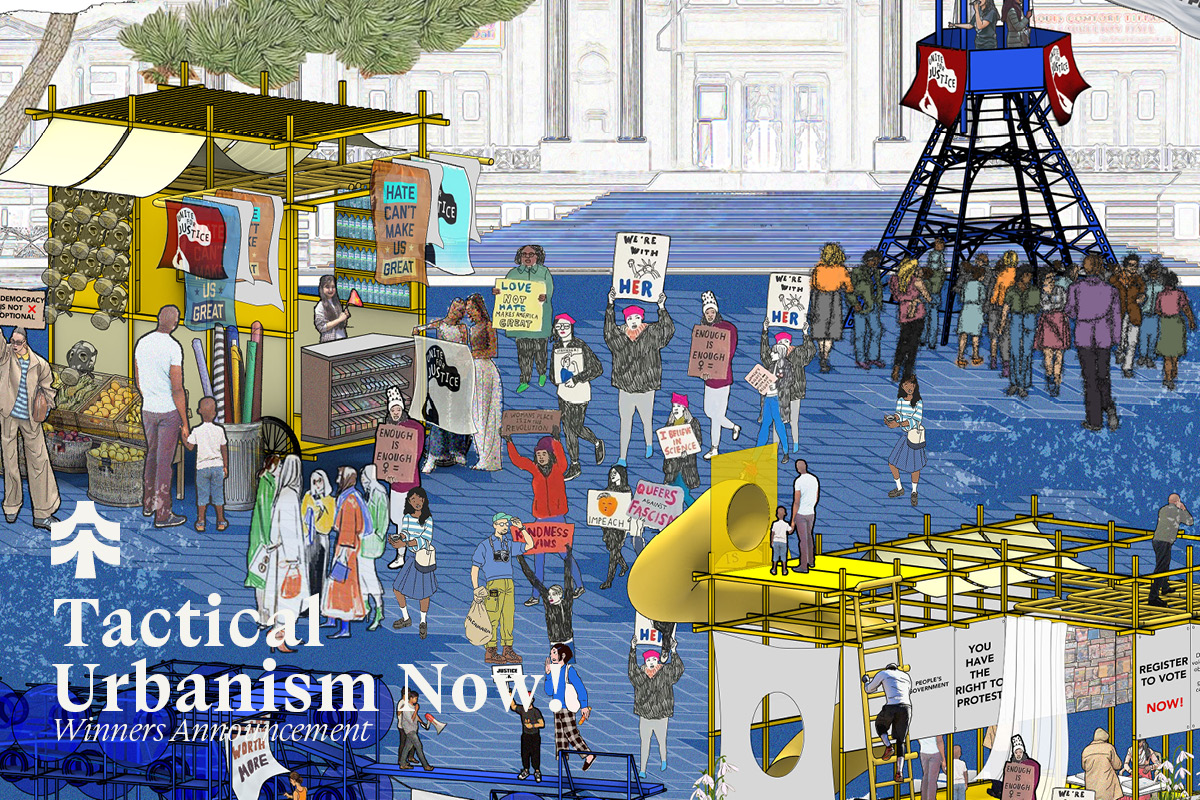
Terraviva has officially released the complete list of awarded projects of the architecture contest entitled “Tactical Urbanism Now! 2025”.
The competition invited designers to rethink the potential of urban environments through small-scale, impactful interventions capable of addressing today’s most urgent spatial and social challenges. it encouraged participants to explore unconventional and often overlooked sites, from derelict alleyways and vacant lots to underused streetscapes and forgotten urban corners, demonstrating how temporary, participatory and low-cost strategies can generate meaningful transformation. The aim was not only to resolve functional issues but also to strengthen community engagement, resilience and sustainability. Whether reactivating an empty plot as a neighborhood gathering space or converting an infrastructural void into a vibrant public node, the competition challenged designers to show how minimal yet thoughtful actions can leave a lasting imprint on the urban fabric.

The jury praised the awarded proposals for their originality, clarity of concept, and ability to translate social, cultural, and spatial narratives into compelling urban gestures. Some projects distinguished themselves by addressing themes of collective action and civil rights, illustrating how public space can become a platform for dialogue and shared identity. Others were recognized for their intelligent simplicity, revealing how informal uses and threshold conditions can redefine the meaning of public space and foster coexistence and resilience. Some highlighted interventions that transformed obsolete structures into flexible and multifunctional systems, offering immediate spatial and social impact while demonstrating strong scalability and implementation potential. Together, these proposals showcased the transformative power of tactical urbanism when rooted in empathy, adaptability and community-driven design.
Terraviva warmly congratulates all participants for their creativity and meaningful contributions, which continue to inspire new ways of shaping more inclusive, vibrant, and resilient urban spaces.
The winners were selected by an international jury panel composed by:
-
- Leonardo Zuccaro (Milan, Italy) | PoliMi + COpE
- Wei Dou (New York, United States) | SWA Group
- Vincent Rault (Lisbon, Portugal) | Muro Atelier
- Rowan Elselmy (Dubai, United Arab Emirates) | DEOND
- Alan Gancberg (Buenos Aires, Argentina) | Crucial Urbanismo
- Teresa Pontini (Milan, Italy) | Urban Consultant
- Pablo Castillo Luna (Las Palmas, Spain) | À la Sauvette
- Yiqing Wu (New York, United States) | Field Operations

1st Prize
Soft Monuments: Constructing the Political City
Kriti Shivagunde, Niriksha Shetty
United States


Soft Monuments: Constructing the Political City
In the restless choreography of New York City, where architecture and action constantly collide, this project imagines protest not as rupture but as rhythm; a right inscribed into the body of the city itself. Our proposal constructs a network of modular interventions through objects of protest that live dual lives. They inhabit everyday urban spaces as benign structures of gathering, exchange, or rest, but in moments of collective urgency, they transform into instruments of resistance.
Each module is conceived as a spatial fragment, light enough to migrate and strong enough to anchor emotion. Composed of familiar materials: shopping carts, scaffolding, plywood, inflatables, these units “plug into” the city wherever voices need amplification. They are tactical and poetic, utilitarian yet utopian. At their core lies a belief that to protest is to belong, and that the built environment can nurture this belonging by refusing to render dissent invisible.
Our project arises from lived experience. The mass protests that rippled through Columbia University and across the city, where architecture itself became a participant. To build for protest is to build for freedom and safety, to assert that dissent deserves design.
We situate our modules at Columbia University, Foley Square, the Metropolitan Museum of Art, and Brooklyn Bridge – sites charged with layered meanings of privilege, history, and connection.
At the heart of this work lies a political and spatial desire, to create conditions of ethnic comfort within predominantly white neighborhoods, to make visible those who are too often peripheralized in the city’s visual and cultural field. By foregrounding immigrant and diasporic presence, the project insists that public space must not only tolerate difference but celebrate it. Architecture becomes a language of inclusion, not enclosure.
Our drawings mirror this ambition: figures rendered in multiple visual idioms – cut-outs, outlines, painterly strokes, occupy the same frame. They refuse the uniformity of representation, instead performing the multiplicity of the city itself.
Through our design, we also reimagine the very implication of a monument. ‘Soft Monuments’ reaches toward an identity that invites participation, within its boundaries and beyond, as opposed to the traditional monument, which demands distance, reverence, and silence. Where conventional monuments are edifices of observation, we propose architectures of engagement: tactile, porous, and alive to the urgencies of their moment.
Ultimately, this project dreams of a city where protest is not disruption but dialogue, to imagine that the city, in all its density and noise, can one day be generous enough to hold every voice that rises within it.
_________________________________________
About the First Prize – Yiqing Wu – Field Operations
“The project addresses a compelling and contemporary theme of protest and civil rights, demonstrating how urban space can serve as a platform for collective action and social change. It offers not just aesthetic value but meaningful social impact.”
About the First Prize – Leonardo Zuccaro – PoliMi + COpE
“The project is an inspiring proposal of soft protest as a common sense of belonging and a driver of dialogue.”
2nd Prize
The Urban Stitch
Arghajit Mazumdar, Avirup Sinha
India


In Indian cities, public spaces are often defined not by their design, but by their occupation. They evolve through use—improvised, contested, and constantly re-imagined. Livelihoods, intimacies, protests, and play all unfold in these supposedly “neutral” zones. What makes them public is not just access, but action. In this context, the Gariahat Flyover in Kolkata becomes a compelling protagonist. Space doesn’t possess a fixed identity. It is an experiential construct—formed through a collective, lived understanding. As Kazi Ashraf articulates in his talk ‘Space is Society’, space acts as a “lived body”, embedding memory, routine, inequality, and resilience. Spatial inequality is not accidental—it is systemic. In Indian cities, these layered asymmetries are most visible in the thresholds: in spaces like footpaths, alleyways, and flyovers.
As Maria Cristina Cravino notes, “the city is conflict, just as society is conflict, but the conflicts that settle and the conflicts that manifest within each city depend on the city itself.” And nowhere is this more evident than beneath the Gariahat Flyover.
Spanning approximately 600 meters, from Rashbehari Avenue Crossing to Ballygunge Phari, the Gariahat Flyover is an arterial structure at one of Kolkata’s most active commercial and residential intersections. The area’s tempo is relentless. But beneath this gray overhead, another city pulses—quieter, fragile, and resilient.
The flyover’s shaded underbelly serves as far more than leftover space. For many, it is a roof, a refuge, and a right. Vendors set up stalls; families assemble makeshift homes; children run barefoot across tarpaulin floors. Here, the flyover gains agency—it becomes a surface of protection, no longer inert infrastructure but a living scaffold of marginalized urban life.This space is shared. It is multifunctional. A zone for sleeping at night becomes a market by day and a transit shortcut for pedestrians. It is a textbook case of informal use, livelihood layering, and the making of the public, private. The flyover’s “belly” is domesticated. Public land is folded into the personal through routines, repetition, and reinvention. A deeply public space acquires privacy in its corners.
When interviewed, Sabita Sardar, a long-time inhabitant, said: “I went to my son’s quarter but couldn’t stay for long.” This longing to return to the flyover underlines a truth: what we often define as “precarious” may be their normal. This so-called precocity hosts an alternative normal, formed in the city’s overlooked folds.From discarded billboard vinyls turned into roofs to bricks used as cooking stoves, the residents recycle the city’s waste to stitch together survival. They carry water to nearby kiosks. They are labour, service, and presence. Marginalized, yes—but integral to the urban system.
The underbelly of the flyover thus becomes a starting point, an urban threshold where alternative systems of living, trading, and resting emerge. This constant friction between the formal and the informal—between ownership and occupation—raises urgent questions: Can public space be owned? Who gets to belong?Their subtle presence on the margins, their quiet cohabitation without permanent appropriation, challenges today’s obsession with permanence and boundaries. In this fluidity, boundaries blur—who crosses whose space, who lives where, who belongs. The flyover becomes not just a road but a theatre—of collisions, coexistence and empowerment, of the spoken and the invisible.
_________________________________________
About the 2nd Prize – Vincent Rault – Muro Atelier
““The Urban Stich” is intelligent in its simplicity and powerful in its purpose. It reveals how informal, improvised uses can redefine what we call “public space,” turning neglect into agency. It’s particularly interesting in how it works with the notion of the threshold, spatially, at urban scales, and socially, showing how these in-between spaces become zones of negotiation, coexistence, and resilience. Though rooted in its context, its insights are universal.”
3rd Prize
Over the Street
Polatip Thongphruksalai, Asashi Teasgorn, Jariya Mahachai, Noossira Suanyeam, Phattarapron Suwanwattana, Phurin Tieneiemanan
Thailand


In the dense urban fabric of Bangkok, footbridge quietly stretch above traffic-choked roads. Often overlooked and underutilized, these structures were originally designed to serve pedestrians but have become spaces people avoid—too hot, steep, and uninviting. Over time, this value has faded, leaving behind traces of failed urban planning scattered across the city.
The “Footbridges of Siam” project aims to redefine the role of footbridges in Bangkok, transforming them into vital components of the city’s social and spatial. By inserting simple, low-cost, and flexible public programs into these bridges, we want to transform these forgotten footbridges as community spaces. This initiative responds to long-standing urban issues such as the lack of accessible public areas, the issue of stray animals in the city, the neglect of the homeless, and disorganized street vending. Through a variety of modular units, these bridges can be transformed into spaces for relaxation, animal shelters, small-scale commerce, or even platforms for public activities.
Our modular system is designed using basic, widely available materials such as round steel pipes, scaffolding joints, waterproof tarpaulin, and recycled plastic components. These materials are durable and allow the structures to be easily assembled, disassembled, relocated, or upgraded as needed. With a standard module size of 2×2 meters, the system allows for easy expansion and adaptation to suit the diverse needs of different neighborhoods.
The installation will be restructured every 3–4 months throughout the year to meet usage needs in each period. This approach helps prevent permanent occupation of the space.
We strongly believe this project has the potential to scale across more than 30,000 footbridges and many other neglected urban spaces throughout Thailand, as well as in countries like Indonesia, Vietnam, the Philippines, India, and Malaysia. Beyond footbridges, other underutilized spaces—such as areas beneath flyovers or vacant lots—can also benefit from this adaptable and inclusive approach.
_________________________________________
About the 3rd Prize – Alan Gancberg – Crucial Urbanismo
“The project successfully reimagines an obsolete urban structure, transforming it into a multifunctional system capable of providing shelter, activity, and programmable public space for a wide range of urban users. The proposal is both original and intuitively aligned with its context, enabling adaptable configurations based on each bridge’s location. This flexibility produces an immediate spatial and social impact while contributing to the city’s architectural identity by reframing everyday infrastructure and making it newly legible. The intervention operates within the framework of tactical urbanism, grounded in a typological pattern that recurs across many global cities. This gives the project strong scalability and implementation potential. Furthermore, the narrative and graphic representation are technically robust and clearly articulated, demonstrating precise attention to detail and a well-resolved design methodology.”
Golden Mention
Rinning Food Festival
Lejing Lin, Yi Pan, Zhen Wang, Junyan Zhao, Lirong Chen, Yuxin Ji, Yawen Li, Yijing Zhong, Chen Du, Anqi Cai, Yuanchuan Yang
China


Food Saves Trastevere
Trastevere, located in Rome, Italy, is one of the city’s oldest neighborhoods. Its traditional cuisine is deeply intertwined with the area’s identity. However, with the advance of urbanization, the aging streets and alleys, along with high food costs, no longer support the continuation of traditional culinary practices. The connections between streets, food, and people, as well as the neighborhood’s cultural characteristics, are gradually being lost.
To address this, we propose the Food Saves Trastevere initiative. Through a series of installations, we tackle issues such as outdated street infrastructure, barriers to neighborhood interaction, abandoned rooftop spaces, improper waste management, and graffiti, while embedding the processes of harvesting and preparing traditional ingredients into each installation and its corresponding street space. This creates a culinary map that begins with ingredient harvesting and preparation at Piazza Trilussa and reaches its climax at Piazza di Santa Maria. Traditional cuisine is no longer treated merely as a finished product; instead, the culinary process reconnects people, food, and Trastevere.
Golden Mention
Cloud Tactics: Pop-up Microclimate
Yuehui Gong, Ling Zhang, Yuting Yan, Yangyi Li, Muhan Li
China


Cloud Tactics: Pop-up Microclimate
With climate change, big cities like New York face intense urban heat islands—summers burn the street and shade is a privilege. You can’t plant a mature tree in a week—but you can borrow the sky. Cloud Tactics arrives not as a structure but as soft resistance to extreme heat. Clouds are generated to raise humidity and cool the street, and the proposed kit is characterized by its adaptability and temporality: it is light and easy to install, clipping to streetlights, scaffolds, and poles; and, with wheels and nozzle control, the cloud migrates through streets, plazas, playgrounds, and parking lots, prioritizing areas where heat and vulnerability overlap over the course of a day.
After a quick installation, the portable mechanical kit connects to city water or a stormwater cistern, filters the water supply, and pumps the treated water through lines to the nozzle heads. Time-controlled spray is released between two mesh layers to form and hold the cloud: an upper function layer of Raschel mesh with approximately 50% openness slows wind and retains the cloud, while a lower interaction layer of monofilament mesh with approximately 60% openness allows mist to interact with people and guides a gentle drip. Sequenced modules assemble into temporary cloud-cooling corridors. Light voile on slender arms catches wind and softens glare, while pulses of fine mist cool the air; as the mesh breathes with the wind, shifting folds push the cloud, drifting along the corridor.
These tactical cloud-cooling corridors are suited to many urban scenarios—shaping a mist performance zone on an overheated plaza where people rest, gather, and dance; creating a cooling corridor along an open street where pedestrians walk and play beneath drifting clouds; or, in parks without mature trees, providing a moving moisture veil that helps vegetation survive extreme heat. As the kit returns seasonally and shifts to where it’s needed most, relief becomes a long-term civic ritual, fostering the growth of plants and civic life under the cloud.
Golden Mention
Urban Inflation
Mingrui Jiang, Yuxin Lin, Yinan Fang, Chunyang Xu
China


Urban Inflation is a tactical urbanism proposal that reactivates underused urban spaces in Ann Arbor through a network of inflatable, movable “bubble” structures. These temporary, lightweight, and cost-effective interventions reactivate forgotten or transitional urban voids—alleys, courtyards, leftover spaces between buildings by transforming them into vibrant social nodes for gathering, play, and exchange.
The concept of inflation works both physically and metaphorically. Physically, the project introduces pneumatic structures of varying scales—from small inflatable furniture and shaded canopies to large semi-transparent enclosures that attach to building façades or extend across open plazas. Metaphorically, Urban Inflation speaks to the expansion of social life, the breathing-in of vitality into spaces that have been deflated by neglect or underuse. The bubbles become adaptive urban prosthetics: soft, temporary, and inclusive, responding flexibly to shifting patterns of use, seasonality, and user needs.
Each installation invites participation. Visitors can rearrange smaller pieces to form relaxing nooks, social pods, or resting spots. Larger inflatable modules can host impromptu exhibitions, performances, or collective gatherings. Made from recyclable and lightweight materials, the bubbles can be easily assembled, moved, or deflated—demonstrating a sustainable and reversible approach to urban activation.
Through these interventions, Urban Inflation challenges conventional boundaries between architecture and event, permanence and ephemerality. It envisions a city that breathes and transforms, where space is not fixed but continually negotiated by its users. By occupying the overlooked edges and in-between zones of the urban space, the project reimagines what “public space” means in a contemporary academic environment—an adaptable, shared, and joyful infrastructure for spontaneous interaction.
Ultimately, Urban Inflation celebrates the transformative potential of inflatable design to create meaningful social impact. By giving form to the city’s invisible and overlooked spaces, it expands the possibilities of urban life and regenerates the existing urban fabric—making the city not only more dynamic, but also more adaptable and vibrant.
Golden Mention
Let’s Play! – A Journey of Regeneration and Reconnection in Glasgow
Xinyue Geng
United States

Concept Overview
Let’s Play! is a conceptual spatial design inspired by the “temporary theatre.” It reinterprets street performance as a medium for cultural and community exchange. Through a sequence of interactive open spaces across Glasgow, the project reconnects the two banks of the River Clyde, revitalizes post-industrial structures, and transforms them into a narrative journey through the city.
Context and Analysis
The proposal occupies Glasgow’s historic Union Railway Bridge, once a vital artery of the industrial age and now an overgrown relic dividing the city. Its massive structure has become a barrier between communities of differing cultures and lifestyles, while the Clyde, once the city’s lifeline, has faded from daily urban life. The viaduct thus offers a chance to bridge both physical and social divides and to revive Glasgow’s theatrical heritage.
Addressing broader urban challenges such as limited dialogue among communities, river pollution, underused waterfronts, industrial waste, and the city’s persistent gloom, the project introduces low-cost, interactive installations. These small, adaptable, and replicable interventions seek to restore vibrancy to public space through participation and play.
Design Strategy
Celebrated for its street art, Glasgow provides fertile ground for transforming performance into public experience. The design introduces a chain of open-air stages linked by a continuous greenway atop the viaduct. These installations serve as platforms for artists and gathering points for residents, inviting people to re-enter the abandoned industrial landscape and reconnect through shared experience.
Rain Theatre
With rain falling most of the year, gloom has become part of Glasgow’s rhythm. The Rain Theatre transforms this persistent rainfall into music. Using a custom echo system made from recycled rainwater pipes, it turns gray, rainy moments into a spontaneous urban symphony.
Floating Theatre
Once central to Glasgow’s identity, the River Clyde has drifted from public life. The Floating Theatre reactivates the river with movable platforms for performances and open-air films, celebrating river culture against the city’s skyline. Audiences watch from boats, reconnecting with the water and enlivening neglected waterfronts.
Landscape Tower
Inspired by historic cranes, the Landscape Tower features a rotating lift which people can use to filter debris from the Clyde. It serves as both a reminder of environmental decay and a call for civic participation. Over time, its perforated frame becomes a habitat for aquatic life, symbolizing regeneration through ecological engagement.
Marimba Walkway
Repurposing abandoned railway tracks into a playable path, the Marimba Walkway echoes the rhythm of the marimba. Mechanical linkages embedded in spiral stairs trigger tones with each step, allowing visitors to rediscover the site’s history through sound and motion.
Conclusion
Together, these installations form a tactical network that communities can build, adapt, or relocate. By intertwining art, ecology, history, and inclusivity, Let’s Play! shows how tactical urbanism transforms industrial remnants into participatory landscapes. Viewing regeneration as an ongoing, collaborative process, the proposal preserves Glasgow’s cultural legacy through creative engagement, reimagining forgotten structures as open stages that unite diverse communities and narrate the city’s evolving story—its past, renewal, and shared future.
Honorable Mention
From Parking To Living
Łukasz Frąc, Gabriela Palasz, Łukasz Duda
Poland


Honorable Mention
Urban Narrative Flow
Sanam Mirzaye-Ahmadi, Mostafa Mirzaye-Ahmadi
Iran


Honorable Mention
Urban Buffers: how to unite communities by activating in-between spaces
Lorenzo Fortunato, Chirstina Pieri, Giulia Paolillo, Giulia Papa, Isabella Souleimanov, Gabriel Barba Alfaro, Giuseppe Semeraro
Italy – Cyprus – Perù


Honorable Mention
Extramuros
avier Vera Cubas, Belén Rey Nuñez de Arenas, Ezequiel Collantes Gabella, Andrea Díaz Rozas
Perú


Honorable Mention
The Floating Shoreline
Yannis Negrel, Juliane Giordano, Marie Gonzalez, Emilie Deschamps, Olivia Porter
France – Switzerland


Honorable Mention
To Gather: The symbiotic renewal design of mixed Sino-African community in Guangzhou
Anqi Cai, Jiaying Gao, Boao Luo, Lingjia Zhu, Zhuangyi Qin, Junda Lu, Junyan Zhao
China


Honorable Mention
Scaffold Plug-ins
Chun Ki Yan
Hong Kong


Honorable Mention
The Vivid Red Within: A Pulse of Lilong Life
Ruoyu Yang, Binhan Wang
United Kingdom


Honorable Mention
MERDİVEN: Vertical Rhapsody
Arda Miskioğlu, Melisa Küçükistanbul, Umut Kaya
Turkey


Honorable Mention
Interlocked Kit
María Lucía Villalba, Frida Rueda Cabrera
Argentina


SHORTLISTED PROJECTS

The post Results: Tactical Urbanism Now! 2025 appeared first on Competitions.archi.