

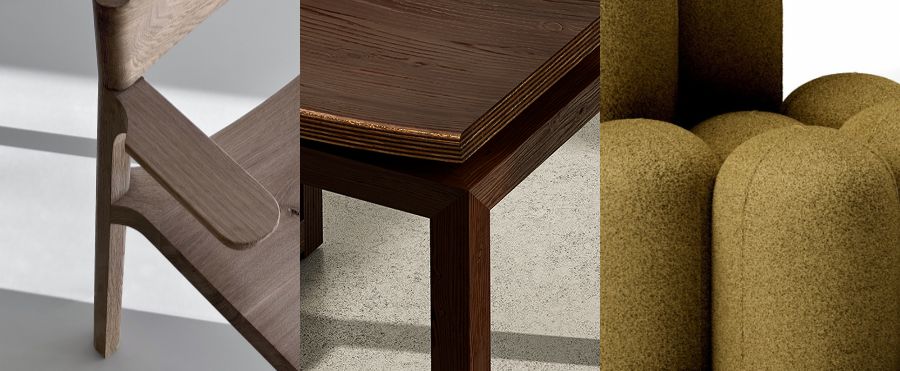
Buildner is proud to announce the results of the fourth edition of the Architect’s Chair Competition, which once again gathered an exceptional collection of ideas from designers and architects across the globe. Now firmly established, the competition continues to serve as a unique platform where architectural thinking, craftsmanship, and material exploration converge through the intimate scale of chair design.
As the competition evolves, Buildner is delighted to celebrate the continued success of its growing publication series, which now includes books featuring the most notable projects from earlier editions. These collections highlight the remarkable creativity and technical rigor demonstrated year after year:
Chair design offers architects a distinct opportunity to test spatial instincts, rethink structure, and refine their relationship to materials. Whether through sculpted minimalism, modular experimentation, or culturally informed craftsmanship, this year’s winning entries reflect the breadth of architectural approaches that can emerge from a single typology.

An accomplished international jury—comprising leading voices in architecture, product design, and furniture craft—evaluated the submissions across several key criteria: functionality and comfort; materiality and construction; aesthetic clarity; ergonomic resolution; and versatility within architectural environments.
The 1st Prize was awarded to Eero Chair by Sergei Grigorev (Cyprus), a minimal wooden piece defined by sculpted transitions and material clarity. The 2nd Prize and Student Award went to Silent Equilibrium by Jimin Oh and Eunseo Shin (South Korea), a chair exploring balance and Korean spatial philosophy through traditional joinery. The 3rd Prize was given to Hills by Andrii Kovalskyi (Ukraine), a modular soft-furniture system inspired by natural topographies. The Sustainability Award went to Think Twice by Andrada Calin (United Kingdom), a public bench made from reclaimed textile waste.
Buildner thanks all participants for their ambitious contributions. Visit our website to view the Honorable Mentions and Shortlisted projects. Buildner extends its appreciation to all participants for their thoughtful and ambitious contributions. The selected winners represent the highest level of precision, imagination, and technical achievement in contemporary chair design, and we are proud to share their work with the global design community.
1st Place
Eero chair
Sergei Grigorev
Cyprus

“I do not have experience with furniture competitions yet, but I do have successful experience with interior competitions. For a beginner, competitions are one of the few ways to receive objective feedback from a professional community rather than from social media users.”
_________________________________________
JURY FEEDBACK summary
Eero Chair is a minimal wooden chair designed around coherence, sculpted transitions, and the expressive potential of solid timber. The form focuses on continuity between planes, using carved junctions and softened geometries to create a fluid relationship between legs, armrests, seat, and back. Each component is shaped to provide ergonomic comfort without adding superfluous detail, relying instead on the visual warmth and structural clarity of natural wood. The chair is developed as a fully crafted object—from joinery to surface treatment—emphasizing durability and aesthetic longevity. Subtle shifts in thickness, curvature, and edge profiles guide the eye through the piece, revealing refinements that become visible only at close range. While its appearance is calm and understated, the design incorporates careful material efficiency, ensuring strength at key junctions while maintaining a light presence in space. Through this combination of sculptural restraint and precise woodworking, the chair achieves a balanced, contemporary character suited for both domestic and architectural settings.
2nd Place + Buildner Student Award
Silent Equilibrium
Jimin Oh, Eunseo Shin
South Korea

JURY FEEDBACK summary
Silent Equilibrium is a minimal wooden chair that investigates balance, emptiness, and proportion through references to Korean spatial philosophy. The design is centred around the idea of a “structural void,” using the space between seat and frame as an active compositional element rather than something to be filled. Its form combines straight, geometric members with a gently curved seat, creating a dialogue between firmness and softness. Constructed in pine with traditional joinery—mortise and tenon, three-way mitre, and sliding dovetail—the chair relies on craftsmanship rather than metal fasteners. The laminated curved seat provides flexibility and comfort while maintaining a light, refined profile. Through clear lines, controlled geometry, and an emphasis on structural clarity, the chair becomes both an object of contemplation and a functional seating solution rooted in a restrained architectural sensibility.
3rd Place
Hills modular soft furniture collection
Andrii Kovalskyi
Ukraine

“Competitions allow me to connect with like-minded designers, discover diverse perspectives, and challenge myself creatively beyond commercial constraints.”
_________________________________________
JURY FEEDBACK summary
Hills is a modular soft-furniture collection composed of simple cylindrical volumes that can be grouped, repeated, or used individually to form flexible seating landscapes. Each element is based on a consistent geometric language—a rounded vertical cylinder—varying only in height. The modules can function as independent stools or combine into larger compositions, allowing users to shape spatial arrangements according to context and scale. The project takes cues from natural topographies, using repetition and soft geometry to evoke the feel of clustered hills or cloud-like formations. Instead of defining a single orientation or fixed function, the system emphasises openness: modules can serve as seats, loungers, informal gathering points or sculptural installations depending on their arrangement. In its minimal form vocabulary and adaptability, the collection transitions easily between domestic, public and architectural settings while maintaining a quiet, unified visual identity.
Buildner Sustainability Award
Think Twice
Andrada Calin
United Kingdom

“I participate in architecture competitions because they challenge me to move beyond the familiar and keep evolving as a designer. The briefs are often far more provocative and ambitious than what I encounter in everyday practice, and that pushes me to think critically, explore new directions, and test ideas that wouldn’t surface otherwise. That level of creative freedom is incredibly energising—it allows me to take risks, stretch my capabilities, and refine my understanding of my own creative practice and the design ethos I want to build. Competitions also offer a valuable break from routine, but what I appreciate most is the collaborative energy they create. They allow me to work with different people—peers, mentors, and professionals from across the industry—each bringing unique strengths and perspectives. Collaborating in this way broadens my thinking, sharpens my process, and helps me build a strong network and meaningful connections that continue to influence my work long after the competition ends. And at the core of it, I do competitions because they bring me joy. They remind me of the curiosity and playfulness that first drew me to architecture and design—the thrill of problem-solving, the excitement of imagining possibilities, and the simple fun of creating something meaningful. They keep me inspired, grounded, and continuously growing.”
_________________________________________
JURY FEEDBACK summary
Think Twice is a public bench constructed entirely from textile waste, transforming discarded fashion materials into a functional piece of urban furniture. Installed in London for the Festival of Architecture, the project demonstrates how reclaimed fabrics can be repurposed into durable, visually expressive architectural components. The bench consists of a plywood structural core clad with “Fabrecos” — compressed, colour-rich panels produced from shredded garments sourced from local charity shops and textile recyclers. The design adopts graphic, geometric forms that reference early modernist and Bloomsbury-era artistic languages, creating a visually distinct street-level object that doubles as an advocacy tool. Through form, colour, and materiality, the bench frames textile waste as a resource rather than a burden, inviting public engagement with sustainability issues. While primarily conceived as an urban installation, its varied seating typologies—leaning, perching, sitting—expand its spatial usability. The project operates at the intersection of design, environmental awareness, and local community circularity.
HONORABLE MENTION
Stra Chair
Carlos Roberto Marin Soto
Panama

“I enter architecture competitions to think out loud through form, challenging the norm and creating what doesn’t yet exist — all for the thrill of challenging myself.”
HONORABLE MENTION
Chair S
Niklas Fiedler
Denmark

“Competitions are an opportunity to challenge myself creatively and to engage in dialogue across disciplines. They provide space to test new concepts, express ideas freely and contribute to the wider conversation around design and architecture. For me, they are both an exercise in clarity and a way to share my perspective with a broader audience.”
HONORABLE MENTION
Filet Chair
Estelle Bureau, Simon Ratte-berube
Canada

HONORABLE MENTION
T-BONE Chair
Victor Percoco, Alicia Melancon
Canada

“As young designers, we participate in architecture competitions because they challenge us to grow, build a meaningful portfolio, and put our work into dialogue with a wider creative community. More importantly, we believe that one does not need to be an architect or industrial designer to contribute to innovation in the built environment. Coming from graphic design, entering these competitions has pushed us to explore spatial thinking, collaborate with industrial designers, and expand our approach—from flat systems to considerations of volume, weight, materiality, and human experience.”
HONORABLE MENTION
Duetta
Olivia G Smith, Nia D Douglas-Kirksey
United States

“This is our first time participating in an architectural competition. We wanted to further hone our design skills by learning something different outside of the classroom. We specifically chose to participate in this competition because we wanted to challenge ourselves to think and design at the intimate scale of a chair. We believe that architects who design most sensitively for the human scale are often those who, at some point in their careers, have also designed chairs.”
HONORABLE MENTION
Atlas Lounge Chair
Mehmet Duru
Turkey

“I see architectural competitions as fields where I can think more freely than in everyday practice. For me, they act as a laboratory for testing new typologies, developing more speculative ideas about material and structure, and challenging my own design approach. Competitions also allow me to see the work of international juries and other participants, which helps me place my own work within a broader context. In short, I choose to take part in competitions to develop myself professionally and to further clarify my portfolio, my way of thinking, and my design language.”
SHORTLISTED PROJECTS

The post Results: the Architect’s Chair #4 appeared first on Competitions.archi.