

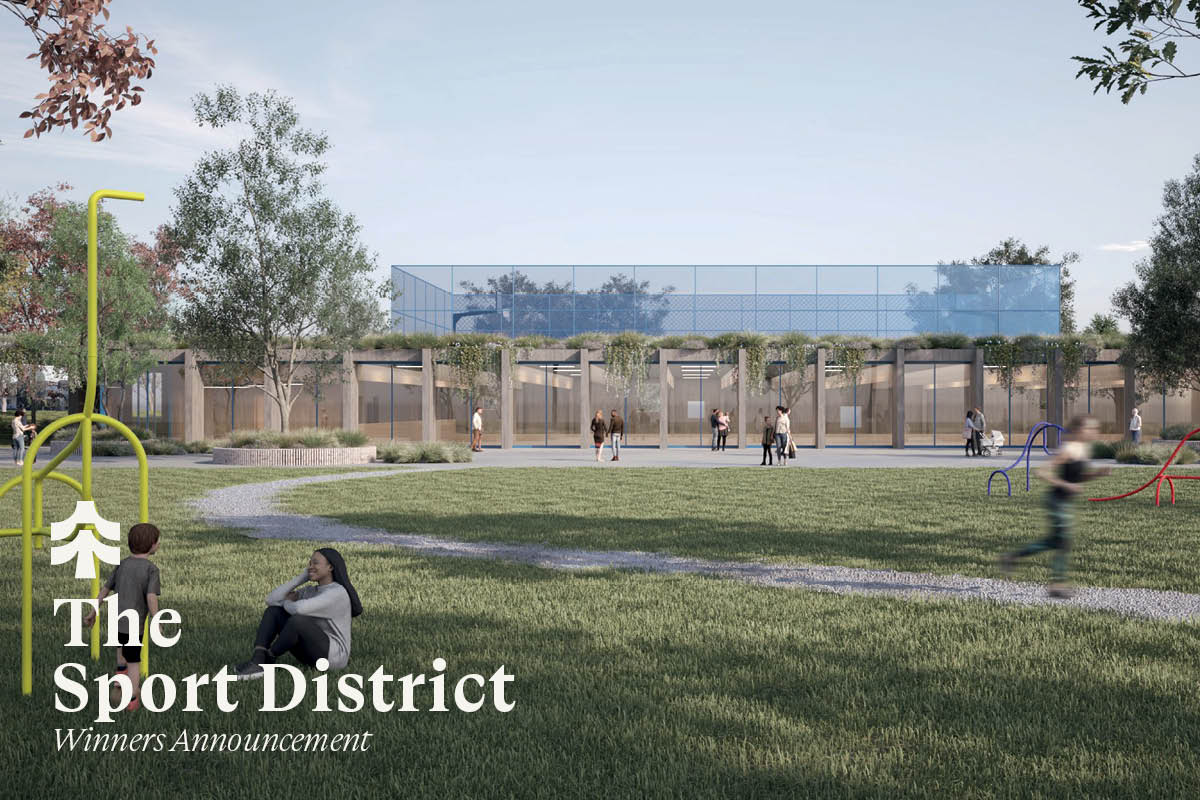
Terraviva has officially released the complete list of awarded projects of the architecture contest entitled “The Sport District”.
The competition invited architects and designers to reimagine Codroipo’s main sports area as a contemporary urban campus where sports, culture and everyday life converge. The challenge called for a comprehensive masterplan capable of integrating existing facilities with new public spaces, improving accessibility and enhancing the overall usability of the district. At the core of the proposal was the design of a new Multipurpose Gym, conceived as a flexible structure able to host both sporting and cultural events. Beyond this, participants were encouraged to activate the area through informal and inclusive spaces, from skateparks and fitness paths to intergenerational zones, redefining sport as a driver for social interaction and urban regeneration. The competition ultimately aimed to propose a new model of open, accessible and dynamic public space for the contemporary city.
The awarded proposals were praised for their holistic and forward-thinking approach to urban regeneration. The jury highlighted projects that placed sustainability at the forefront, integrating greenery, water systems and landscape strategies to create a balanced relationship between human activity and the natural environment. Some proposals stood out for their sensitive response to the site others were recognized for their strong urban strategies. Across the selected works, particular attention was given to the creation of flexible public realms, the reuse of existing structures and the introduction of new architectural landmarks capable of fostering identity and community engagement.

Terraviva warmly congratulates all participants for their creativity and dedication, whose proposals have contributed to redefining the role of sport as a powerful catalyst for inclusive, sustainable and vibrant urban environments.
The winners were selected by an international jury panel composed by:
• Francesco Garofalo [Rotterdam, Netherlands] | Openfabric
• Alessandra Baldin [Codroipo, Italy] | Comune di Codroipo
• Alessandro Verona [Udine, Italy] | AVS
• Giovanni Aurino [Napoli, Italy] | OD’A Officina d’Architettura
• Silvia Gelain [Bourg-lès-Valence, France] | Atelier Chony
• Raffaelle Sciascia [Rome, Italy] | Eur S.p.A.
• Sara Gelibter [Biel/Bienne, Switzerland] | Sara Gelibter Architecte
• Octavio Montestruque Bisso [Lima, Peru] | University of Lima

1st Prize
Trame condivise
Diego Zanette, Debora Casagrande, Mattia Pianezzola, Federica Sartorato
Italy


Il nuovo distretto sportivo di Codroipo si configura come un sistema integrato per la pratica sportiva contemporanea e sostenibile, in cui le diverse discipline dialogano tra loro e con il Parco delle Risorgive, che si estende fino agli spazi sportivi. La relazione tra sport e natura costituisce il principio fondativo del progetto, promuovendo una fruizione equilibrata tra chi pratica attività sportive e chi vive quotidianamente il parco.
Pur nella forte intersezione tra i due ambiti, il progetto cerca una chiara identità per ciascuno di essi, valorizzando le specificità dello spazio sportivo e di quello naturalistico all’interno di un disegno unitario. Il distretto assume anche il ruolo di elemento di ricucitura urbana tra il centro storico, i quartieri residenziali limitrofi, l’area sportiva esistente e il parco, oggi vicino al centro ma privo di connessioni pedonali continue e di un ingresso principale riconoscibile. Il nuovo sistema ristabilisce continuità spaziali, ambientali e funzionali, rafforzando il rapporto tra città, sport e paesaggio.
La strategia insediativa individua alle estremità del sito le aree di sosta, liberando la parte centrale, cuore del progetto, per le attività sportive e l’integrazione controllata del parco.
A nord è prevista la riqualificazione dell’edificio esistente, destinato a nuova sede delle associazioni sportive e concepito come principale porta d’accesso al distretto. Questo elemento funge da ingresso riconoscibile e filtro tra città, sport e paesaggio. Da qui si sviluppa una direttrice pavimentata su cui si attestano campi da gioco e una pensilina coperta, elemento ordinatore che connette le diverse funzioni alle aree di parcheggio e alle scuole esistenti, in relazione al tessuto costruito.
A sud il progetto rafforza il dialogo con la città e il parco tramite la nuova palestra, edificio contemporaneo che ricerca il dialogo con l’ambiente naturale, contenendo l’elevazione dalla quota del terreno, risultando parzialmente incassato nel terreno e sormontato da una copertura verde che prolunga il sistema paesaggistico, segnando un secondo punto di accesso riconoscibile. La palestra coincide con la terminazione di un secondo ambito pavimentato su cui sono innestati ulteriori spazi sportivi e l’area cani.
Le aree nord e sud sono oggi separate dalla circonvallazione. Il progetto affronta la criticità mediante una sopraelevazione del parco che attraversa la viabilità, garantendo continuità ecologica e funzionale. Nei punti di connessione a terra si collocano funzioni di servizio come bar, parcheggi coperti, spalti, locali tecnici e il polo museale delle Risorgive, integrate nel disegno complessivo del paesaggio. Sul lato ovest del parco, dove la Roggia San Odorico crea una discontinuità con il tessuto urbano; il progetto prevede nuovi collegamenti ciclo-pedonali tramite semplici ponti complanari, rafforzando la connessione con il Parco Urbano Durigat, anch’esso oggetto di riqualificazione.
L’intero distretto è concepito secondo principi di inclusività, garantendo accesso alle aree sportive, piena fruizione del parco e continuità dei percorsi pedonali e ciclabili tra centro, quartieri e sistema del Parco delle Risorgive. Il progetto restituisce alla città un luogo dove sport, paesaggio e spazio pubblico convivono in equilibrio, preservando identità riconoscibili e costruendo un duraturo rapporto tra comunità, natura e movimento.
_________________________________________
About the First Prize – Giovanni Aurino – OD’A Officina d’Architettura
“A strong commitment to sustainability defines this proposal. The project emphasises the patterns of nature-greenery, water, and the creation of new centres of activity. It envisions a new sports park where nature and human presence can find a renewed balance.”
About the First Prize – Silvia Gelain – Atelier Chony
“The project is highly appreciated for its sensible thorough research into the landscape and community. The use of partially underground architecture is a well-considered solution, providing additional space for outdoor life and activities while preserving the site’s openness.”
2nd Prize
The Urban Collage
Zihua Mo
United States


Codroipo exists as a profound cultural mosaic within the Friulian Plain. However, its current sports district remains a collection of isolated functional islands lacking a unified vision. Rather than imposing a forced, top-down order, this proposal adopts the methodology of “The Urban Collage,” where new programmatic layers are surgically superimposed onto the existing fabric, creating a localised negotiation between history and modernity.
Through the juxtaposition of heterogeneous elements, the project redirects facilities into a state of organised complexity. It generates a vibrant district where localised tensions between diverse programmes create complementary urban energy—an environment that is dynamic, resilient, and deeply contextual.
The strategic framework is defined by two primary experiential loops: the North Sports Loop, consolidating fragmented athletic assets, and the South Nature Loop, anchoring the site into the ecological corridor of the Regional Park of the Risorgive. A restored ecological axis along the Roggia San Odorico stitches these sectors together, while transverse sports axis and civic axis reintegrate the previously isolated Parco Durigat into a legible urban system.
Prioritising human-centric values and Active Mobility, this proposal replaces rigid fences with vegetative buffers and asphalt with permeable gravel. Underutilised voids are transformed into dense groves and revitalised outdoor spaces, replacing urban expansion with the aggregation and reuse of existing resources.
The district evolves from a restricted zone of segregated facilities into an all-day “Diffused Sports Plaza.” Here, sport transcends physical activity to become a catalyst for urban identity and social-ecological inclusion. Providing a welcoming haven for all—from children and students to the elderly—the project creates a shared habitat for both domestic pets and local biodiversity, weaving a richer tapestry of life into the urban fabric.
_________________________________________
About the 2nd Prize – Raffaelle Sciascia – Eur S.p.A.
“The project is awarded for its urban methodology, which integrates new layers into Codroipo’s existing fabric. By replacing rigid fences with vegetative filters and focusing on active mobility, the proposal transforms the district into a shared space where social inclusion and ecological resilience weave a new urban fabric. The strategic framework, built around two loop paths (North Sports Loop and South Nature Loop), reconciles local history with contemporary needs. The new sports hall, a light-filled structure, serves as an architectural hub and a new landmark for the community.”
3rd Prize
Altis
Francesco Gervasoni, Andreana Utile
Italy


Richiamando l’omonimo recinto sacro di Olimpia, il masterplan “Altis” per Codroipo si configura come un orga-nismo territoriale capace di trasformare le criticità idriche in un’opportunità di rigenerazione urbana e paesaggi-stica. Il principio cardine è la rigorosa ortogonalità rispetto al ruscello esistente, una griglia che governa i flussi tramite una rete di nuovi canali. Questi vettori idrici scandiscono lo spazio e diventano veri generatori della forma urbana, definendo interassi variabili che dettano la cadenza delle funzioni insediate. In questa trama ritmica, la vocazione sportiva trova la sua massima espressione, elevandosi a pilastro della proposta.
L’acqua come infrastruttura attiva
L’acqua smette di essere un elemento decorativo e diventa un’infrastruttura attiva a supporto delle attività atle-tiche e del benessere. Sui margini dei canali si innestano percorsi podistici e ciclabili che sfruttano il microclima generato dalla presenza idrica, mentre le vasche di laminazione ospitano discipline che interagiscono con l’e-lemento liquido. Questa simbiosi tra idraulica e sport permette irrigazione e manutenzione a chilometro zero. Il programma fonde attività ricreative e agonistiche in un parco lineare integrato, dove l’architettura del paesaggio agisce come collante tra necessità tecnica e desiderio sociale.
Adaptive re-use e permeabilità paesaggistica
Cerniera vitale del nuovo parco è la palestra, un radicale esempio di adaptive re-use. Il volume diventa un padi-glione permeabile dalla massima flessibilità interna. L’operazione per sottrazione svela la struttura originaria per massimizzare la continuità visiva col paesaggio. L’elemento caratterizzante è la nuova copertura reticolare che, estendendosi oltre il perimetro, genera una vera stoà contemporanea. Al piano terra, il limite interno-esterno si dissolve: il campo ribassato permette alla luce di invadere l’arena, in continuo dialogo con la natura.
Il cuore sportivo e il paesaggio intergenerazionale
Fulcro dinamico del masterplan, la radura centrale accoglie il campo da calcio e la pista di atletica. Gli ampi canali definiscono i margini delle aree di allenamento outdoor a sud, sfumando nel nuovo bosco sportivo. La tra-ma dei percorsi si estende oltre l’impianto per innestarsi col vicino sito archeologico. A nord, lo spazio pubblico diventa un paesaggio ludico intergenerazionale: un playground per l’infanzia filtrato da un giardino roccioso si densifica nel distretto polisportivo, dove la vecchia palestra dialoga con nuovi volumi per l’arrampicata, campi da basket, tennis e skatepark.
Mobilità, cuore civico e mimetismo architettonico
Il Parco Durigat viene riorganizzato come nodo per la mobilità dolce, con un nuovo padiglione organico che funge da rifugio e hub per biciclette. Il cuore civico prende forma nel sistema di piazze tra le scuole: uno spazio flessibile per la comunità dominato da una grande vasca che risolve le criticità idriche e accompagna verso il di-stretto sportivo retrostante.
Quest’ultimo respira in armonia col paesaggio. Nelle isole fluide tra i canali trovano posto i campi da calcio. Le architetture di supporto — spogliatoi e tribune — non dominano la vista: protette da ampi tetti verdi, si mimetiz-zano diventando morbide colline abitabili. Il dialogo tra coperture erbose e canali genera un’oasi di comfort termi-co rigenerante, dove l’architettura sfuma lasciando la scena allo sport.
_________________________________________
About the 3rd Prize – Octavio Montestruque Bisso – University of Lima
“The project presents a solid urban regeneration proposal, highlighting the care with which the new public squares are integrated into the existing urban fabric of Codroipo. Particularly effective is the integration of water systems as a generative structure for the masterplan, capable of transforming a critical condition into an active element of spatial and landscape organization.
The choice of lightweight and flexible construction solutions is also appropriate, allowing for greater adaptability of public space and encouraging its use by the community. Equally interesting is the strategy of reusing existing infrastructure, together with new extensions, establishing a balanced dialogue between memory, landscape, and new urban activities.”
Golden Mention
Where sport flows
Marco Carrara
Italy


The project proposes the regeneration of the Codroipo sports district as an integrated centre dedicated to sport and wellness, open to all ages and capable of expanding its user base through nature-related activities.
The concept starts from the dialogue with the Tagliamento river, whose intertwined riverbed morphology becomes the compositional matrix of the project. Similarly, the San Odorico canal crosses the area from north to south, forming an ecological street connecting the urban centre and the Risorgive system.
This structure generates a double axis: the “cardo della Natura”, which is organic and landscape-oriented, and the “decumano dello Sport”, dedicated to daily recreational activities. Their interaction generates new spaces for socialising and introduces a principle of biophilia capable of mending a fragmented environment, restoring its identity, continuity and urban quality.
The masterplan organises the area through a clear system of spaces and slow mobility routes, differentiated by age and interest, while maintaining vehicular access along the perimeter. The cycle and pedestrian network and the squares are defined by an organic and recognisable feature, which reinforces identity and orientation within the lot.
Urban connections take the form of filter squares that accompany the transition between the city and the district, introducing a landscape dedicated to sport, leisure and well-being. To the north, these spaces interact with the school system, forming new entrance courtyards and meeting places.
The main functions are distributed along the two generating axes, with a diversified articulation of activities to ensure accessibility and inclusion. The result is an integrated and permeable system, capable of transforming itself into a new urban centre for the community.
The choice of the plot for the new gym is based on a careful analysis of accessibility, size and integration into the landscape. Plots A and B are unsuitable due to space constraints, location and urban context, while plot C, located at the end of the sports district and close to another competitive facility, offers adequate space and optimal flow management. Blending into the natural landscape, the gym becomes an integrated, iconic building, a new urban landmark. The flexible internal configuration, with movable panels, allows for multiple uses: gym, theatre or event and conference hall, maximising its use and usability for the community and strengthening the social and cultural role of the building within the district.
The master plan and the gym are designed to be in close harmony with the natural environment. The canal generates the urban layout, while the view of the Castelliere guides the architectural design. The hill and vegetation inspire an organic roof that blends into the landscape, offering visual continuity and a privileged relationship with the park.
The project goal is to reorganise a large area, enhancing the path along the canal with integrated functions. The multi-purpose building along the sports axis reorganises activities, offering a versatile space open to citizens all year round. The gym, built with organic and sustainable materials, blends into the landscape, promoting environmental and social well-being and becoming the identity hub of the district.
Golden Mention
Trame d’acqua
Marco Quadrini, Marco Di Caprio, Flavia Leone, Marta Rossetti
Italy


L’idea di progetto nasce dall’esigenza di immaginare un fil rouge tra la città di Codroipo e la Riserva Naturale delle Risorgive.
Quest’ultima rappresenta una risorsa di carattere ecologico e culturale fondamentale per lo sviluppo dell’intero centro urbano. Dunque, il progetto prende avvio dalla definizione di un masterplan che si configura come cerniera urbana tra l’ambito antropico e naturale, attraversando e mettendo in relazione i diversi paesaggi a essi correlati.
Il fil rouge dell’intervento è individuato nella caratterizzazione del lungo fiume (Roggia di Sant’Odorico) come una grande “arteria urbana”, capace di connettere la città con la riserva. Da essa si dirama una rete di percorsi urbani contraddistinti dalla presenza dell’acqua quale elemento naturale identitario.
Da questa impostazione nascono “Trame d’Acqua”, che si insinuano nel tessuto urbano collegando i diversi ambiti del masterplan e generando un sistema continuo di spazi pubblici, attrezzature sportive e percorsi lenti. Il disegno si ispira alle trame dei campi agricoli e ai relativi sistemi di irrigazione caratterizzanti il paesaggio circostante, assumendoli come elemento di mediazione tra paesaggio antropico della città insediata e quello naturale della riserva. In questa prospettiva, il progetto intende dimostrare come l’intervento antropico possa e debba preservare l’autenticità del paesaggio, instaurando un rapporto di continuità ecologica e percettiva.
L’acqua costituisce l’elemento cardine del progetto e accompagna ogni componente del masterplan sia come dispositivo ecologico sia come presenza poetica. Il sistema prevede la raccolta, la gestione e il riuso delle acque meteoriche mediante canalizzazioni integrate nello spazio urbano e coperture capaci di convogliare l’acqua verso serbatoi di accumulo, con l’obiettivo di ridurre gli sprechi e costruire una riserva idrica disponibile per usi successivi.
Parallelamente, l’impiego diffuso di pavimentazioni drenanti consente al suolo di mantenere la propria permeabilità, mentre una quota delle acque raccolte viene reimmessa in falda attraverso una rete di canali connessi al fiume, contribuendone alla rigenerazione e al supporto del sistema agricolo del territorio circostante.
Emblema delle volontà del progetto è la nuova palestra, collocata strategicamente nel punto di contatto tra città e riserva naturale, dove assume il ruolo di dispositivo di connessione tra spazio urbano e sistema ambientale.
L’edificio si configura come una grande vasca di raccolta grazie alla pendenza dichiarata della copertura, che convoglia l’acqua nel sistema delle canalizzazioni: una parte alimenta le due piazze antistanti come elemento poetico di qualificazione dello spazio pubblico, mentre la restante quota è destinata alla riserva e ai campi agricoli.
L’architettura dell’oggetto tende a essere il più possibile leggera e trasparente, grazie a una struttura reticolare sospesa con tiranti in acciaio e pannellature mobili in policarbonato traslucido che consentono la reciproca permeabilità visiva tra la città e la riserva naturale. Il disegno in sezione è estremamente rappresentativo dell’idea e dimostra come la figura “sospesa” della palestra sia da intendersi come un prolungamento dello spazio pubblico esterno, generato da due piazze simmetriche e proporzionate sui due terzi della dimensione complessiva dell’oggetto architettonico, nella volontà di creare nuovi luoghi di aggregazione e socialità per la città.
Golden Mention
PARCO CONTINUO CODROIPO – Landscape of Movement, Community and Green Resilience
Róbert Lipták, Nikoleta Mitríková, Michal Šourek, Matej Ďurinďák, Lenka Nosková
Slovakia


CONCEPT PROPOSAL
A continuous running track together with pedestrian promenades forms the primary structural layer of the proposal, linking the football field, multi-purpose courts, skatepark, and community zones into one coherent system. The track is designed as multifunctional — serving runners, pedestrians, and cyclists alike. Thanks to its strategic connections, it allows access from various parts of the city, naturally integrating the park into the everyday life of residents. The pedestrian promenade encircles the park and continues seamlessly toward the city center, strengthening the urban connection of the area.
This mobility network promotes daily physical activity and a healthy lifestyle while ensuring clear orientation and full accessibility. The park remains legible, open, and inclusive for all age groups.
Sports facilities are carefully embedded within greenery rather than separated from it. Transparent fencing, open sightlines, and gradual transitions between dynamic and calm zones create spatial continuity. Active surfaces in warm terracotta tones enter into a visual dialogue with the green landscape framework, connecting the cultural identity of the region with the natural character of the site.
At the urban scale, the park functions as an important green connector within Codriipo. Through its materiality, vegetation, and spatial openness, it reinforces the identity of the Friuli-Venezia Giulia region. The result is a resilient and contemporary public landscape that supports community life, movement, and a responsible response to current environmental challenges.
Structural Landscape Strategy
Greenery forms the primary spatial and ecological structure of the proposal. Tree-lined avenues define the main movement axes and create a clear compositional framework across the site. The principal alley is planted with Platanus × acerifolia and Celtis australis, providing continuous shade while referencing the character of traditional Italian promenades. Secondary avenues incorporate Tilia cordata and Carpinus betulus, introducing rhythm, seasonal variation, and microclimatic comfort.
The grassy meadows represent open recreational areas with freely placed specimen trees such as Quercus robur and Acer campestre, strengthening the landscape character and enhancing biodiversity. These areas accommodate informal activities while forming a transition between intensively used sports facilities and quieter park zones. Around retention and natural infiltration areas, moisture-tolerant species such as Alnus glutinosa and Salix alba are proposed. These trees help stabilize the soil, support the water regime, and create ecologically valuable habitats.
Community and entrance spaces are complemented by accent species such as Cercis siliquastrum and Magnolia grandiflora, providing strong seasonal expression and reinforcing the identity of the place. In sun-exposed areas, Olea europaea may be introduced as a symbolic element of the Mediterranean landscape.
Organic planting along the park edges creates a natural transition to the surrounding landscape and increases ecological resilience. A combination of perennial planting beds, flowering trees, and meadow areas supports pollinators and enhances seasonal dynamics.
Greenery therefore serves not only an aesthetic function but operates as an integrated green infrastructure system — improving microclimate, supporting water retention, providing shade, and shaping the identity of the public space. The proposal transforms the site into a cohesive recreational landscape that integrates sport, movement, community life, and environmental resilience. The park is not conceived as a collection of isolated functions, but as a continuous green structure that connects active zones, public spaces, and natural processes into a single, legible spatial composition. A key principle of the design is the elevation and expansion of green areas. Vegetation is not perceived as leftover space between functions, but becomes the primary structural element of the proposal. Lawns, groups of trees, and planting strips frame the sports facilities, define spatial hierarchies, and improve the microclimate by providing shade and reducing heat accumulation. The project also introduces natural retention areas integrated directly into the landscape. Shallow terrain depressions, vegetated swales, and permeable surfaces allow rainwater to infiltrate naturally into the ground. These nature-based solutions reduce surface runoff, support groundwater recharge, and contribute to long-term environmental sustainability. Water is not treated as waste, but as a valuable landscape element that enhances biodiversity and the seasonal dynamics of the space.
The Sport Hall
The proposed multi-purpose sports hall is partially embedded into the terrain, allowing the building to integrate naturally with its surroundings. The roof is conceived as a rectangular plane with two raised and two lowered corners, creating a dynamic yet restrained architectural expression. Through careful landscape modeling, the terrain smoothly connects to both the main sports floor and the accessible rooftop. The roof itself serves as a public space, incorporating a running track and recreational area. The hall has a capacity of 490 spectators plus dedicated spaces for wheelchair users, ensuring inclusivity and accessibility. The stepped seating is integrated directly into the section of the building, reinforcing the spatial relationship between structure and landscape. Beneath the elevated seating area, storage rooms for sports equipment and public restrooms are located. A technical room and additional service facilities are positioned under the side ramp running along the playing field.
The hall is directly connected to an existing student accommodation building, which has been repurposed to provide locker rooms, showers, and other supporting facilities. This functional linkage optimizes the overall operation of the complex and reduces the need for additional built volume. The above-ground portion of the hall is constructed from timber, emphasizing sustainability and warmth in material expression.
Golden Mention
Campo de Codroipo
Hangseon Jo, Jaewon Lee, Taehun Kim
South Korea


The existing Codroipo sports district, despite its abundant facilities, lacks organic connectivity and remains scattered without an overarching vision.
However, the nearby educational facilities, natural environment, and heritage involve diverse potential. What form should the new master plan take? Moreover, what gesture should the new gymnasium adopt within it?
Ideal Sports District Vision
This place must evolve into a human-scale space where citizens naturally gather, communicate, and engage in diverse activities. Rather than a single large park, it is composed of a network of campos of various sizes by function, overcoming existing fragmentation and functioning as an urban center.
This will establish a more pedestrian-friendly environment and become a park with diverse possibilities. Furthermore, it is intended to integrate naturally within the city by connecting with nearby educational facilities and cultural heritage sites.
Masterplan Strategy
The Campos transcend mere open spaces, functioning as central nodes where people linger and form relationships along the flow of the Roggia San Odorico and citizens’ everyday activities. The new multi-purpose gymnasium complements the renovated Student House (Casa dello Studente), blending harmoniously into the surrounding context with a non-imposing form derived from motifs of the historic facility. Additionally, the existing Student House is reborn as a visitor center and community hub, performing auxiliary functions for both the city and the gymnasium.
As a result, the gymnasium, capable of accommodating at least 350 people, functions for various sports activities and allows citizens to freely engage, positioning itself as another campo.
Additional Strategic Elements
Sports, the Former Codroipo archaeological site, and outdoor spaces of various scales linked to the Roggia San Odorico will be utilized multifunctionally, from daily physical activities to festivals and events. The campos densely arranged throughout the site can function as central spaces where people linger. The expansive site to the south will serve as a festival venue within the city or as an archipelago where diverse people gather.
As a result, we name it ‘Campo de Codroipo’, signifying that the newly planned Codroipo sports district will become a human-scale piazza brimming with myriad activities and possibilities, naturally blending into the surrounding context like a campo of nature.
Golden Mention
AXIS
Mihail Sobolkov, Andrew Skinder, Andrei Rahashchuk, Danila Dziamenka
Belarus


The core design philosophy of this multifunctional sports complex is the celebration of movement, horizontality, and the fluid boundary between the built environment and the natural landscape. The guiding principle is “The Horizon,” manifesting in a series of elongated, parallel lines that stretch across the site. These lines are not merely decorative; they are the organizing principle of the entire complex.
The form is conceived as a series of stratified, horizontal planes that appear to float lightly above the ground. The façade is the primary expression of this concept. It is not a single, flat wall but a deep, layered surface. Horizontal bands of alternating materials—perhaps brushed metal, long-format timber slats, and translucent polycarbonate panels—stretch the entire length of the building. These bands visually extend the complex beyond its physical dimensions, anchoring it to the landscape and creating a dynamic play of light and shadow that changes throughout the day. The elongated lines guide the eye and, symbolically, the athlete, towards a distant goal.
The building does not simply sit on the site; it emerges from it. The landscape is designed as an extension of the architectural lines. A series of green terraces and low, grass-covered berms rise to meet the building’s plinth, blurring the line where the earth ends and the structure begins. Long, linear pathways of decomposed granite or textured concrete lead visitors to the main entrance, their geometry mirroring the building’s facade. This integration ensures the complex feels like a natural part of the topography, a man-made horizon complementing the natural one.
Ground Floor: The Field Level
This level houses the most dynamic and publicly accessible functions. The centerpiece is the multifunctional hall. Designed with high ceilings and retractable seating, its long, horizontal proportions make it ideal for a variety of indoor sports (basketball, volleyball, futsal). Large-format, translucent panels on the facade allow diffused, glare-free natural light to flood the space, maintaining a connection to the outdoors without disrupting play. This level also features the main lobby, concessions, and locker rooms, all organized along a central “spine” that maintains the building’s linear axis.
Upper Floor: The Aerobic Level
Dedicated to the athletics gym, this upper floor is a mezzanine-level space that overlooks the main hall below through a long, horizontal ribbon window. This visual connection creates a sense of energy and shared purpose between the different athletic activities. The gym itself is a long, unobstructed space for running, weight training, and fitness classes. The elongated lines of the exterior facade continue here as a full-length clerestory window, offering panoramic views of the surrounding landscape. This provides an open, airy atmosphere that is motivating for training.
Honorable Mention
How far can a box go?
Fernando Medina, Pranav Raghavan
Spain-India


Honorable Mention
INTERSTIZI ATTIVI: sport, community e paesaggio
Giorgio Del Fabbro, Riccardo Del Fabbro, Anna Marcon, Mara Marton, Francesco Perusin
Italy


Honorable Mention
CUCITURA
Chenhao Luo, Junye Zhong, Khurtsbileg Erdenetsogt
United Statesù


Honorable Mention
Where Paths Become Play
Ruoxi Li, Yongcong Gou
China


Honorable Mention
The spine
Diana Dan, Alexandra-Ioana Milu, Alexandra-Mihaela Parpală, Anastasia Untaru
Romania


Honorable Mention
FILO VERDE
Giacomo Penco, Marilena Magalotti, Davide Camera, Ilaria Camera, Giovanni Sallemi, Luca Benassi, Artin Lesani Abdi
Italy-Iran


Honorable Mention
TertaLink
Irina Ursea
Romania


Honorable Mention
THE CROSS-FIELD
Ray Agung Sucika Pratama, Ahmad Alfu Ihsan, Faris Raihan Friadi
Indonesia


Honorable Mention
Connessioni Parallele
Luigi Soramel, Claudia Gasparini, Filippo Prevedello, Massimiliano Selenati, Antonio Soramel
Italy


Honorable Mention
Snakes and Ladders
Jacques Ippoliti, Marion Lacas
France


SHORTLISTED PROJECTS

The post Results: The Sport District appeared first on Competitions.archi.