

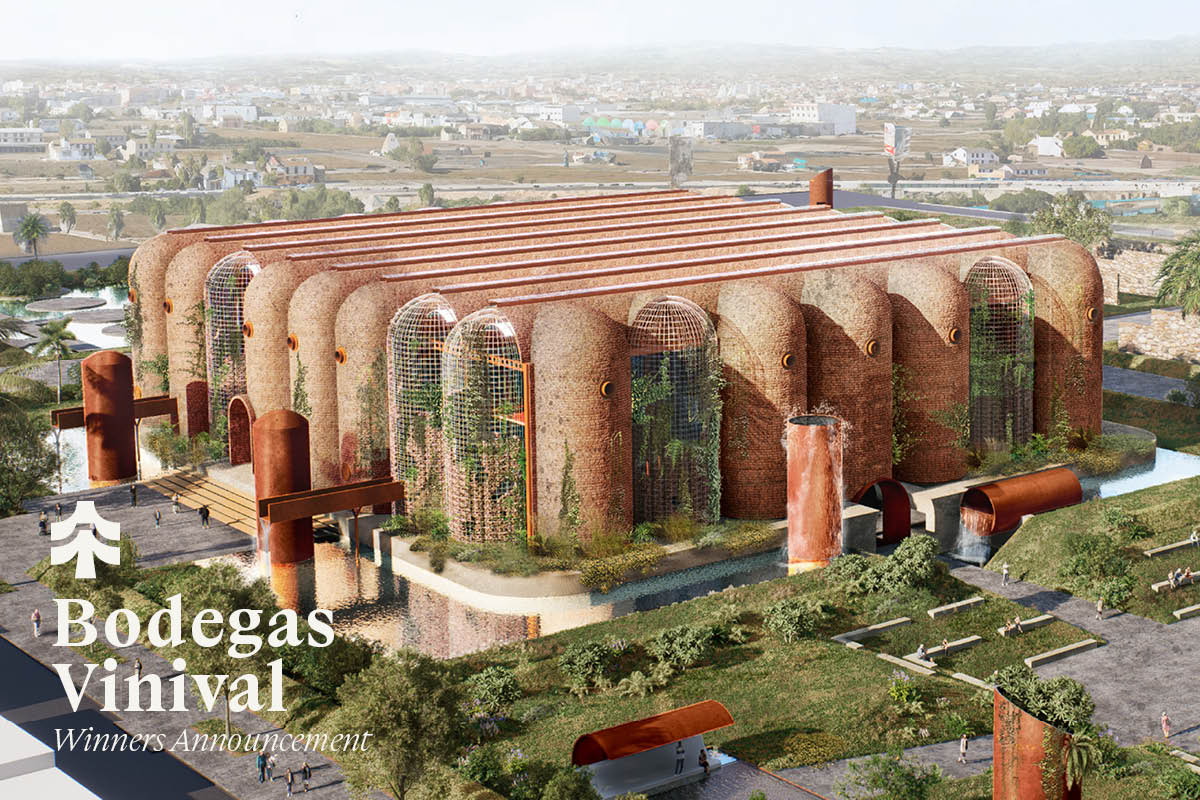
Terraviva has officially released the complete list of awarded projects of the architecture contest entitled “Bodegas Vinival”.
Set within the vibrant coastal landscape of Alboraya, just outside Valencia, the competition invited architects, designers and creatives to reimagine the historic mid-century wine complex as a cultural space shaped by the spirit of Las Fallas. Participants were asked to breathe new life into this former industrial landmark through architectural and landscape interventions that celebrate memory, craftsmanship and reinvention. Whether through bold spatial transformations or subtle reinterpretations of the complex’s structural rhythm, the challenge called for a visionary proposal capable of turning the Bodegas into a dynamic environment for community gathering, creativity and cultural expression. The resulting transformation aimed to establish the site as a living centre for exhibitions, performances, workshops and everyday activity, honouring Valencia’s traditions while opening the doors to new cultural experiences and year-round public use.
The jury praised the awarded proposals for their ability to balance innovation with deep sensitivity to the identity of Bodegas Vinival. Some projects distinguished themselves through the seamless integration of architecture, landscape and water systems, transforming industrial structures into ecological frameworks that horon both agricultural memory and the festive spirit of Las Fallas. Others were commended for their pragmatic and realistic approach, demonstrating how minimal, economically viable interventions can unlock new spatial possibilities, activate the surrounding public realm and reinterpret the existing structure with clarity and purpose. Additional recognition was given to proposals that addressed broader urban needs, pairing adaptive reuse with a coherent landscape strategy that strengthens the connection between the Bodegas and its territorial context. Together, these visions showcased a thoughtful and inspiring reimagining of the site’s cultural future.
Terraviva warmly congratulates all participants for their creativity and valuable contributions, which continue to inspire new ways of transforming heritage sites into vibrant spaces for community and culture.
The winners were selected by an international jury panel composed by:
-
- Nuria Matarredona Desantes (Valencia, Spain) | Universitat Politècnica
- Elisa Battilani (Barcelona, Spain) | Cream Estudio
- Artur Mc Clean (Barcelona, Spain) | SGA
- Luis Gallego Pachón (Madrid, Spain) | Pachón-Paredes
- Virginia Theilig (Rosario, Argentina) | FAPyD
- Diego Serrano Rosado (Valencia, Spain) | Archif
- Jose Luis Perez Hermo (Vienna, Austria) | Coop-Himmelb(l)au

1st Prize
The Garden of the Silos
Daniel Guerreri, Alejandra Linares, William Criollo, Nicolas Colorado, Carolina Delgado , Yovani Bolaños, Luis Delgado , Stephania Sanchez
Colombia

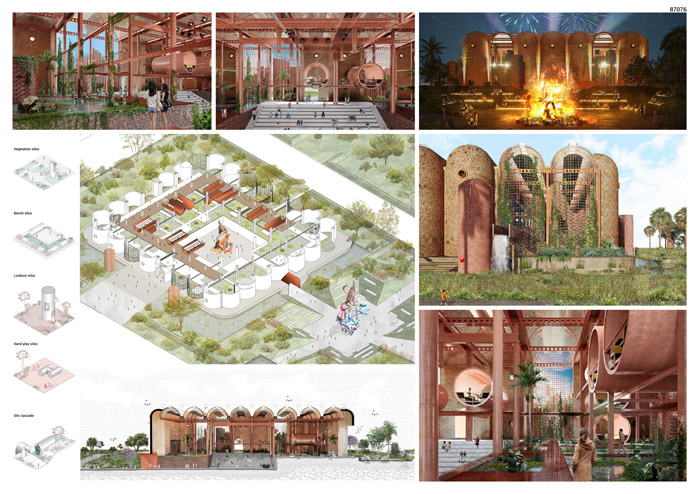
The project arises from the need to reconnect Valencia’s agricultural memory with the existing network of water channels that link the territory to the sea, as well as with the industrial and winemaking heritage of the former Vinival warehouses. Within this proposal, the project acts as a mediator between the agricultural fields and the sea through water as a connective element, flooding the site to create a sequence of urban landscapes defined by fountains that evoke the Islamic-influenced gardens of Spain. Additionally, new embankments are introduced to shape boundaries and circulation routes around the intervention, accompanying the exterior landscaping. The reused silos from the original complex are transformed into structural and symbolic pieces that accommodate new uses and serve as reference points within the urban proposal, offering diverse spatial experiences while preserving the memory of the place.
I. Water Systems and Agricultural Memory
Within the project, the silos are associated with the preservation of the productive identity of the former wineries, while water is conceived as a formative resource that molds topography and regulates the building’s environmental conditions. It generates courtyards, channels, and edges that guide visitors along their paths, shaping aquatic landscapes interwoven with native vegetation that recall the memory of regional architecture. These elements accompany the pedestrian experience both inside and outside the building, establishing a continuous dialogue between structure, landscape, and climate.
II. Industrial Reuse and Porous Architecture
The former winery complex is transformed through adaptive reuse, where the metallic silos become inhabitable structures capable of assuming multiple functions—viewpoints, water fountains, reading spaces, or vertical circulations. The building takes shape as an inhabited garden where the industrial fabric engages with the surrounding landscape. The central void becomes the main public space, conceived for collective activities, diverse exhibitions, and displays of Las Fallas floats—the emblematic event that gives meaning to the new architectural intervention. Fragments of demolished walls are integrated into the proposal to allow a ceaseless exchange between interior and exterior, allowing vegetation to inhabit the interior spaces and the mirror of the water to traverse them, generating a tempered and inhabitable microclimate.
III. Public Topography and Urban Ecology
The intervention in the public space enhances the main access plaza, framed by a large park where the embankments reshape the topography to emphasize observation areas for cultural events and the burning of Las Fallas sculptures. These variations of the terrain create spaces for permanence and movement, relating to the human scale and enhancing the enjoyment of the urban fabric surrounding the project. The proposal recalls adjacent buildings through their traces and reinterprets the urban plane with landscape interventions composed of orange trees, grasses, and Mediterranean species. The project thus unfolds as an open structure in which the materials of the past and natural processes define a renewed equilibrium between architecture, landscape, and climate.
_________________________________________
About the First Prize – Artur Mc Clean – SGA
“This proposal stands out for its beautiful integration of landscape and architecture, transforming the silos and water systems into a living ecological framework. It creates a sustainable, climate-responsive environment while preserving the agricultural and industrial memory of the site.”
About the First Prize – Jose Luis Perez Hermo- Coop-Himmelb(l)au
“The project demonstrates a refined understanding of adaptive reuse by preserving Bodegas Vinival’s industrial character while transforming the silos into multifunctional elements. Vegetation, water, and memory coexist in harmony with the lively spirit of Las Fallas.”
2nd Prize
Aging like fine wine
Alexandre Shushkov, Neus Dachs
Spain


The proposal begins by acknowledging the unique condition of the site: a strategically located yet isolated area positioned for significant urban development growth, supported by strong rail and road connections. At the same time, the city suffers from a lack of accessible public and green spaces, despite the major assets like Central Park and Turia Garden. The project responds to this context by creating a new cultural and community facility embedded within a large park – an intervention that complements rather than competes with the existing green infrastructures while extending the ecological and social continuity across the territory.
To reinforce this approach, the design introduces minimal new construction. Instead, it highlights the existing emblematic building by surrounding it with vegetation and transforming the ground level into a permeable public plinth. This open, accessible base acts as an extension of the park, softening boundaries between interior and exterior, incorporating greenery booth visually and physically. The building becomes not an isolated object but an active component of a broader landscape.
The architectural intervention removes ceramic pieces from three facades, opening the building to the park. Retained corners and rear modules house services, vertical circulation and larger exhibition spaces, preserving fragments of the building’s original character. Part of the roof is also removed, following the interior program’s modular layout. Open strips are created in the areas where the program is more open, allowing greater natural light to enter the space.
The circulation is divided into two main routes, each encompassing two programmatic modules, as these share a stronger relationship with one another. In this way, the design further emphasizes the character of each program and the user group it serves.
Programmatically, the project consolidates several community-oriented functions currently dispersed throughout the city. Four interconnected modules, each associated with a particular age group and mode of engagement – thinking, creating, sharing and exhibiting – come together under one roof. Each part of the program fulfills its role within this cycle, acting as a point of connection among different groups of people and ages: The Voice represents the initial flame, The Future symbolizes the seed, The Hands embody creation, The Vision corresponds to exhibition, and Celebration concludes with the final act: la Cremà.
The first module is composed of spaces that allow the community to share and discuss topics that affect their daily lives, such as political, social and community issues. The area dedicated to young people focuses on providing a safe environment for teaching, working, studying, sharing, and learning. The workshops are designed as multifunctional spaces that transform throughout the year, adapting to various themes. Finally, the exhibition space brings together the results of all these activities, allowing the community to display the processes and knowledge developed within each module.
_________________________________________
About the 2nd Prize – Luis Gallego Pachón – Pachón-Paredes
“A project that, while being proactive and sensitive to the site and the architectural piece it encounters, is able to transform them by adopting pragmatic, constructive, and realistic solutions that make sense in relation to the collective memory, geometry and spatial character of the existing structure. Through minimal and economically viable interventions, is capable of transforming both the interior landscape and the surrounding public environment. The proposal of generating a new simple big “park” within a territorial context —a vast natural open area that users can appropriate for different uses— seems like a very direct yet very realistic and necessary approach, in contrast to the overdesigned landscapes and parks. At the same time, the strategy to open up the ground floor extensively to the exterior—even introducing elements for circulation and for the separation of interior spaces using different materialities, while responding to what already exists, with a construction that appears easy to reuse and insert—makes this proposal one of the most comprehensive, pragmatic, and realistic in relation to the social and spatial context of its surroundings.”
3rd Prize
Renovament
Juan Felipe Astudillo Molina, Laura Ángel Orozco, Cristian Camilo Marín Correa
Chile – Colombia


Concept
The proposal is based on the process of transformation that defines Las Fallas: history, burning, and rebirth. This concept is articulated around the Antigua Bodega Vinival in Alboraya, a witness to Valencian memory where tradition and transformation intertwine. Located between the sea and the orchards, and surrounded by urban growth, the winery is conceived as a bridge connecting three fundamental landscapes: sea, city, and orchard. Its revitalization reinterprets Las Fallas as an act of renewal, in which fire transforms a space that preserves the memory of the territory. In this way, the winery becomes a place of symbolic transition, where fire, sea, orchards, and city engage in dialogue, creating a duality that integrates collective memory and landscape within a single narrative.
Strategies
The north-south axis organizes the proposal, generating a continuous reading between sea, city, and orchards. The demolition of adjacent buildings is proposed to create a new public space that functions as a forecourt and as a unifying element of the complex, arranged according to the winery’s original modular grid. This operation also reinforces the connection with the Falla Patacona, a key element in the project’s narrative.
The public space is structured into three sectors aligned along the north-south axis, unified by a perimeter circuit that gives rise to different shaded and resting areas. On the western elevation, facing the orchards, vegetation dominates, recognizing existing species while incorporating native plants. Towards the east, facing the sea and the city, the space takes on a recreational character and incorporates reflective water features that evoke dialogue with the sea. At the northern end, the bonfire is located, serving as the stage for the ritual act of burning, conceived as a contemplative plaza. A continuous platform connects the winery with this space, beneath which a lower level is developed for gatherings and fire ceremonies. Surrounding this core are workshops, a café, and exhibition niches that reinterpret the formal language of the old wineries, housing fallas or their remnants.
The building of the old winery is conceived as a large hall in constant dialogue with the exterior—a versatile space intended for meeting, creation, and exhibition. Its open interior is organized over two levels, taking advantage of the existing grid structure. The ground floor prioritizes spatial flexibility through retractable partitions, allowing the configuration of auditoriums, workshops, classrooms, or festive spaces. The upper floor houses a library and meeting rooms in the northern wing, while the western and eastern fronts contain study areas and collaborative workspaces. A bridge with flexible resting and coworking areas offers a dual panorama: one facing the workshops and classrooms, and the other overlooking the exhibition and community spaces.
_________________________________________
About the 3rd Prize – Jose Luis Perez Hermo- Coop-Himmelb(l)au
“This project identifies key urban needs of Alboraya while proposing a landscape that reinforces the adaptive reuse strategy.”
Golden Mention
Loop
Ugur Ozer Ozguven, Ergi Bozyigit, Sevgi Bodur, Kubra Altan , Turac Sarikamis, Ozden Yalnizgul, Taha Demirors, Ata Kaynarca
Turkey


The Bodegas Vinival Project
The Bodegas Vinival project is a comprehensive architectural transformation that blends Valencia’s industrial past with its most significant cultural heritage, the Las Fallas festival, converting an abandoned industrial site into a vibrant, multi-purpose urban island that honors its urban memory.
At the core of the project is the fusion of the passionate and vibrant spirit that forms the basis of the Las Fallas tradition—starting with the burning of old wood by carpenters and evolving into a grand festival intertwined with sculptural art—and the powerful industrial architecture of Bodegas Vinival, which symbolizes Valencia’s rich winemaking heritage.
The design adopts the continuous cycle of renewal inherent in Las Fallas, the process of creation, destruction, and recreation, as a fundamental concept. This cycle is then experienced by users as an architectural “LOOP” motif. Through this approach, the dormant Bodegas Vinival has been transformed into a dynamic and lively urban island returned to the city.
In this context, the red color, used as the main tone in the design, makes a strong reference to both the old wine factory and the literally fiery spirit of Las Fallas. The industrial identity of the structure is reinforced by utilizing the existing wine silos, bridges, and the building’s emphasized structural frame as distinctive and defining architectural elements throughout the project. Elements like the existing wine silos and bridges served as design inputs and sources of inspiration for the project. Thus, the design, inspired by Vinival’s roots, is also seen to be shaped by a principle that celebrates craftsmanship.
In terms of spatial organization, in addition to the winery building, which was once a closed production area, the entire project site has been converted into a public cultural platform where the resulting ‘products’ can be exhibited, shared, and ultimately ‘burned’. The open-air plan is designed as a concept of a plaza and cultural habitat, creating spaces that serve various purposes. These areas include numerous workshop spaces, co-working areas, tasting zones, a botanical garden, and entertainment and event venues, making them multi-purpose spaces that serve a wide range of users and functions.
The design, heavily inspired by the internal layout of Bodegas Vinival, creates surprising spaces by offering diverse spatial experiences at different elevations and reflecting a dynamic, playful social loop. Considering Vinival’s climate, the design incorporates extensive shaded areas, green spaces, and semi-open and closed structures, ensuring a lively, colorful, and unique environment that integrates with the urban fabric and appeals to all ages.
Golden Mention
La Plantà
Silvia Sierra Maestro, Biel Graset Isern
Spain


LA PLANTÀ
FALLAS ARTS & CULTURE INTERPRETATION CENTER
OLD VINIVAL WINERIES, ALBORAYA, VALÈNCIA
La Plantà is conceived as a living laboratory of Fallas culture—an open center for research and creation located in the former Vinival Wineries in Alboraya. It is a place of shared creativity, capable of transmitting the awareness and experience of Valencia’s most emblematic tradition. Its name evokes the ritual of la plantà, the moment when Fallas artists assemble their monuments on the Valencian streets where, days later, they will be burned. The project extends that moment of contemplation, allowing visitors to appreciate the work in progress as the collective outcome of a year’s effort.
The complex is organized into two main areas: one half functions as a covered public square, adaptable for multiple events, while the other houses active spaces that bring together a wide variety of users. The program includes a public library and co-working area, with soft, inviting textures that encourage reading and individual work beneath the preserved winery structure; an interactive Fallas Arts Museum, offering multiple viewpoints and spaces dedicated to memory, history, and the creation of the Fallas inventory; and a creation and innovation research center, where local and international artists experiment with new materials and techniques aimed at reducing the festival’s environmental impact. Researchers can reside within the complex to enhance creativity and draw inspiration from the site’s unique energy. A central café encourages exchange and interaction between users, reinforcing the project’s social and inclusive dimension.
La Plantà also operates as a center for architectural sustainability: the controlled combustion of the Fallas serves as a source of thermal energy, while the roof aperture can be closed to generate a greenhouse effect and retain heat in winter.
The surroundings of the former wineries are being redeveloped with a focus on sustainable mobility, incorporating a new train station and a promenade, the Fallas Boulevard, that connects l’Horta de València (València’s countryside) with the beach through an urban park. Along this route, traditional Mediterranean rainwater cisterns help create a refreshing microclimate, offering relief from València’s hot summer days. The landscape, designed as a cool and airy refuge, extends the street into the interior of the building, creating visual and spatial continuity.
The user experience is shaped by the decision to preserve the original structure and wine tanks, whose distinctive red tones are reinterpreted as a symbol of respect for tradition. Open 364 days a year—closing only on March 15th to prepare for the plantà, which culminates in the cremà on March 19th—La Plantà stands as a lasting gesture, a flame that never fades. More than a building, it is a living cultural organism where the ephemeral art of the Fallas finds a permanent home for experimentation, sustainability, and the continuous renewal of Valencian identity through community, memory, and shared creation.
Golden Mention
La Cremà Cotidiana
Kenya Mashimo, Mao Hashiguchi, Xinyi Meng, Ryota Kaneko, Tomoka Hamada, Hiroto Kuwahara, Hiroki Inoue, Takeru Osato
Japan – China


Las Fallas—an annual festival of destruction and creation. We have discovered this spirit within the daily rhythms of this site and reinterpreted it through architecture. As a metaphor for perpetual cycle of destruction and creation, the solar orbit which marks the beginning and end of each day is positioned at the core of spatial experience.
At the end of the road extending from the coast, a slope symbolically captures the setting sun piercing through the winery. This slope is not just a passage but an architectural expression of time and light. As visitors ascend the slope, they are guided from the lively bustle of the marketplace to the tranquil observation deck enveloped in silence. From there, Valencia’s cityscape could be seen beyond the fields, where the land’s memory and future converge. Through the destruction of a single span and the creation of the ramp, new winds literally flow through this building.
Along both sides of the ramp, local people’s activities unfold behind transparent glass. The fermentation process of culture breathes within the architecture. Visitors naturally transition from observers to participants, and the entire ramp becomes a living cultural museum.
On the north side facing the vast landscape, the existing winery undergoes dramatic transformation. Opening cut along the sun path at summer solstice forms a massive arch, converting the closed production space into a stage of expression. Just as Falla figures are sublimated in flames, here daily labor is elevated to artistic act. The hillside becomes a natural amphitheater where people sit on the ground to witness cultural festivities.
For more flexible event hosting, a movable circular stage is positioned around the hill. Moving along the solar orbit, this stage accommodates diverse regional cultural activities and generates vibrancy.
From the west, roads from the highway are drawn into the site, making it easier for people from the outer city to access. Simultaneously, pathways are secured for harvests from surrounding farmlands to flow naturally into the marketplace. Leveraging this land’s character as a junction point, fields, coastline, residential areas, and schools will be organically connected by the landscape.
Inside, light deck slabs and polished concrete are adopted to dialogue with the existing brick masonry’s heaviness. The contrast woven by old and new materials weaves the story of tradition and innovation’s coexistence. The Mediterranean’s intense sunlight carves temporal shadows on these surfaces, giving the space rhythms of the past and present.
This is not merely a tourist destination but a place where local people gather daily to create and interact. Spaces that show different faces throughout the day—from morning markets to evening concerts—become a cultural fermentation ground that contemporarily interprets the spirit of Las Fallas: destruction and creation, daily life and festival, individual and community. Just as the sun rises and sets, this place continues to nurture the region’s unique cultural identity within perpetual change.
Golden Mention
FABRIC DE FALLES
Marcelo Luna, Andrés Ruz
Chile

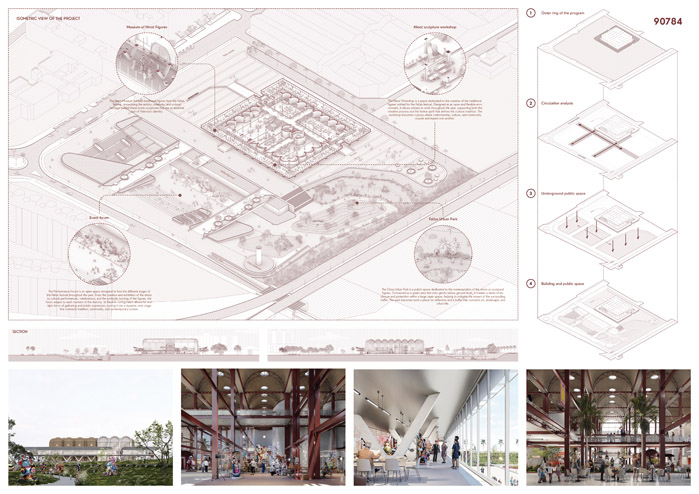
The Fabric de Falles project proposes the recovery of the former Vinival industrial complex in Valencia, transforming it into a cultural and productive center dedicated to the creation, preservation, and dissemination of the Fallas tradition. The intervention seeks to reactivate this site of great symbolic value, integrating tradition and contemporaneity through an architecture that connects industrial memory with the public life of the city.
The proposal is based on the dual nature that defines Valencian culture: interior and exterior, creation and celebration. The Fallas embody this duality between the ephemeral and the permanent; between the workshop where the idea is built and the street where the collective experience unfolds. This concept is translated architecturally into a project that organizes productive and public spaces in a continuous sequence, capable of adapting to and coexisting with the pre-existing structure.
The original Vinival building is defined by its reinforced concrete, brick, and steel structure, the latter giving the complex its distinct industrial character. The intervention respects these materials, enhancing their expressiveness through a contemporary reinterpretation. A peripheral ring is introduced, surrounding the existing building, conceived in reinforced concrete but reinterpreted with the lightness and slenderness inspired by the logic of the original steel framework. This ring functions as both a functional and symbolic element, linking interior areas with the new exterior spaces and creating a dynamic sequence of light, shadow, and transparency.
The architectural program is organized along a central axis that preserves the industrial rhythm and spatial quality of the complex. Inside, the main spaces are distributed as follows: an urban market, an information area, workshops for the construction of ninots and other Fallas elements, auditoriums, collaborative and research areas, and a permanent Fallas Museum exhibition. Each of these spaces promotes the continuity between cultural production, learning, and civic participation.
Externally, the intervention expands the public character of the complex. An open-air amphitheater and the Fallas Park are proposed, an open green area that includes exhibition esplanades and flexible spaces for outdoor events. These exterior zones allow the interior activity to extend into the city, transforming the site into a new urban hub for coexistence and creation.
At the urban scale, the project takes advantage of the site’s natural topography to partially embed part of the new program, reducing its volumetric impact while emphasizing the monumental presence of the original building as a permanent visual landmark. The use of glass enclosures complements the intervention, providing transparency, permeability, and a constant visual dialogue between interior and exterior spaces.
Fabric de Falles is an architecture that preserves the material memory of its place while projecting it toward the future. It is a living space where Valencian culture is built, shared, and celebrated, an encounter between history and contemporary urban life that reaffirms the city’s collective identity.
Golden Mention
Las Fallas 2.0
Ui Yeon Jeong, Suk Joon Lee, Sun Bin Hwang
South Korea


Las Fallas is one of the few remaining festivals in modern society where people consciously engage with light and fire. More than a visual spectacle, it is a ritual through which a community expresses and renews its emotions in the darkness. Fire, though fleeting, becomes an intense symbol of liberation, burning away imposed order and leaving behind the possibility of a new beginning.
Thus, a monument dedicated to Las Fallas must embody these variations of light and fire. It should not be an architecture of fixed form, but an organic structure that captures the changing flow of light through time and emotion. The way light is born inside, spreads along walls and openings, and finally emerges outward becomes a performance in itself.
Where past architecture sought to control light, this building instead seeks to liberate it. Here, light is no longer a passive tool that merely illuminates space, but an active agent with its own motion and temperature that composes the architecture. Its traces reflect on the urban skin, generating different expressions through time, and ultimately reconnecting people and the city.
Located at the threshold between farmland and sea, our site captures the spirit of Las Fallas as it unfolds within the city. The transformation of a once-closed wine factory into a cultural complex is not just a shift of function, but a reinterpretation of memory itself. While preserving the industrial traces and symbolic forms of the past, the architecture opens toward the city and its people through gestures of exchange and transparency.
The wave that cuts through the building gives rhythm and dynamism to the static mass, channeling the flow of light and wind. Light entering the interior diffuses along walls and gaps, creating, like the flames of Las Fallas, a rhythm of creation and destruction that is momentary yet powerful.
The kinetic façade visualizes the spirit of the festival. Its fiery motion evokes the destructive energy of art, while its delicate reflection and modulation of light express the process of creation. Along the wave, segmented spaces host distinct activities: the upper open zones become stages of creativity where human movement projects outward like shadows, while the lower grounded zones serve as galleries of memory and art.
This spatial composition does not remain enclosed. The flows of movement, sight, and light that begin inside extend beyond the boundaries, naturally connecting with the programs scattered across the landscape. The continuity of the wave and the organization of space unfold into courtyards, plazas, and gardens, where architecture, landscape, people, and city merge into one living, organic field.
Honorable Mention
Bodegas Suspendidas
Jacopo Marino, Francesco Giaquinto
Italy


Honorable Mention
RE:FILL BARREL
Sebo Shim
South Korea


Honorable Mention
The Void: A Cultural Core
Jan Perrin, Lamia Ahmed, Viktor Kjellberg
Sweden

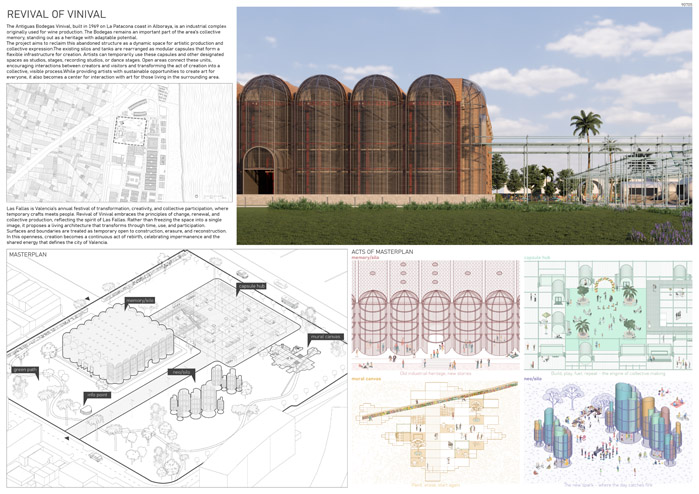
Honorable Mention
Revival of Vinival
Emrecan Bostan, İdil Mersin
Turkey

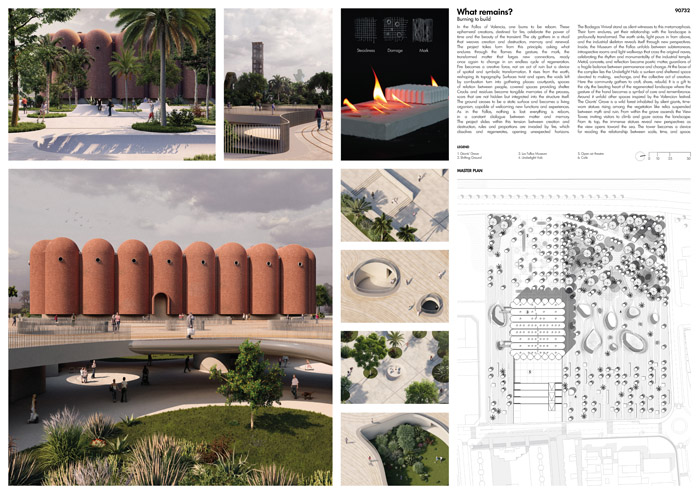
Honorable Mention
What Remains? Burning to build
Matteo Pardini, Rebecca Di Palermo
Italy

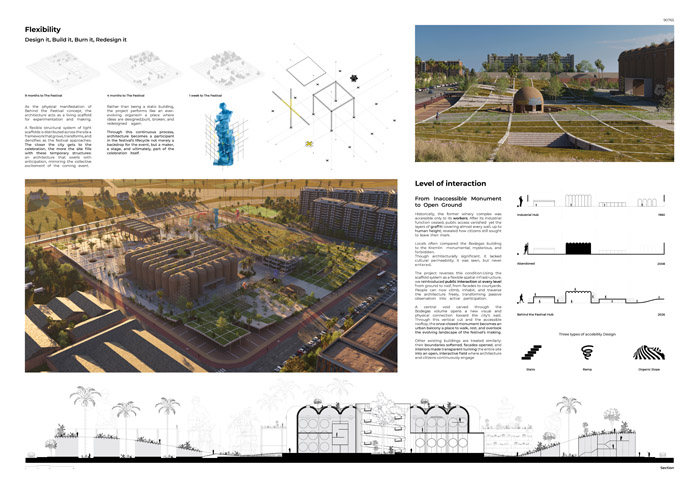
Honorable Mention
Behind The Festival (360 Days Behind)
Nima Ghanei, Hadi Koohi Habibi, Pariya Shahbazi
Iran

Honorable Mention
Renewal of water
Louise Herrmann
France


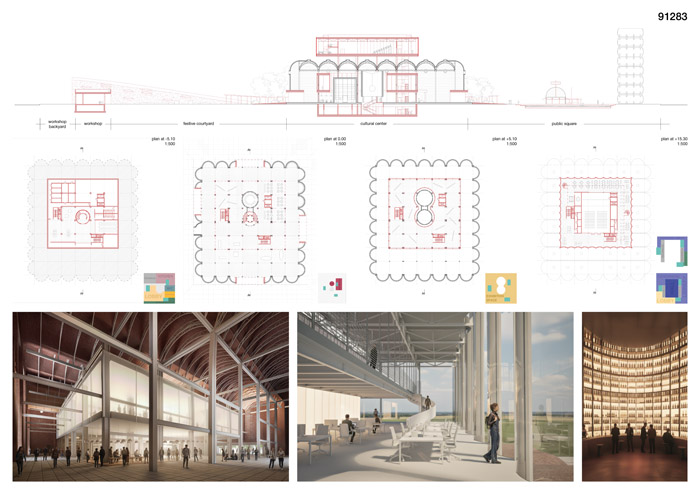
Honorable Mention
Bodegas Continuum
Oleg Bogdanov, Andrei Kustov, Egor Mikhnevich, Evgeny Moroz, Ilia Savasteev, Vladislav Lobko
Georgia

Honorable Mention
RESIGNIFYING THE PAST
Mariano Caprarulo, María Paz Albisu, Santiago Canale, Francisco Lecot, Francisco Otero, Pilar Ferrario, Ana Stark
Argentine


Honorable Mention
Bodegas Healing Forest
María José Martínez, Katya Gantous, Regina De Carcer
México


SHORTLISTED PROJECTS

The post Results: Bodegas Vinival appeared first on Competitions.archi.