

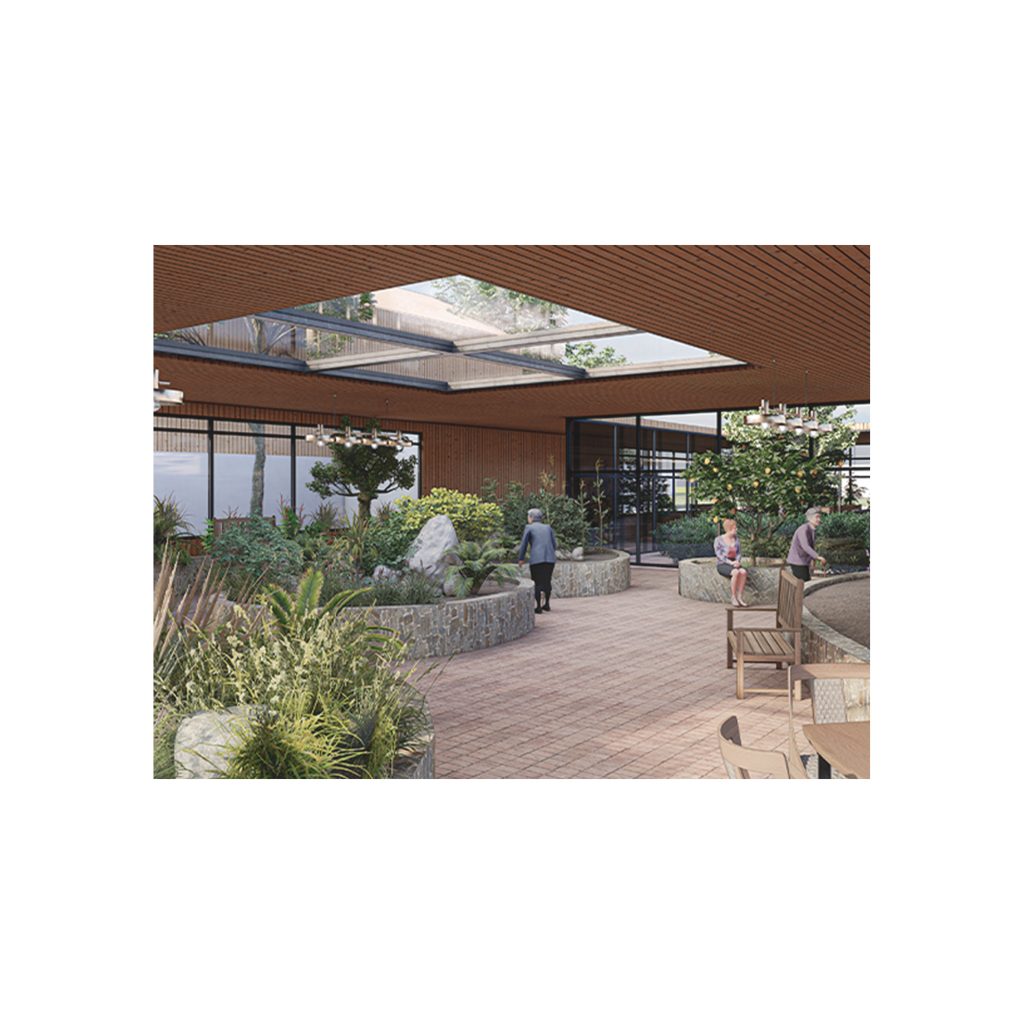
Designing for seniors is often reduced to technical accessibility and medical requirements. But what if we treated elderly residents not as “patients,” but as active, social individuals with a deep need for connection?
Today, we’re diving into a heart-warming and insightful feature from the Architecture Competitions Yearbook. We’re looking at “LA VIE” – the winning proposal for the Beyond Isolation: Senior Housing competition, organized by Buildner. A team of four students from Iran and Canada (Nasim, Sara, Niki, and Negin) shares how they combined Persian cultural traditions with Canadian urban context to create a “shared living room” for the city of La Chute. From interviewing a social science student to gain a fresh perspective, to the “Phase Zero” realization that form follows human experience—this article is a masterclass in social sustainability and the power of persistence.
The team:
We are a team of four architecture students from Iran and Canada. Nikki, Negin, and I first met during their undergraduate studies at Tabriz Art University, while I connected with Sarah through a previous collaboration. In 2019, I graduated with a degree in architecture and moved to Canada to pursue a master’s degree at McGill University. At that time, Nikki and Negin were still completing their architecture studies, and Sarah was working on her bachelor’s project at Tabriz University. Having previously collaborated on various architectural competitions and becoming familiar with each other’s design styles, we found our past experiences to be quite successful. This inspired us to come together once more to participate in another competition, this time focusing on “senior housing design beyond isolation.”


How competitions help us
Participating in competitions has proven to be a fantastic way for us to practice our design skills, explore new topics, and face fresh challenges. For architecture students, who didn’t have many opportunities to work on real-world architectural projects, these competitions are invaluable learning experiences. Unlike university projects, which are often guided by predefined syllabi, competitions allow us the freedom to express our ideas and challenge our architectural thinking. They give us the liberty to define our own site locations and identify problems we are passionate about solving. This autonomy is crucial for our growth as architects.
They also serve as a form of free advertisement for our design style and help us gain recognition. We highly recommend that other architecture students participate in competitions. The experience not only enhances their skills and design thinking but also provides a strong foundation for developing their architectural practice. Whether aiming to establish a firm or secure internships, competitions offer an excellent starting point to build a portfolio and gain real-world experience.

Phase Zero: from Hypothetical to Contextual
I first came across the Senior Housing Competition on Buildner’s website. After registration and team assembly, we began discussing the main issue at hand. Our first step was to carefully study the competition brief to fully understand the challenge: creating a space where elderly people could enjoy their lives without feeling societal pressure, thereby going beyond mere isolation.
Initially, we chose not to focus on a specific site for the competition. Instead, we decided to approach our ideas and concepts hypothetically, free from any contextual or site constraints. This decision was influenced by our previous experiences, as we worked extensively with modular design, which is more about components and is hypothetical rather than contextual. However, after about a week of sharing our initial formal concepts, we realized that this was not the right approach for this particular competition. The challenge was rooted in a real-world problem, and we couldn’t afford to ignore the users—the elderly—and their specific needs. Designing a form without considering the people who would inhabit it, the actual context, or the real-life situations, would not lead to successful architecture. We recognized that to address this issue meaningfully, we needed to shift our focus from form and modules to considering the human experience and practical functionality. After some deliberation, we decided to find a specific location to situate our project. Initially, we considered designing the project in Iran, our home country, and proceeding with that cultural context. However, we eventually decided to shift our focus from a Middle Eastern cultural context to a Western one, thinking it might be more relatable and understandable for the competition jury.

Concept Phase
The site we chose was about an hour from Montreal. It was a long urban block, in downtown La Chute, which faced several issues, including a proliferation of parking lots and a lack of vibrancy or urban activity. The site was essentially a dead space, and the residents tended to rely heavily on cars rather than walking and experiencing the city on foot. This made it an ideal site for our project, as it presented a real opportunity to revitalize the area and create a more vibrant, people-oriented space.
After site analysis, each of us introduced our concept, but all came from a Persian cultural context. At times, we realized the need for an external viewpoint, one that wasn’t strictly architectural. To gain this perspective, I invited a friend of mine named Tadd, a social science undergraduate student at Concordia University, to join one of our meetings. As a Canadian, Tadd brought a different cultural context and offered valuable insights on the topic of senior living, helping us refine our concepts. He emphasized the importance of not making elderly individuals feel like a burden or isolated from their families. His input gave us valuable insights into how people in Canada perceive and interact with senior citizens and led us to go back to the competition’s title, beyond isolation, and focus more on creating a strong sense of place and atmosphere.
To address this, we aimed to avoid designing a space that resembled a hospital or clinical environment. Instead, we prioritized social sustainability, aiming to create a space where seniors wouldn’t be viewed merely as “elderly people” but as regular individuals, just like everyone else. At that moment, we realized we were onto something meaningful. The key insight was that, when designing for seniors, the common assumption is to focus solely on their physical limitations—thinking they can’t move as easily, are often tired, or aren’t as healthy as younger people. This often leads to solutions overly tailored to these limitations. Our breakthrough idea was to shift this perspective. Instead of focusing on what makes seniors different, we treated them like any other members of society. By doing so, we aimed to create an inclusive environment that respects and values them as individuals, not defined solely by age.

With the fresh idea in hand, we went back to our site analysis. Given the elongated nature of the site, we decided to incorporate a main pedestrian path as the spine of our design, forming the central circulation route and accommodating all key activities. Perpendicular paths would branch off from this main axis, linking the two main streets of downtown. This design choice not only facilitated movement across the site but also aimed to revitalize the area. The next step was to identify key focal points within the site. One of the most significant was an old, abandoned train station, which became the central focus of our project and served as a hub for social and communal activities. Our primary communal spaces, clinical facilities, kitchen, community garden—everything was designed to have a view of and access to this pedestrian path, ensuring connectivity and interaction.

Modular Phase: residential units
Once we had established the main circulation, access points, and activity zones, we shifted our focus to the residential units, which were a core requirement of the competition. We began by designing a simple room layout for a single household, considering the essential elements: a bathroom, storage space, kitchen, bed, living area, window, and balcony. This basic layout served as the foundation upon which we developed our ideas, incorporating structural considerations to define our modules, units, and grid system. We expanded the module to accommodate different configurations, including units for two, and four people, as well as multi-family units. We created four types of modules, continuously refining our design through a back-and-forth process between 2D plans and 3D models.
If you ask how we approached designing the activities and spatial arrangements and features, I’d say this: we were four architecture students with a cultural background from Iran, which gave us a different perspective. The way we interact with and care for our elderly, as well as how we socialize is quite different from Western norms. We aimed to integrate some of these cultural traditions and activities from Iran into our project in La Chute, adapting them to fit the local context, essentially creating a Canadian version of these traditions. I believe this cultural perspective was the other key factor that contributed to our win.

Social Phase
Our project was not about technical design or architectural details; it was fundamentally about social sustainability. We focused heavily on creating spaces that support various activities and foster social interaction. It was all about balancing privacy and shared spaces, and we carefully designed these aspects. In our proposal, each residential unit includes a private garden at the back, providing a secluded area for personal use, while also having access to the main pedestrian path, which is more public and social. This dual approach caters to different personality types. For instance, someone who is introverted and prefers solitude can enjoy their private garden, while those who are more extroverted can engage with others along the main path. Our aim was to accommodate a diverse range of residents—introverts, extroverts, artists, athletes, and people from all walks of life. We designed the architecture to respect each individual’s character and needs, ensuring the environment is safe, enjoyable, and inclusive.
This is why we named our project “LA VIE,” which means “the life” in French. We envisioned it as a shared living room, a space where elderly residents live together and ultimately become a part of a larger family. The design encourages residents to interact, see each other, and build connections. By fostering a sense of community and trust, we aimed to create an environment where friendships and familial bonds would naturally form. An insightful conversation with my grandmother inspired this approach. She told us that now, at over 80 years old, she truly understands the value of friendship and being part of a community. However, due to muscle pain and other physical limitations, she finds it difficult to walk, which isolates her from social activities.
In La Vie, we designed the landscape and building layout to ensure that even if residents have limited mobility, they can still feel connected. They can sit by their windows, look out at the pedestrian paths, and see people moving around, which provides a sense of safety and inclusion. This visual connection helps them feel less isolated, knowing there are people around and that they are part of a community, even if they can’t physically join in all the time.

Presentation Phase
But it is not the end of the story. Presentation is as important as the concept. In our case, we focused on rendering scenes that highlight activities and bring the space to life—human experience. We placed the cameras at spots that would show off the project’s circulation and the interactive spaces created between the buildings and the pathway, using a human perspective (which feels more real than a bird’s eye view). Our renderings are vibrant, with people interacting, walking around, and engaging with one another—creating a sense of community and friendship. We aimed to convey a cozy and inviting atmosphere in our visuals, and we carried this feeling through all our project documents. Every element, from the choice of colors to the brightness of the renderings and even the sky we selected, was carefully chosen to support the narrative we wanted to tell through our architecture.
We also took a unique approach with our floor plan design by imagining ourselves as elderly residents living in the space. We considered what their daily routine might look like—waking up in the morning and deciding on their activities for the day. Based on these considerations, we introduced specific spaces and programs in our plan. If you look at our plan, you’ll see that it’s a narrative in itself. The audience, the jury, and anyone who views it become part of that story, experiencing the space through the eyes of the people who will live there.


Conclusion
We learned it all starts with the story. You need to have a solid story and concept. The projects that stand out and have a shot at winning are the ones where the architect can convey the essence of the idea to a non-architect using just a few sentences and simple visuals. If you can make a part of the project stick in someone’s mind, turning it into a memory, then you’ve truly succeeded in answering the project’s goals through your story. We also learned architecture is all about understanding space and creating a true sense of place. If you succeed in designing and conveying a space that feels safe and welcoming, you achieve more than just a physical structure—you positively impact people’s lives, their lifestyles, and their happiness.

Our advice to architects who want to make a real difference in people’s lives is to engage directly with them. Go out and talk to people, interview them, and listen to their needs, their expectations, their memories, and their preferences. The key is to incorporate these insights into your designs. The art of an architect lies in carefully understanding these human elements and finding a balance between these personal qualities and the architectural elements—the walls, the plans, and the spaces you create. This understanding is what truly defines great architecture.
This was our sixth competition, and after many attempts, we finally won this one. Through these experiences, we learned invaluable lessons about architecture and the importance of teamwork. Finding the right team and working collaboratively is crucial. Start forming your team and participate in competitions together. After three or four competitions, you’ll start to see progress, and eventually, you’ll experience the satisfaction of success. The journey may be challenging, but the rewards are truly worth it.


Authors: Nasim Mollazadeh Sorkhabi, Niki Haddad Razavi, Negin Shokry, Sara Davari

Love this case study?
“LA VIE” is just one of the many award-winning stories we’ve curated for the Architecture Competitions Yearbook 2025. If you want to have the best competition projects, expert interviews, and design strategies of the year all in one place—available at any time to inspire your next big project—check out the full publication. It’s the ultimate resource for every ambitious designer.
Architecture Competitions Yearbook
The post Beyond the Grid: How Empathy and Storytelling Won “La Vie” appeared first on Competitions.archi.