


Is there a “secret recipe” for winning an architectural competition?  While many search for a magic formula, the team of Francisco Rodríguez Zafra, Diego Peña Jurado, and Kei Sugimoto views each challenge as something much more valuable: a high-intensity exercise in professional growth.
In this insightful article from the Architecture Competitions Yearbook, the authors break down their personal methodology—from the initial “Synthesis Phase” to the adrenaline-fueled “Design Phase.” Using their experience from social-focused projects in India, they share honest lessons on why you should never rush the brief, how to “put yourself in the shoes” of future users, and why even a discarded idea is a lesson learned. If you’re a young professional looking to sharpen your skills, manage your time better, and build a critical spirit, this deep dive is your ultimate guide to the “why” and “how” of the competition world.
Introduction
Facing an architectural competition is an exciting exercise in which many factors have to be played with until a satisfactory result is achieved. There is no set formula with which to face this type of challenge, although over the years and through participation in different competitions, we have realized the importance of following a planning and approach to certain aspects that we consider fundamental. With this we do not intend to offer a definitive recipe, but only to share in an honest way what we have learned, with its nuances, successes and challenges, when approaching an architectural competition.
 It is important to note that not all competitions work in the same way and that the dynamics can vary depending on the circumstances of each one. The article is based on our own experience as young professionals, learning from different situations and working areas, and where our own inquisitiveness motivate us to continue with this discipline.
We are particularly attracted to competitions with a social and low-cost perspective, especially those with a humanitarian character. These tend to have fewer restrictions in terms of city ordinances and regulations, but present architectural challenges when designing and building in regions with fewer resources. Projects of this nature, with such an important social charge, can become agents of change within their environments, where we see how a building and all that it entails around it can improve people’s quality of life. The architecture itself is only the beginning, which will later lead to its adaptation to its uses and to its maintenance and care, hence the importance of integrating concepts such as resilience and adaptability .Moreover, nowadays, thanks to new technologies, it is possible to approach different contexts without geographical restrictions or previous links, which can bring a new perspective to this type of competition, without overloading it with information. This external view can be an advantage, as long as it does not imply ignoring local particularities, that will allow to combine and integrate current concepts in specific places, seeking a balance between the new and the existing.
In our opinion, an architectural competition presents many challenges in itself, in different layers. Layers that overlap, all of them of great importance and that will help us to organize the ideas and the process: from an initial phase with the first contact with the bases and the study of references (Analysis and Synthesis), the development of ideas (Design and Presentation) and the organization of the work over time (Planning), to a final evaluation of the results themselves (Learning). It is not a question of following a sequence, but rather of bringing all the conditioning factors that come into play and that are intertwined with each other to the table.

A competition as an analysis exercise
As a starting point, it is essential to read the terms and conditions of a competition thoroughly in order to establish a first connection with the project. Stopping to study in detail the real needs and objectives will give many clues as to what you are looking for. Rushing into the design without having understood the framework in which the project is inserted is usually counterproductive and delays rather than accelerates the process to obtain satisfactory results.
A good understanding of the social and physical context of the project is essential when starting any design. Aspects such as the plot, the climate, the orientation or even the position of the trees are essential when starting a project. The analysis of the programme is another fundamental aspect: the study of surfaces and uses through diagrams allows a first approximation to understand the scale of the project and the possible relationships that could be established. We understand the analysis process as a basis for identifying the conditioning factors of the project and at the same time as a source of inspiration, as a way of boosting creativity from the outset.
 Researching and analyzing similar projects, both local and foreign, that have a similar context, theme or scale are a source of information from which to examine solutions/proposals at all levels: formal, constructive, functional…etc. Comparing and reflecting on aspects that catch our attention can serve as an orientation when making the first decisions in a competition.
It is advisable to make a summary of the bases, a summary panel so as not to have to keep going back to the bases. This concentrated panel should include key words of the programme, important data of the future users, a summary in the form of a table of surfaces and uses, and for example a first relational scheme of the uses or a scheme of hierarchies of spaces. It is also possible to add images of projects that have struck us as suggestive and to create a kind of collage or moodboard with the collected texts, diagrams and images.
For example, in the competition for the construction of a social center in India, there was the possibility of working with very interesting concepts such as flexibility, replication, the use of low-cost strategies and the durability or useful life of this type of basic infrastructure. The first contact was to graphically study the scale of the project by means of diagrams, proposing different forms of grouping and occupation of the plot: from a more compact model to a more dispersed model.

A competition as a synthesis exercise
After having studied the programme and analyzing other proposals, it is necessary to select which aspects seem fundamental to the project and to make the first decisions which points will be developed from this moment onwards. In this initial phase, it is advisable not to cover too much, but it will be more beneficial to focus on a series of main ideas to give shape to, since as the design process progresses, aspects that seemed interesting during the analysis could always be added.
Asking questions about what you want to achieve, drawing conclusions and prioritizing aspects that seem essential is one of the most complex parts of an architectural project. This is where the use of diagrams, images and the first outlines are fundamental to order and summarize the initial ideas. A good way to start is to draw the project programme, as a tool to understand the scale and scope of the proposal.
In the case of the Kodidoddi project, we decided to prioritize three aspects that we felt were fundamental: the modularity, the open spaces and the boundaries. For example, we asked ourselves whether the presence of the Neem tree should condition the design of the community center. We decided to take it into account when designing the outdoor spaces, but not to integrate it as part of the building, since it was an external element that might not be present in other locations. In addition, we opted for a compact model, with the aim of conveying the image of a community center under one roof as the main idea of the project.

A competition as a design exercise
Starting to make sketches, to give shape to ideas and concepts is undoubtedly one of the most exciting parts of a competition. However, you have to know how to manage that initial dose of adrenaline and learn how to manage your strength well until the deadline. At some point during the competition, you have to pick up the pace and get a running start because time is running out.
When designing, it is important to take into account two points of view: the conception of the space from our vision as designers, i.e. from our vision as architects, and the future perception, interaction and acceptance of the people for whom the space is intended. As architects we must ‘put ourselves in the shoes’ of the people who are going to use the building, always bearing in mind who the design is intended for and how they are going to use it in the future. We must be able to develop our empathy and learn to identify with the users and the uses to which it will be put and constantly ask ourselves if what we are proposing corresponds to the needs and requirements that were established as a basis.
In the India project baseline, the programme of uses was very well defined and the list of available materials was very specific. In this case, we opted to use local available materials and to stick to what was specified in the terms of reference. Choosing between one material or another, between a more complex volumetry or a simpler form is part of the risk we take with each proposal, as we don’t know if it will be successful.
Personally, the first line is always the most difficult. I imagine that there are architects / designers who have quite clear ideas from the beginning, but we have learned to work with multiple options from the very beginning. We have to try out shapes, proportions, volumes, uses and relationships, and when we say ‘try them out’ we mean draw them, it is not enough just to visualize them mentally. Only in this way will we be able to define the proposal and discard options that do not convince us. Arranging the variants in a table, listing them and discussing one by one the main pros and cons of each variant helps us to organize the ideas and make a choice. It is important not to erase the discarded ideas in case we ever go back and want to recover some aspect. In our experience, we may be guilty of spending too much time on the development of variants, but we believe that this is the most exciting phase of a competition. Even so, we must learn to limit the number of options because of the approaching deadline.
However, there are always moments of mental blocks when you are not sure how to move forward. In these cases, it is important to take a step back and look at the situation from a broader perspective. You have to take a step back and rethink your strategy, because you may have wanted to take on too much. Here it is essential to free yourself from the aspects that are hindering you and learn to simplify.One of the most positive aspects of the working groups is that they generate dialogue and discussion, i.e. there is continuous feedback that enriches the whole process and ultimately improves the project.

A competition as an exercise of representation
An attractive and well-designed representation and layout is essential in an architectural competition. The panels should facilitate the reading of the proposal in the broadest sense, as a graphically suggestive delivery can make all the difference. All graphic material (drawings, schemes, diagrams,…) should be able to explain the ideas without the need for too many words. Explanatory texts should have a secondary character, serving only to reaffirm and complete the concept with words.
The layout of the panels should not be left to the end, but should be very present from the beginning, as it is essential to know from the outset what and how you want to tell the story of the project and what elements will be necessary to do so. This initial organization will be important for deciding the proportion of the renderings, scale of the plans, elevations, sections, construction details, size of the explanatory diagrams, etc. Basic aspects such as which orientation (vertical vs. horizontal) best enhances the project or whether the use of colors favors the reading of the panel, are basic questions that should always be asked, because each competition is different in the end. The key is to know how to attract attention to the most relevant points of the proposal, highlighting what makes the solution unique.
Above all, it is important to avoid overload and repetition of information. In the case of submissions with more than one panel, we recommend using similar proportions and organization in all panels. Arranging the panels in a schematic ‘full and empty’ spaces can be a good way to find a balance, with the ‘empty’ space being line drawings and the ‘full’ space being photomontages or renderings.
In the case of the layout of the community center, we produced more elevations, sections and construction diagrams than finally appeared on the panel. This is something that happens very often and is something we are used to, but it is preferable that during the design phase everything is well tied up, even if it means extra work. After testing the presentation, we realized that too many diagrams or drawings made the project difficult to read, rather than easy, so we finally decided that showing only 3 sections was sufficient, as too many elements could distract attention from the key points. On the other hand, by doing the 3D modeling and rendering, we discovered more suggestive perspectives, which we had not initially planned, such as the image from the outside of the plot, which represented the view of the building that the neighbors would have from the outside, so we decided to enhance these perspectives to better capture the essence of the proposal.

A competition as a planning exercise
Participating in an architectural competition is a good opportunity to develop our organizational and time management skills. In a short period of time, often counted in weeks, you have to be able to come up with an idea, develop it and transmit it. In this sense, a competition is like a race against the clock, it is important to visualize very early on the amount of material you want to produce and to plan your development according to the time available.
In our first competitions, we wasted a lot of time defining an initial proposal, which then left us with little time to reflect on the representation, visualizations and layout of the submission. It is therefore important to learn to define the time to be devoted to each of the phases of the project, for which it is crucial to know how to recognise in which aspects you excel or are more competent, or with which you are more motivated, in order to assign the tasks more efficiently to each of the members of the team. It is also important, in the case of teamwork, to define which channels will be used to communicate and share information from the beginning. A competition can also be a good exercise in discipline and coordination.
For example, for the India competition, we organized meetings almost daily to review the progress of the project together, but we tried to limit their duration in order to make the best use of that time. We also tried to use a single channel of communication and file sharing within the team, although it is sometimes difficult not to be tempted to comment on points quickly via instant messaging services.
 A competition as a learning exercise
With every competition there is a feeling of having learned something new. Many competitions have a somewhat frantic pace and during a short but intense period, you become an expert on the subject. Therefore, it is also important to digest all this information throughout the process.
After submission, it is necessary to reflect on the strategy employed, identify what worked well and what could be improved for the next exercise. Through repetition, testing and applying what has been learned in various competitions, one learns to establish more effective strategies on how to approach the next one. It is true that each competition is started from scratch, but there are dynamics that can be repeated if we consider that they have worked well.
One of the most exciting moments of a competition is when the results are published. Firstly, because it lets you know if the jury has considered your proposal among the first places, as a form of external recognition for a job well done, beyond the cash prize. Secondly, because examining the proposals of other teams is an interesting exercise, as you see how there are multiple solutions to the same problem and it allows you to develop a critical spirit. It is not only interesting to see the formal proposals of other teams, but also to see other forms of representation, different types of layouts, etc. Surely, from many of them you can bring out aspects of interest and from which you can learn as an architect.
Conclusions
We would especially like to emphasize the importance of encouraging working groups in architecture. Only by reflecting on a subject in a group can enriching discussions take place; there is much beauty in the group or collective process of creating or designing. Dialogue, learning to put forward ideas, to argue and in turn to understand other points of view can only enrich our work. We would also like to add that writing this short article has been for us a beautiful exercise of introspection, where the competition becomes an opportunity to debate and grow and to highlight the importance of the work of architects, urban planners and designers, not only in humanitarian projects, but also in housing solutions, basic services or infrastructure with low resources and our commitment as planners in sustainability issues. We must be aware of the transformation processes of cities and the rapid urbanization processes in developing countries and the opportunity that this means to propose innovative and responsible solutions. A competition is certainly an opportunity to learn.
Finally, we encourage young architects to get started in the world of competitions, to use architectural competitions as a way to explore creativity. We even encourage them to take part in a competition from time to time simply for pleasure, for the sake of practicing. Drawing or materializing proposals is a way of learning. A competition is ultimately an opportunity to experiment and grow professionally.

Authors: Francisco Rodríguez Zafra, Diego Peña Jurado, Kei Sugimoto
Want to sharpen your design process? 
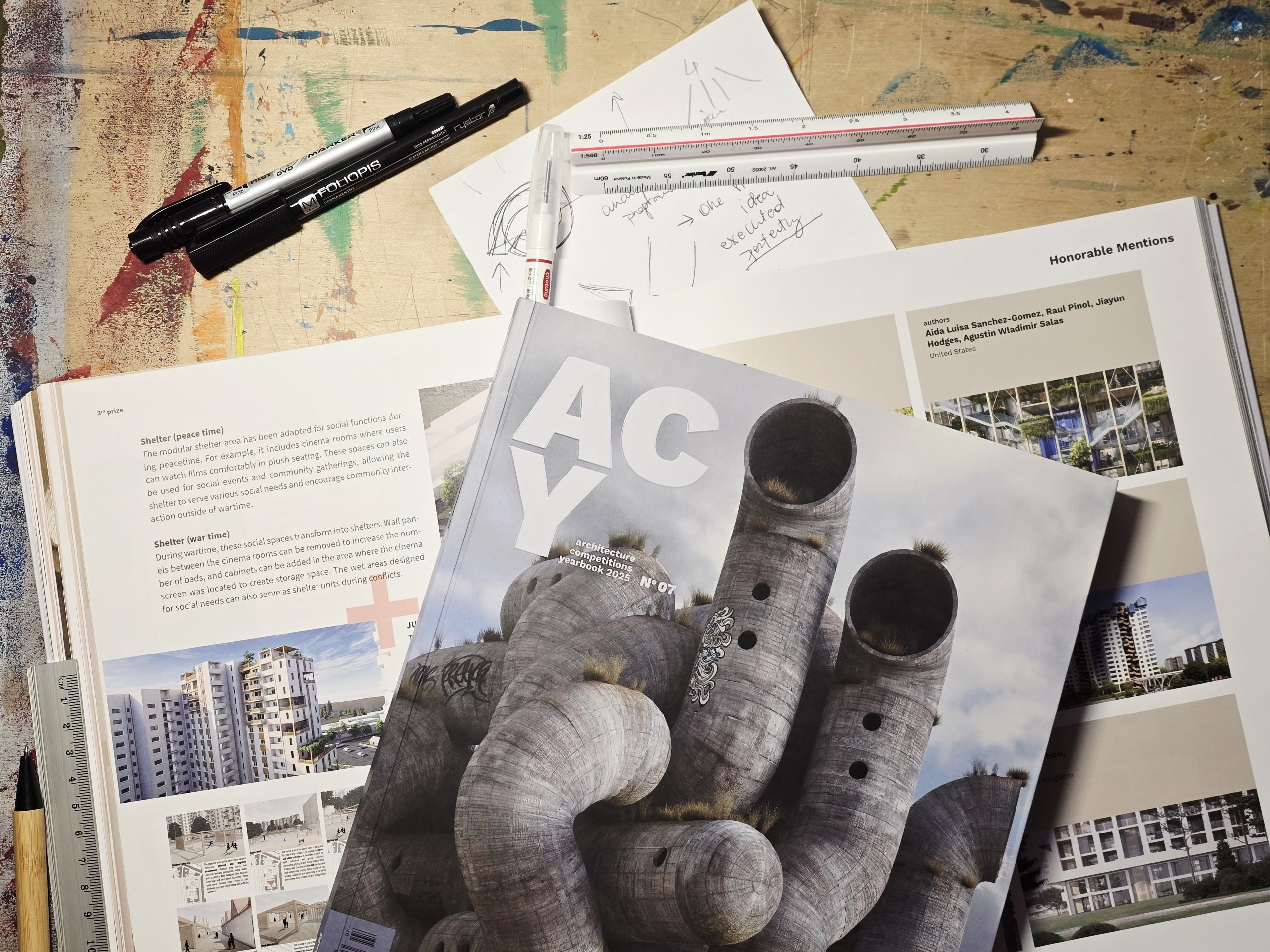
This masterclass on competition planning is one of the three exclusive long-form articles featured in the Architecture Competitions Yearbook 2025. We believe that the best designers are lifelong students, and this year’s collection is packed with the “behind-the-scenes” logic that you won’t find in textbooks. Grab your copy to explore 10 award-winning projects and the expert strategies that brought them to life.
[Add ACY 2025 to your professional library here] 
The post More than a prize: The architectural competition as a learning tool appeared first on Competitions.archi.